


 Home
Home
GLM-5.3 Released by Zhipu: 740 Billion Parameters Unchanged, Performance Boosted 50% via Post-Training Programming Ability Approaches
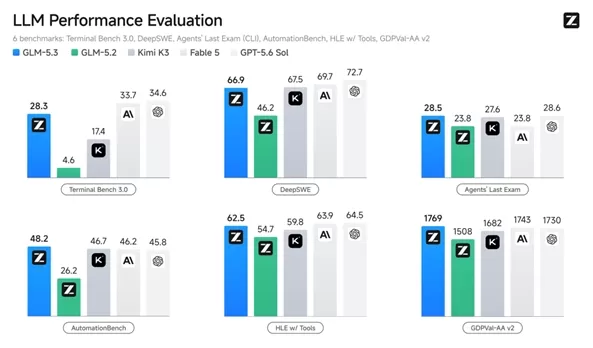
Zhipu officially launched GLM-5.3 on August 14, maintaining the 74-billion parameter count of its predecessor, GLM-5.2, while skipping the rumored trillion-parameter upgrade, which may be saved for GLM-5.5. Through advanced post-training techniques, Zhipu boosted GLM-5.3’s performance by 50% over the previous generation, securing top rankings among current open-source models across multiple mainstream benchmarks. Its coding and agent capabilities rival Claude Opus 4.8, surpassing other domestic models in programming efficiency.
Key benchmark improvements highlight the model’s enhanced capabilities. On Terminal-Bench 3.0, which assesses complex task completion in real terminal environments, the score surged from 4.6 to 28.3. In DeepSWE v1.1, focusing on long-horizon software engineering and continuous code modification, performance rose from 46.2 to 66.9. On Agents’ Last Exam, covering diverse professional scenarios with an emphasis on cross-tool collaboration and long-horizon tasks, the score increased from 23.8 to 28.5. Additionally, GLM-5.3 achieved 1,769 points in GDPval-AA v2, which spans 44 professions and evaluates high-value knowledge work, demonstrating strong professional task execution grounded in programming skills. Overall, the model shows significant advancements in complex software engineering, terminal operations, and broader real-world agent tasks.
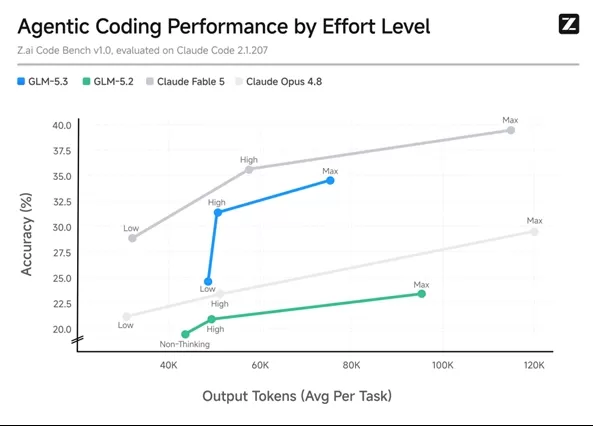
The most compelling evidence comes from Zhipu’s proprietary Z.ai Code Bench, an evaluation suite that places the model in a real local development environment to execute end-to-end tasks under various reasoning modes, closely simulating the experience of using a Coding Agent. Results indicate that GLM-5.3 achieves an optimal balance between effectiveness and token efficiency: in High mode, it reached a 31.4% accuracy rate, outperforming Claude Opus 4.8’s maximum mode of 29.5%, while using only about 50,000 tokens per task on average, compared to Opus 4.8’s 120,000 tokens. This demonstrates that GLM-5.3 can complete identical tasks with a significantly shorter execution path.
Regarding product availability, GLM-5.3 is now accessible on Zhipu’s official coding tool, ZCode, and productivity tool, AutoClaw, and is open to all GLM Coding Plan users and subscribers. Third-party coding platforms, including TraeWork, TraeCode, Kousi, WorkBuddy, CodeBuddy, Qoder, QwenWork, CatPaw, JoyCode, and OpenCode, have also granted early access. The API will launch soon, with full model weights open-sourced within two weeks following necessary security enhancements. Zhipu’s strategy focuses on limiting the model’s potential attack capabilities while preserving its defensive value. At 13:00 today, quotas for all GLM Coding Plan users were reset, and usage statistics in the backend now reflect restored limits for everyone.
Related article
 Tesollo Launches IPO Drive Amid Humanoid Hand Development
Tesollo is engineering high degree-of-freedom robotic hands compatible with any humanoid platform. | Credit: TesolloRobotic hand innovator Tesollo Inc. has officially launched preparations for an initial public offering (IPO) scheduled for next year,
Prentis, New AI Lab Co-Founded by Reid Hoffman and Mark Pincus, in Talks to Raise $100M
Prentis, an emerging AI research lab specializing in computer-use models and co-founded by serial entrepreneur Ritankar Das alongside tech industry veterans Reid Hoffman and Mark Pincus, is currently negotiating to secure $100 million in funding at a
AIR Raises $50M to Help Companies Vet Skills and Add-Ons Used by AI Agents
As organizations increasingly grant AI agents access to their internal systems, a new software supply chain is emerging around the tools these agents rely on: skills, plugins, MCP servers, and add-ons that enable internet interaction.AI security star
Related Special Topic Recommendations
Business
Tesollo Launches IPO Drive Amid Humanoid Hand Development
Tesollo is engineering high degree-of-freedom robotic hands compatible with any humanoid platform. | Credit: TesolloRobotic hand innovator Tesollo Inc. has officially launched preparations for an initial public offering (IPO) scheduled for next year,
Prentis, New AI Lab Co-Founded by Reid Hoffman and Mark Pincus, in Talks to Raise $100M
Prentis, an emerging AI research lab specializing in computer-use models and co-founded by serial entrepreneur Ritankar Das alongside tech industry veterans Reid Hoffman and Mark Pincus, is currently negotiating to secure $100 million in funding at a
AIR Raises $50M to Help Companies Vet Skills and Add-Ons Used by AI Agents
As organizations increasingly grant AI agents access to their internal systems, a new software supply chain is emerging around the tools these agents rely on: skills, plugins, MCP servers, and add-ons that enable internet interaction.AI security star
Related Special Topic Recommendations
Business
 AI RFP Response Software for Enterprise Proposal Workflows
2026 Latest Best AI RFP Response Software for Enterprise Proposal Workflows! XIX.AI curates a top-rated list of powerful tools that pass rigorous real-world tests, offering must-try features to boost productivity and streamline your proposal processes. Get a free vs paid comparison, see detailed rankings, and discover how these game-changing solutions can help you create high-quality responses faster. Explore now to unlock your AI edge!
 9 tools
 xix.ai
Video creation
AI Subtitle and Dubbing Tools: Localize Video for Global Audiences
xix.ai
Video creation
AI Subtitle and Dubbing Tools: Localize Video for Global Audiences
2026 Latest Best Top-rated AI Subtitle and Dubbing Tools Curated for Localizing Video for Global Audiences Powerfully boost content reach across language barriers with game-changing accuracy Real-world tests prove these must-try solutions offer free vs paid comparison and reliable rankings to maximize productivity Explore now to Discover your perfect tool for global content delivery
10 tools
xix.ai
automation
AI Invoice Processing Tools for AP Automation, Approval Routing, and ERP Sync Workflows
2026 Latest Best AI Invoice Processing Tools for AP Automation, Approval Routing, and ERP Sync Workflows! XIX.AI curates top-rated, powerful solutions that pass rigorous real-world tests to boost productivity dramatically. Get a free vs paid comparison, see detailed rankings, and discover must-try options to streamline your finance operations. Explore now to unlock your AI edge!
9 tools
xix.ai
writing
AI Technical Documentation Tools for Developer Teams
2026 Latest Best Top-rated AI Technical Documentation Tools for Developer Teams! XIX.AI has curated a powerful, game-changing collection of must-try tools that go through rigorous real-world tests and weekly updated rankings. These top-rated solutions help teams boost productivity dramatically by streamlining content creation, fixing documentation errors, and accelerating coding workflows across all projects. Explore now to Discover your perfect tool for unlocking your AI edge!
13 tools
xix.ai
Software Development
AI Bug Triage Assistants: Rank Issues by Severity and User Impact
2026 Latest Best Top-rated AI Bug Triage Assistants Ranked! This curated collection showcases powerful game-changing tools that help teams quickly sort bugs by severity and user impact, saving valuable time. XIX.AI offers a free vs paid comparison along with real-world tests to help you find the must-try solution that boosts productivity significantly. Explore now to Discover your perfect tool for streamlining development workflows!
10 tools
xix.ai
code
Best AI Coding Tools for Python and JavaScript
2026 Latest Best Top-Rated AI Coding Tools for Python and JavaScript are here on XIX.AI’s curated list. These powerful game-changing tools have undergone rigorous real-world tests to deliver exceptional results for writing efficient code, fixing bugs, and boosting productivity. Get a free vs paid comparison and see which options suit your needs. Explore now to Discover your perfect coding tool and Unlock your AI edge.
10 tools
xix.ai

 Comments (0)
0/500
Comments (0)
0/500
Zhipu officially launched GLM-5.3 on August 14, maintaining the 74-billion parameter count of its predecessor, GLM-5.2, while skipping the rumored trillion-parameter upgrade, which may be saved for GLM-5.5. Through advanced post-training techniques, Zhipu boosted GLM-5.3’s performance by 50% over the previous generation, securing top rankings among current open-source models across multiple mainstream benchmarks. Its coding and agent capabilities rival Claude Opus 4.8, surpassing other domestic models in programming efficiency.
Key benchmark improvements highlight the model’s enhanced capabilities. On Terminal-Bench 3.0, which assesses complex task completion in real terminal environments, the score surged from 4.6 to 28.3. In DeepSWE v1.1, focusing on long-horizon software engineering and continuous code modification, performance rose from 46.2 to 66.9. On Agents’ Last Exam, covering diverse professional scenarios with an emphasis on cross-tool collaboration and long-horizon tasks, the score increased from 23.8 to 28.5. Additionally, GLM-5.3 achieved 1,769 points in GDPval-AA v2, which spans 44 professions and evaluates high-value knowledge work, demonstrating strong professional task execution grounded in programming skills. Overall, the model shows significant advancements in complex software engineering, terminal operations, and broader real-world agent tasks.
The most compelling evidence comes from Zhipu’s proprietary Z.ai Code Bench, an evaluation suite that places the model in a real local development environment to execute end-to-end tasks under various reasoning modes, closely simulating the experience of using a Coding Agent. Results indicate that GLM-5.3 achieves an optimal balance between effectiveness and token efficiency: in High mode, it reached a 31.4% accuracy rate, outperforming Claude Opus 4.8’s maximum mode of 29.5%, while using only about 50,000 tokens per task on average, compared to Opus 4.8’s 120,000 tokens. This demonstrates that GLM-5.3 can complete identical tasks with a significantly shorter execution path.
Regarding product availability, GLM-5.3 is now accessible on Zhipu’s official coding tool, ZCode, and productivity tool, AutoClaw, and is open to all GLM Coding Plan users and subscribers. Third-party coding platforms, including TraeWork, TraeCode, Kousi, WorkBuddy, CodeBuddy, Qoder, QwenWork, CatPaw, JoyCode, and OpenCode, have also granted early access. The API will launch soon, with full model weights open-sourced within two weeks following necessary security enhancements. Zhipu’s strategy focuses on limiting the model’s potential attack capabilities while preserving its defensive value. At 13:00 today, quotas for all GLM Coding Plan users were reset, and usage statistics in the backend now reflect restored limits for everyone.








 Tesollo Launches IPO Drive Amid Humanoid Hand Development
Tesollo is engineering high degree-of-freedom robotic hands compatible with any humanoid platform. | Credit: TesolloRobotic hand innovator Tesollo Inc. has officially launched preparations for an initial public offering (IPO) scheduled for next year,
Tesollo Launches IPO Drive Amid Humanoid Hand Development
Tesollo is engineering high degree-of-freedom robotic hands compatible with any humanoid platform. | Credit: TesolloRobotic hand innovator Tesollo Inc. has officially launched preparations for an initial public offering (IPO) scheduled for next year,
 Prentis, New AI Lab Co-Founded by Reid Hoffman and Mark Pincus, in Talks to Raise $100M
Prentis, an emerging AI research lab specializing in computer-use models and co-founded by serial entrepreneur Ritankar Das alongside tech industry veterans Reid Hoffman and Mark Pincus, is currently negotiating to secure $100 million in funding at a
Prentis, New AI Lab Co-Founded by Reid Hoffman and Mark Pincus, in Talks to Raise $100M
Prentis, an emerging AI research lab specializing in computer-use models and co-founded by serial entrepreneur Ritankar Das alongside tech industry veterans Reid Hoffman and Mark Pincus, is currently negotiating to secure $100 million in funding at a
 AIR Raises $50M to Help Companies Vet Skills and Add-Ons Used by AI Agents
As organizations increasingly grant AI agents access to their internal systems, a new software supply chain is emerging around the tools these agents rely on: skills, plugins, MCP servers, and add-ons that enable internet interaction.AI security star
AIR Raises $50M to Help Companies Vet Skills and Add-Ons Used by AI Agents
As organizations increasingly grant AI agents access to their internal systems, a new software supply chain is emerging around the tools these agents rely on: skills, plugins, MCP servers, and add-ons that enable internet interaction.AI security star
2026 Latest Best AI RFP Response Software for Enterprise Proposal Workflows! XIX.AI curates a top-rated list of powerful tools that pass rigorous real-world tests, offering must-try features to boost productivity and streamline your proposal processes. Get a free vs paid comparison, see detailed rankings, and discover how these game-changing solutions can help you create high-quality responses faster. Explore now to unlock your AI edge!
9 tools
xix.ai

2026 Latest Best Top-rated AI Subtitle and Dubbing Tools Curated for Localizing Video for Global Audiences Powerfully boost content reach across language barriers with game-changing accuracy Real-world tests prove these must-try solutions offer free vs paid comparison and reliable rankings to maximize productivity Explore now to Discover your perfect tool for global content delivery
10 tools
xix.ai

2026 Latest Best AI Invoice Processing Tools for AP Automation, Approval Routing, and ERP Sync Workflows! XIX.AI curates top-rated, powerful solutions that pass rigorous real-world tests to boost productivity dramatically. Get a free vs paid comparison, see detailed rankings, and discover must-try options to streamline your finance operations. Explore now to unlock your AI edge!
9 tools
xix.ai
2026 Latest Best Top-rated AI Technical Documentation Tools for Developer Teams! XIX.AI has curated a powerful, game-changing collection of must-try tools that go through rigorous real-world tests and weekly updated rankings. These top-rated solutions help teams boost productivity dramatically by streamlining content creation, fixing documentation errors, and accelerating coding workflows across all projects. Explore now to Discover your perfect tool for unlocking your AI edge!
13 tools
xix.ai

2026 Latest Best Top-rated AI Bug Triage Assistants Ranked! This curated collection showcases powerful game-changing tools that help teams quickly sort bugs by severity and user impact, saving valuable time. XIX.AI offers a free vs paid comparison along with real-world tests to help you find the must-try solution that boosts productivity significantly. Explore now to Discover your perfect tool for streamlining development workflows!
10 tools
xix.ai

2026 Latest Best Top-Rated AI Coding Tools for Python and JavaScript are here on XIX.AI’s curated list. These powerful game-changing tools have undergone rigorous real-world tests to deliver exceptional results for writing efficient code, fixing bugs, and boosting productivity. Get a free vs paid comparison and see which options suit your needs. Explore now to Discover your perfect coding tool and Unlock your AI edge.
10 tools
xix.ai












