


 Home
HomeGen Z dating apps like Ditto ditch swiping for AI matchmaking
This wave of young adults has grown so weary of swipe-driven dating platforms that they are willing to experiment with virtually any alternative, including AI-powered matchmaking. Following their departure from UC Berkeley, Ditto co-founders Allen Wang and Eric Liu embarked on a mission to create a solution that enables their peers to form connections without sacrificing hours each week to the chaotic nature of apps like Tinder and Hinge.
“As members of Gen Z, we directly observed a shift in how people interact,” Wang explained to TechCrunch. “We noticed that users are exhausted by endless swiping and superficial small talk, seeking instead more authentic interactions in the real world.”
Rather than a conventional application, college students can join Ditto by texting a specific iMessage number along with a unique code. An AI chatbot then introduces itself as Ditto, describing the platform as “a dating initiative created by college students who understand the struggle… no swiping, no awkward direct messages, just real dates every Wednesday at 7 pm.”
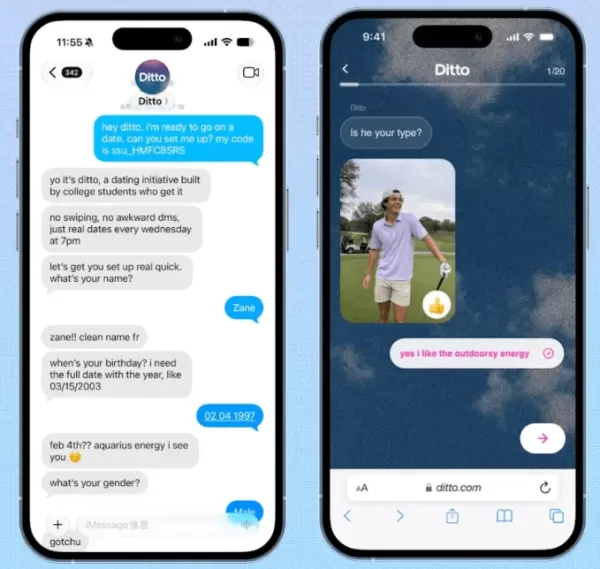
Image Credits:Ditto (opens in a new window)
Users navigate an onboarding process via text, beginning with basic biographical details such as name, gender, and birth date. Ditto then asks more targeted questions to gauge personality, interests, and dating preferences. Some users even upload photos of their celebrity crushes to help the AI understand their type.
The Ditto algorithm prioritizes matching people based not on shared hobbies, but on what those interests reveal about their character.
“Consider a guy passionate about rock climbing, skydiving, and outdoor sports, and a girl interested in hip hop, streetwear, and skateboarding,” Wang noted. “While these hobbies may seem unrelated on the surface, I can identify that both are highly adventurous and likely individualistic. This deeper alignment is what fosters chemistry, and our core premise is that chemistry can be predicted with the right data signals.”
Every Wednesday at 7 p.m., Ditto notifies users of their match for the week.
“The notification includes the person’s details, a specific time, and a location. Users simply need to show up, date, and return,” Wang said. “We gather feedback on the date to refine our understanding of the user, helping them find better matches in the future. Our goal is to eliminate friction by handling the heavy lifting, allowing users to simply meet whoever they are paired with.”
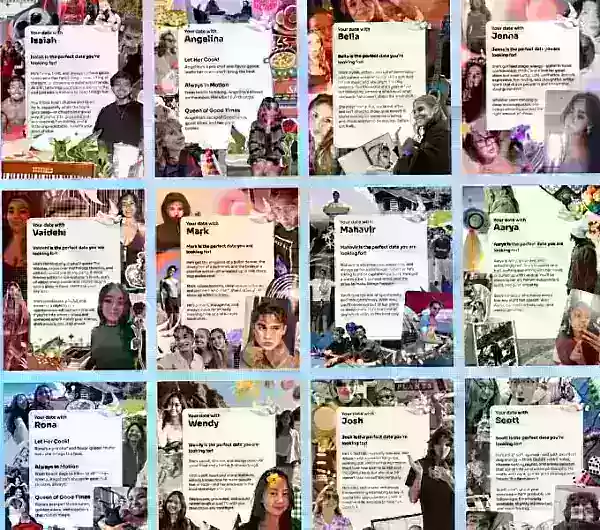
Image Credits:Ditto (opens in a new window)
Ditto has accumulated 150,000 signups. According to Wang, approximately 20% of matches facilitated by Ditto result in an actual date. (If that figure seems low, you have likely never used Tinder.)
Ditto generates a collage-style graphic to introduce users to one another and explain the basis for their compatibility—a visual style popular among Gen Z that other connection apps founded by young entrepreneurs, such as Sonder, have also adopted.
With any dating application, particularly one that minimizes the time between matching and meeting, safety can be a concern: is the person you are meeting truly who they claim to be? Currently, as Ditto operates at only a few dozen colleges, it includes a built-in verification process ensuring that users are students at your university with a .edu email address. Ditto is focused on expanding to more institutions—and eventually beyond college campuses—while maintaining safety standards. This is a difficult challenge even for established, well-funded dating apps, but Ditto has secured $9.2 million in seed funding from investors including Gradient, Peak XV, and Scribble.
Wang stated, “99% of our investors reached out to us through inbound interest, as we were quite active on LinkedIn and Twitter. Even Duolingo’s co-founder, Severin Hacker, contacted me, saying, ‘Hey, I love your mission and really like what you’re doing. Let’s hop on a call.’”
Ditto has built this reputation through unconventional marketing, such as videos featuring robot stunts. Now based in San Francisco, Ditto employs twelve full-time staff members and is also hiring a “Chief Yacht Officer” to host promotional parties (yes, this is a legitimate job listing).
“Our users are college students, and they can detect corporate marketing from a mile away,” Wang said. “However, these stunts are merely the top of the funnel, not the product itself… Viral moments attract college students’ attention, but a good first date is what keeps them engaged.”
Related article
 Sesame, AI Startup by Oculus Founders, Debuts on iOS
On Thursday, Sesame, an AI startup founded by the creators of Oculus and other former Meta VR team members, unveiled a public preview of its conversational AI agents, which have been in development for over a year. Through its new iOS application, Se
Waze Unveils New AI Tools and Customization Options
Waze, the Google-owned navigation app, is getting new AI-powered features and customization updates, including the ability to report road updates conversationally and get personalized navigation. Some of the new features are powered by Google’s Gemin
Google Yields to User Backlash Over AI ‘Ask Photos’ Search Feature
Responding to user concerns about AI integration in everyday applications, Google has introduced a toggle in Google Photos that allows users to revert to the faster, traditional “classic” search experience instead of the newer AI-driven “Ask Photos”
Related Special Topic Recommendations
Meeting Assistant
Sesame, AI Startup by Oculus Founders, Debuts on iOS
On Thursday, Sesame, an AI startup founded by the creators of Oculus and other former Meta VR team members, unveiled a public preview of its conversational AI agents, which have been in development for over a year. Through its new iOS application, Se
Waze Unveils New AI Tools and Customization Options
Waze, the Google-owned navigation app, is getting new AI-powered features and customization updates, including the ability to report road updates conversationally and get personalized navigation. Some of the new features are powered by Google’s Gemin
Google Yields to User Backlash Over AI ‘Ask Photos’ Search Feature
Responding to user concerns about AI integration in everyday applications, Google has introduced a toggle in Google Photos that allows users to revert to the faster, traditional “classic” search experience instead of the newer AI-driven “Ask Photos”
Related Special Topic Recommendations
Meeting Assistant
 Best AI Agenda Builders: Plan Better Weekly Syncs in Minutes
2026 Latest Best AI Agenda Builders page features a curated list of top-rated tools that make planning weekly team syncs effortless. These powerful solutions help you create organized, efficient agendas in just minutes, saving valuable time and boosting productivity. XIX.AI ensures all entries go through rigorous real-world tests before inclusion. Get a free vs paid comparison and discover the must-try options that deliver game-changing results. Explore now to find your perfect tool for smoother workflows!
 15 tools
 xix.ai
Business
Best AI Business Plan Tools for Startups
xix.ai
Business
Best AI Business Plan Tools for Startups
2026 Latest Best Top-Rated AI Business Plan Tools for Startups! XIX.AI curates a powerful, game-changing collection of must-try tools that go through real-world tests and rigorous weekly updated rankings. These top solutions help startups draft flawless plans, boost productivity, and unlock their full AI edge. Explore now to discover your perfect tool!
9 tools
xix.ai
Marketing
Best AI Persona Builder Tools for Audience Research
2026 Latest Best Top-rated AI Persona Builder Tools for Audience Research are here on XIX.AI! This curated list features powerful, game-changing tools that help you conduct real-world tests and create accurate audience profiles through detailed free vs paid comparison. You’ll discover the must-try options that boost writing efficiency and unlock your AI edge in marketing strategies. Explore now to find your perfect tool!
9 tools
xix.ai
Video creation
AI Demo Video Tools for SaaS Product Marketing
2026 Latest Best Top-rated AI Demo Video Tools for SaaS Product Marketing, carefully curated by XIX.AI. These powerful game-changing solutions help marketers create high-quality video content fast, boost writing efficiency, and streamline marketing workflows. Enjoy a free vs paid comparison along with real-world tests and updated rankings weekly. Explore now to Discover your perfect tool for boosting SaaS sales!
9 tools
xix.ai
Prompt
AI Prompt Testing Tools for Better Output Quality
2026 Latest Best Top-rated AI Prompt Testing Tools for Better Output Quality! XIX.AI has curated a powerful, game-changing collection of highly efficient tools that undergo rigorous real-world tests to ensure consistent top-tier results. You’ll find detailed free vs paid comparison insights, comprehensive rankings, and expert guidance to help you identify the must-try solutions that boost your workflow significantly. Explore now to unlock your AI edge!
11 tools
xix.ai
Business
AI Customer Insight Tools for Product Positioning
2026 Latest Best Top-rated AI Customer Insight Tools for Product Positioning! XIX.AI has curated a powerful, game-changing collection that goes through real-world tests and weekly updated rankings. It helps you uncover customer needs quickly to boost writing efficiency, create optimal SEO content, and craft perfect social media messages without wasting time. Explore now to Discover your perfect tool and Unlock your AI edge.
10 tools
xix.ai

 Comments (0)
0/500
Comments (0)
0/500
This wave of young adults has grown so weary of swipe-driven dating platforms that they are willing to experiment with virtually any alternative, including AI-powered matchmaking. Following their departure from UC Berkeley, Ditto co-founders Allen Wang and Eric Liu embarked on a mission to create a solution that enables their peers to form connections without sacrificing hours each week to the chaotic nature of apps like Tinder and Hinge.
“As members of Gen Z, we directly observed a shift in how people interact,” Wang explained to TechCrunch. “We noticed that users are exhausted by endless swiping and superficial small talk, seeking instead more authentic interactions in the real world.”
Rather than a conventional application, college students can join Ditto by texting a specific iMessage number along with a unique code. An AI chatbot then introduces itself as Ditto, describing the platform as “a dating initiative created by college students who understand the struggle… no swiping, no awkward direct messages, just real dates every Wednesday at 7 pm.”
Image Credits:Ditto (opens in a new window)
Users navigate an onboarding process via text, beginning with basic biographical details such as name, gender, and birth date. Ditto then asks more targeted questions to gauge personality, interests, and dating preferences. Some users even upload photos of their celebrity crushes to help the AI understand their type.
The Ditto algorithm prioritizes matching people based not on shared hobbies, but on what those interests reveal about their character.
“Consider a guy passionate about rock climbing, skydiving, and outdoor sports, and a girl interested in hip hop, streetwear, and skateboarding,” Wang noted. “While these hobbies may seem unrelated on the surface, I can identify that both are highly adventurous and likely individualistic. This deeper alignment is what fosters chemistry, and our core premise is that chemistry can be predicted with the right data signals.”
Every Wednesday at 7 p.m., Ditto notifies users of their match for the week.
“The notification includes the person’s details, a specific time, and a location. Users simply need to show up, date, and return,” Wang said. “We gather feedback on the date to refine our understanding of the user, helping them find better matches in the future. Our goal is to eliminate friction by handling the heavy lifting, allowing users to simply meet whoever they are paired with.”
Image Credits:Ditto (opens in a new window)
Ditto has accumulated 150,000 signups. According to Wang, approximately 20% of matches facilitated by Ditto result in an actual date. (If that figure seems low, you have likely never used Tinder.)
Ditto generates a collage-style graphic to introduce users to one another and explain the basis for their compatibility—a visual style popular among Gen Z that other connection apps founded by young entrepreneurs, such as Sonder, have also adopted.
With any dating application, particularly one that minimizes the time between matching and meeting, safety can be a concern: is the person you are meeting truly who they claim to be? Currently, as Ditto operates at only a few dozen colleges, it includes a built-in verification process ensuring that users are students at your university with a .edu email address. Ditto is focused on expanding to more institutions—and eventually beyond college campuses—while maintaining safety standards. This is a difficult challenge even for established, well-funded dating apps, but Ditto has secured $9.2 million in seed funding from investors including Gradient, Peak XV, and Scribble.
Wang stated, “99% of our investors reached out to us through inbound interest, as we were quite active on LinkedIn and Twitter. Even Duolingo’s co-founder, Severin Hacker, contacted me, saying, ‘Hey, I love your mission and really like what you’re doing. Let’s hop on a call.’”
Ditto has built this reputation through unconventional marketing, such as videos featuring robot stunts. Now based in San Francisco, Ditto employs twelve full-time staff members and is also hiring a “Chief Yacht Officer” to host promotional parties (yes, this is a legitimate job listing).
“Our users are college students, and they can detect corporate marketing from a mile away,” Wang said. “However, these stunts are merely the top of the funnel, not the product itself… Viral moments attract college students’ attention, but a good first date is what keeps them engaged.”








 Sesame, AI Startup by Oculus Founders, Debuts on iOS
On Thursday, Sesame, an AI startup founded by the creators of Oculus and other former Meta VR team members, unveiled a public preview of its conversational AI agents, which have been in development for over a year. Through its new iOS application, Se
Sesame, AI Startup by Oculus Founders, Debuts on iOS
On Thursday, Sesame, an AI startup founded by the creators of Oculus and other former Meta VR team members, unveiled a public preview of its conversational AI agents, which have been in development for over a year. Through its new iOS application, Se
 Waze Unveils New AI Tools and Customization Options
Waze, the Google-owned navigation app, is getting new AI-powered features and customization updates, including the ability to report road updates conversationally and get personalized navigation. Some of the new features are powered by Google’s Gemin
Waze Unveils New AI Tools and Customization Options
Waze, the Google-owned navigation app, is getting new AI-powered features and customization updates, including the ability to report road updates conversationally and get personalized navigation. Some of the new features are powered by Google’s Gemin
 Google Yields to User Backlash Over AI ‘Ask Photos’ Search Feature
Responding to user concerns about AI integration in everyday applications, Google has introduced a toggle in Google Photos that allows users to revert to the faster, traditional “classic” search experience instead of the newer AI-driven “Ask Photos”
Google Yields to User Backlash Over AI ‘Ask Photos’ Search Feature
Responding to user concerns about AI integration in everyday applications, Google has introduced a toggle in Google Photos that allows users to revert to the faster, traditional “classic” search experience instead of the newer AI-driven “Ask Photos”

2026 Latest Best AI Agenda Builders page features a curated list of top-rated tools that make planning weekly team syncs effortless. These powerful solutions help you create organized, efficient agendas in just minutes, saving valuable time and boosting productivity. XIX.AI ensures all entries go through rigorous real-world tests before inclusion. Get a free vs paid comparison and discover the must-try options that deliver game-changing results. Explore now to find your perfect tool for smoother workflows!
15 tools
xix.ai

2026 Latest Best Top-Rated AI Business Plan Tools for Startups! XIX.AI curates a powerful, game-changing collection of must-try tools that go through real-world tests and rigorous weekly updated rankings. These top solutions help startups draft flawless plans, boost productivity, and unlock their full AI edge. Explore now to discover your perfect tool!
9 tools
xix.ai

2026 Latest Best Top-rated AI Persona Builder Tools for Audience Research are here on XIX.AI! This curated list features powerful, game-changing tools that help you conduct real-world tests and create accurate audience profiles through detailed free vs paid comparison. You’ll discover the must-try options that boost writing efficiency and unlock your AI edge in marketing strategies. Explore now to find your perfect tool!
9 tools
xix.ai
2026 Latest Best Top-rated AI Demo Video Tools for SaaS Product Marketing, carefully curated by XIX.AI. These powerful game-changing solutions help marketers create high-quality video content fast, boost writing efficiency, and streamline marketing workflows. Enjoy a free vs paid comparison along with real-world tests and updated rankings weekly. Explore now to Discover your perfect tool for boosting SaaS sales!
9 tools
xix.ai

2026 Latest Best Top-rated AI Prompt Testing Tools for Better Output Quality! XIX.AI has curated a powerful, game-changing collection of highly efficient tools that undergo rigorous real-world tests to ensure consistent top-tier results. You’ll find detailed free vs paid comparison insights, comprehensive rankings, and expert guidance to help you identify the must-try solutions that boost your workflow significantly. Explore now to unlock your AI edge!
11 tools
xix.ai

2026 Latest Best Top-rated AI Customer Insight Tools for Product Positioning! XIX.AI has curated a powerful, game-changing collection that goes through real-world tests and weekly updated rankings. It helps you uncover customer needs quickly to boost writing efficiency, create optimal SEO content, and craft perfect social media messages without wasting time. Explore now to Discover your perfect tool and Unlock your AI edge.
10 tools
xix.ai












