


 Home
HomeFujitsu's PHOTON Architecture Boosts AI Performance 475x, Tackles Compute Bottlenecks
As large models continue to evolve rapidly, computing costs and processing efficiency remain key industry concerns. Fujitsu recently introduced a novel architecture called PHOTON (Top-down Network Parallel Hierarchical Computing), designed to overcome the performance limitations of traditional Transformer models in complex scenarios.
The Transformer architecture, now dominant in AI, handles long texts or high-concurrency multi-query tasks well, but often slows down due to frequent memory access for retrieving historical information, increasing GPU workload. Fujitsu's research team addressed this pain point by rethinking the PHOTON architecture's design.
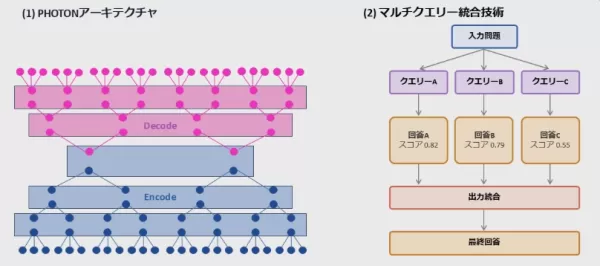
PHOTON's core strength lies in its hierarchical processing approach. Instead of the token-level segmentation used by traditional Transformers, PHOTON introduces semantic layering, which cuts computational complexity while boosting parallel computing. Additionally, for multi-query tasks, the architecture streamlines decision-making: it needs only a single inference to reach a conclusion, using "majority voting" or "best choice" strategies.
Test results show that in smaller models with 600M, 900M, and 1.2B parameters, PHOTON delivers very high throughput and extremely low memory usage. In the 1.2B parameter model, its multi-query performance reaches 475 times that of mainstream Transformer architectures, significantly improving resource scheduling efficiency.
Because this architecture requires less KV Cache per iteration, the system can handle more iterations. This is a major performance boost for intelligent agent systems that manage many I/O processes. While some quality metrics see a slight trade-off, PHOTON's leap in computational efficiency makes it a promising technical solution for reducing AI operational costs.
Fujitsu is now actively promoting the architecture's application, aiming to provide lighter, more efficient underlying support for future intelligent scenarios through innovations in core algorithms.
Related article
 ZTE, Tencent Forge AI Cloud Partnership with Native Work Buddy
ZTE hosted an AI Cloud Computer Experience Day in Beijing, announcing a strategic partnership with Tencent to launch a new AI cloud computer featuring Tencent’s Work Buddy. The market responded swiftly: on June 4, ZTE’s A-shares rose over 5% to 38.5
Wanxiang Shengsheng Unveils Low-Cost AI Audiobook Tool at Under 8 Yuan per 10k Characters
Two months after its public beta, Wanzhuang Yousheng officially launched its automated production system, "Fully Automatic AI Multi-voice Audiobook Creation," a feature that had already won over rights holders during internal trials.Launched by the c
How to fix Core Web Vitals for better SEO ranking
How to Build Beautiful Websites Using AI and Google SitesTable of Contents:IntroductionMastering Web Design and Creation with Google SitesThe Role of Artificial Intelligence in Modern Web DesignBuilding a Site with Google TemplatesUsing AI Tools Like
Related Special Topic Recommendations
chatbot
ZTE, Tencent Forge AI Cloud Partnership with Native Work Buddy
ZTE hosted an AI Cloud Computer Experience Day in Beijing, announcing a strategic partnership with Tencent to launch a new AI cloud computer featuring Tencent’s Work Buddy. The market responded swiftly: on June 4, ZTE’s A-shares rose over 5% to 38.5
Wanxiang Shengsheng Unveils Low-Cost AI Audiobook Tool at Under 8 Yuan per 10k Characters
Two months after its public beta, Wanzhuang Yousheng officially launched its automated production system, "Fully Automatic AI Multi-voice Audiobook Creation," a feature that had already won over rights holders during internal trials.Launched by the c
How to fix Core Web Vitals for better SEO ranking
How to Build Beautiful Websites Using AI and Google SitesTable of Contents:IntroductionMastering Web Design and Creation with Google SitesThe Role of Artificial Intelligence in Modern Web DesignBuilding a Site with Google TemplatesUsing AI Tools Like
Related Special Topic Recommendations
chatbot
 AI Customer Chatbot Tools for Website Support
2026 Latest Best Top-Rated AI Customer Chatbot Tools for Website Support are here on XIX.AI! Our curated list features powerful, game-changing solutions that boost response speeds, improve customer satisfaction, and save tons of manual work. Each option goes through rigorous real-world tests, complete with free vs paid comparison details. Explore now to find the perfect tool that boosts your online support efficiency!
 10 tools
 xix.ai
Social Media
Instagram AI Comment Reply Tools for Shops, DMs, and Community Management
xix.ai
Social Media
Instagram AI Comment Reply Tools for Shops, DMs, and Community Management
2026 Latest Best Instagram AI Comment Reply Tools for Shops, DMs, and Community Management! XIX.AI has curated a top-rated list of powerful game-changing solutions featuring weekly updated rankings, free vs paid comparison, and real-world tests. These must-try tools help boost productivity significantly by streamlining reply tasks, saving time, and enhancing customer engagement across all social media platforms. Explore now to discover your perfect tool for seamless community management!
10 tools
xix.ai
Image editing
Best AI Photo Retouch Tools for Portrait Editing
2026 Latest Best Top-Rated AI Photo Retouch Tools for Portrait Editing are here on XIX.AI! This curated list features powerful, game-changing solutions that help creators boost writing efficiency and unlock their full creative potential. We conduct real-world tests and provide detailed free vs paid comparison along with weekly updated rankings to ensure you find the must-try perfect tool for flawless portrait edits. Explore now to discover your ideal choice!
12 tools
xix.ai
Text-to-speech
ElevenLabs Voice Cloning Tools for Podcasts, Courses, and Product Walkthroughs
2026 Latest Best Top-rated Voice Cloning Tools for Podcasting, Course Creation, and Product Walkthroughs are here on XIX.AI. This curated list features powerful game-changing solutions that undergo real-world tests to deliver flawless results every time. You’ll find a free vs paid comparison along with detailed rankings to help you choose the most suitable option for boosting your productivity. Explore now and Discover your perfect tool for enhancing audio content creation.
9 tools
xix.ai
writing
AI Rewrite Tools for Business Writing: Make Dense Copy Clearer
2026 Latest Best Top-rated AI Rewrite Tools for Business Writing are here on XIX.AI! This curated list features powerful, game-changing tools that undergo real-world tests to make dense copy clearer and boost writing efficiency. Get a free vs paid comparison and see which option suits your needs. Explore now to discover your perfect tool and unlock your AI edge in business communication.
13 tools
xix.ai
Music composition
AI Songwriting Tools for Lyrics and Melody Ideas
2026 Latest Best Top-Rated AI Songwriting Tools for Lyrics and Melody Ideas are here on XIX.AI! This curated collection features powerful, game-changing options that go through rigorous real-world tests to deliver accurate lyric and melody suggestions. Get a free vs paid comparison, see detailed rankings, and discover must-try tools that can boost your creative workflow significantly. Explore now to find the perfect fit for your needs!
8 tools
xix.ai

 Comments (0)
0/500
Comments (0)
0/500
As large models continue to evolve rapidly, computing costs and processing efficiency remain key industry concerns. Fujitsu recently introduced a novel architecture called PHOTON (Top-down Network Parallel Hierarchical Computing), designed to overcome the performance limitations of traditional Transformer models in complex scenarios.
The Transformer architecture, now dominant in AI, handles long texts or high-concurrency multi-query tasks well, but often slows down due to frequent memory access for retrieving historical information, increasing GPU workload. Fujitsu's research team addressed this pain point by rethinking the PHOTON architecture's design.
PHOTON's core strength lies in its hierarchical processing approach. Instead of the token-level segmentation used by traditional Transformers, PHOTON introduces semantic layering, which cuts computational complexity while boosting parallel computing. Additionally, for multi-query tasks, the architecture streamlines decision-making: it needs only a single inference to reach a conclusion, using "majority voting" or "best choice" strategies.
Test results show that in smaller models with 600M, 900M, and 1.2B parameters, PHOTON delivers very high throughput and extremely low memory usage. In the 1.2B parameter model, its multi-query performance reaches 475 times that of mainstream Transformer architectures, significantly improving resource scheduling efficiency.
Because this architecture requires less KV Cache per iteration, the system can handle more iterations. This is a major performance boost for intelligent agent systems that manage many I/O processes. While some quality metrics see a slight trade-off, PHOTON's leap in computational efficiency makes it a promising technical solution for reducing AI operational costs.
Fujitsu is now actively promoting the architecture's application, aiming to provide lighter, more efficient underlying support for future intelligent scenarios through innovations in core algorithms.








 ZTE, Tencent Forge AI Cloud Partnership with Native Work Buddy
ZTE hosted an AI Cloud Computer Experience Day in Beijing, announcing a strategic partnership with Tencent to launch a new AI cloud computer featuring Tencent’s Work Buddy. The market responded swiftly: on June 4, ZTE’s A-shares rose over 5% to 38.5
Wanxiang Shengsheng Unveils Low-Cost AI Audiobook Tool at Under 8 Yuan per 10k Characters
Two months after its public beta, Wanzhuang Yousheng officially launched its automated production system, "Fully Automatic AI Multi-voice Audiobook Creation," a feature that had already won over rights holders during internal trials.Launched by the c
ZTE, Tencent Forge AI Cloud Partnership with Native Work Buddy
ZTE hosted an AI Cloud Computer Experience Day in Beijing, announcing a strategic partnership with Tencent to launch a new AI cloud computer featuring Tencent’s Work Buddy. The market responded swiftly: on June 4, ZTE’s A-shares rose over 5% to 38.5
Wanxiang Shengsheng Unveils Low-Cost AI Audiobook Tool at Under 8 Yuan per 10k Characters
Two months after its public beta, Wanzhuang Yousheng officially launched its automated production system, "Fully Automatic AI Multi-voice Audiobook Creation," a feature that had already won over rights holders during internal trials.Launched by the c
 How to fix Core Web Vitals for better SEO ranking
How to Build Beautiful Websites Using AI and Google SitesTable of Contents:IntroductionMastering Web Design and Creation with Google SitesThe Role of Artificial Intelligence in Modern Web DesignBuilding a Site with Google TemplatesUsing AI Tools Like
How to fix Core Web Vitals for better SEO ranking
How to Build Beautiful Websites Using AI and Google SitesTable of Contents:IntroductionMastering Web Design and Creation with Google SitesThe Role of Artificial Intelligence in Modern Web DesignBuilding a Site with Google TemplatesUsing AI Tools Like

2026 Latest Best Top-Rated AI Customer Chatbot Tools for Website Support are here on XIX.AI! Our curated list features powerful, game-changing solutions that boost response speeds, improve customer satisfaction, and save tons of manual work. Each option goes through rigorous real-world tests, complete with free vs paid comparison details. Explore now to find the perfect tool that boosts your online support efficiency!
10 tools
xix.ai

2026 Latest Best Instagram AI Comment Reply Tools for Shops, DMs, and Community Management! XIX.AI has curated a top-rated list of powerful game-changing solutions featuring weekly updated rankings, free vs paid comparison, and real-world tests. These must-try tools help boost productivity significantly by streamlining reply tasks, saving time, and enhancing customer engagement across all social media platforms. Explore now to discover your perfect tool for seamless community management!
10 tools
xix.ai

2026 Latest Best Top-Rated AI Photo Retouch Tools for Portrait Editing are here on XIX.AI! This curated list features powerful, game-changing solutions that help creators boost writing efficiency and unlock their full creative potential. We conduct real-world tests and provide detailed free vs paid comparison along with weekly updated rankings to ensure you find the must-try perfect tool for flawless portrait edits. Explore now to discover your ideal choice!
12 tools
xix.ai

2026 Latest Best Top-rated Voice Cloning Tools for Podcasting, Course Creation, and Product Walkthroughs are here on XIX.AI. This curated list features powerful game-changing solutions that undergo real-world tests to deliver flawless results every time. You’ll find a free vs paid comparison along with detailed rankings to help you choose the most suitable option for boosting your productivity. Explore now and Discover your perfect tool for enhancing audio content creation.
9 tools
xix.ai

2026 Latest Best Top-rated AI Rewrite Tools for Business Writing are here on XIX.AI! This curated list features powerful, game-changing tools that undergo real-world tests to make dense copy clearer and boost writing efficiency. Get a free vs paid comparison and see which option suits your needs. Explore now to discover your perfect tool and unlock your AI edge in business communication.
13 tools
xix.ai

2026 Latest Best Top-Rated AI Songwriting Tools for Lyrics and Melody Ideas are here on XIX.AI! This curated collection features powerful, game-changing options that go through rigorous real-world tests to deliver accurate lyric and melody suggestions. Get a free vs paid comparison, see detailed rankings, and discover must-try tools that can boost your creative workflow significantly. Explore now to find the perfect fit for your needs!
8 tools
xix.ai












