


 Home
HomeFlapping Airplanes on AI: 'We want to pursue radically different approaches'
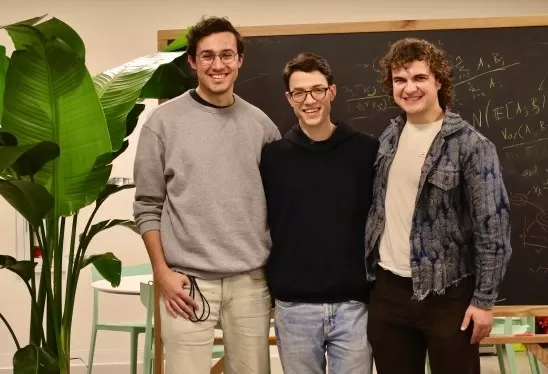
In recent months, a wave of ambitious research-focused AI labs has emerged, and Flapping Airplanes stands out as one of the most intriguing. Driven by its young, curious founders, the lab is dedicated to finding less data-hungry ways to train AI. This approach could fundamentally reshape both the economics and capabilities of AI models — and with $180 million in seed funding, they have plenty of room to explore.
Last week, I sat down with the lab’s three co-founders — brothers Ben and Asher Spector, along with Aidan Smith — to discuss why this is a compelling time to launch a new AI lab and why they keep returning to ideas inspired by the human brain.
Let me start with the obvious question: why now? Labs like OpenAI and DeepMind have poured enormous resources into scaling their models. I imagine the competition feels intimidating. What made this feel like the right moment to launch a foundation model company?
Ben: There’s just so much left to do. The advances over the past five to ten years have been remarkable. We love the tools — we use them every day. But the question is whether this is the full scope of what needs to happen. We thought about it carefully, and our answer was no — there’s much more ahead. For us, the data efficiency problem seemed like the critical thing to tackle. Today’s frontier models are trained on essentially all human knowledge, yet humans manage with far less. That gap is huge, and it’s worth understanding.
What we’re doing is essentially a concentrated bet on three things. First, that data efficiency is the right problem to solve — a genuinely new direction where progress is possible. Second, that solving it will be commercially valuable and make the world better. And third, that the right kind of team to take this on is creative and, in some ways, inexperienced — a group willing to reexamine these problems from scratch.
Aidan: Absolutely. We don’t really see ourselves as competing with other labs because we’re focused on a very different set of problems. Look at the human mind — it learns in a fundamentally different way than transformers. Not necessarily better, just very different. So we see different trade-offs. LLMs are incredible at memorization and drawing on vast knowledge, but they struggle to pick up new skills quickly — it takes enormous amounts of data to adapt. When you look inside the brain, the algorithms it uses are fundamentally different from gradient descent and other current training techniques. That’s why we’re building a new wave of researchers to address these problems and rethink the AI landscape.
Asher: This question is deeply scientifically interesting: why are the intelligent systems we’ve built so different from what humans do? Where does that difference come from, and how can we use it to build better systems? At the same time, I believe this is commercially viable and good for the world. Many important domains are data-constrained — robotics, scientific discovery, even enterprise applications. A model that is a million times more data efficient would be a million times easier to integrate into the economy. So for us, taking a fresh perspective felt exciting: if we could build a vastly more data-efficient model, what could we do with it?
Techcrunch eventTechCrunch Founder Summit 2026: Tickets Live
On June 23 in Boston, more than 1,100 founders come together at TechCrunch Founder Summit 2026 for a full day focused on growth, execution, and real-world scaling. Learn from founders and investors who have shaped the industry. Connect with peers navigating similar growth stages. Walk away with tactics you can apply immediately
Save up to $300 on your pass or save up to 30% with group tickets for teams of four or more.
TechCrunch Founder Summit: Tickets Live
On June 23 in Boston, more than 1,100 founders come together at TechCrunch Founder Summit 2026 for a full day focused on growth, execution, and real-world scaling. Learn from founders and investors who have shaped the industry. Connect with peers navigating similar growth stages. Walk away with tactics you can apply immediately
Save up to $300 on your pass or save up to 30% with group tickets for teams of four or more.
Boston, MA|June 23, 2026REGISTER NOWThis leads into my next question, which also ties into the name Flapping Airplanes. There’s a philosophical debate in AI about how much we should try to replicate human brain processes versus creating a more abstract intelligence that follows a completely different path. Aidan comes from Neuralink, which is all about the human brain. Do you see yourselves pursuing a more neuromorphic view of AI?
Aidan: I see the brain as an existence proof — evidence that other algorithms are out there, not just one orthodoxy. The brain operates under crazy constraints. Firing an action potential takes a millisecond; in that same time, your computer can perform countless operations. So there’s probably an approach that’s actually much better than the brain, and very different from the transformer. We’re inspired by some things the brain does, but we don’t feel tied to it.
Ben: To add to that, it’s right there in our name: Flapping Airplanes. Think of current systems as big Boeing 787s. We’re not trying to build birds — that’s too far. We’re trying to build something like a flapping airplane. From a computer systems perspective, the constraints of the brain and silicon are sufficiently different that we shouldn’t expect these systems to end up looking the same. With such different substrates and very different trade-offs around compute cost, locality, and data movement, these systems will naturally look a bit different. But that doesn’t mean we shouldn’t draw inspiration from the brain and use the parts we find interesting to improve our own systems.
It seems like there’s now more freedom for labs to focus on research rather than just developing products. That feels like a big shift for this generation of labs. Some are very research-focused; others are “research-focused for now.” How does that conversation play out inside Flapping Airplanes?
Asher: I wish I could give you a timeline. I wish I could say, in three years, we’ll have solved the research problem and here’s how we’ll commercialize. But I can’t. We don’t know the answers. We’re searching for truth. That said, we do have commercial backgrounds. I spent time developing technology for companies that generated reasonable revenue. Ben has incubated startups with commercial roots, and we’re genuinely excited to commercialize — we think it’s good for the world to put created value into the hands of people who can use it. So we’re not opposed. We just need to start with research, because if we begin by signing big enterprise contracts, we’ll get distracted and won’t do the valuable research.
Aidan: Right — we want to try radically different things, and sometimes radical ideas are simply worse than the current paradigm. We’re exploring a set of different trade-offs, hoping they’ll pay off in the long run.
Ben: Companies are at their best when they’re really focused on doing one thing well, right? Big companies can afford to do many things at once. As a startup, you have to pick the most valuable thing and go all in. We create the most value when we’re fully committed to solving fundamental problems for now.
I’m actually optimistic that fairly soon we might have made enough progress to start touching grass in the real world. You learn a lot from real-world feedback. The amazing thing about the world is that it constantly teaches you — it’s a tremendous vat of truth you can look into anytime. I think the recent shift in economics and financing for these structures has enabled companies to focus longer on what they’re good at. That focus — the thing I’m most excited about — will let us do truly differentiated work.
To spell out what I think you’re referring to: there’s so much excitement around AI that investors are willing to give $180 million in seed funding to a brand-new company full of very smart, very young people who didn’t just cash out of PayPal. How was engaging with that process? Did you know going in there was that appetite, or did you discover you could make this a bigger thing than you expected?
Ben: It was a mix of both. The market has been hot for months, so it wasn’t a secret that large rounds were coming together. But you never know how the fundraising environment will respond to your specific ideas. Again, you have to let the world give you feedback. Even during our fundraise, we learned a lot and changed our ideas — we refined our priorities and timelines for commercialization.
We were somewhat surprised by how well our message resonated. It was clear to us, but you never know if others will believe the same or think you’re crazy. We were extremely fortunate to find a group of amazing investors who really connected with our message and said, “Yes, this is exactly what we’ve been looking for.” That was amazing — surprising and wonderful.
Aidan: Yeah, a thirst for the age of research has been in the air for a while. More and more, we find ourselves positioned as the player to pursue that age and try these radical ideas.
At least for scale-driven companies, the cost of entry for foundation models is enormous — building a model at that scale is incredibly compute-intensive. Research sits somewhere in the middle: presumably you’re building foundation models, but if you’re doing it with less data and not as scale-oriented, maybe you get a break. How much do you expect compute costs to limit your runway?
Ben: One advantage of deep, fundamental research is that, paradoxically, it’s much cheaper to try really crazy, radical ideas than to do incremental work. With incremental work, to see if it works you have to go far up the scaling ladder — many small-scale interventions don’t persist at scale. That’s expensive. But if you have a wild new idea about an architecture optimizer, it’ll probably fail on the first run anyway, so you don’t need to scale it up. It’s already broken — that’s great.
That doesn’t mean scale is irrelevant for us. Scale is an important tool in the toolbox. Being able to scale up our ideas is certainly relevant. So I wouldn’t frame us as the antithesis of scale. But it’s a wonderful aspect of our work that we can try many ideas at very small scale before even thinking about large scale.
Asher: Yeah, you should be able to use all the internet — but you shouldn’t need to. We find it really perplexing that you need to use the entire internet to achieve human-level intelligence.
So, what becomes possible if you can train more efficiently on data? Presumably the model will be more powerful and intelligent. Do you have specific ideas about where that leads? Are we talking about more out-of-distribution generalization, or models that get better at a particular task with less experience?
Asher: First, we’re doing science, so I don’t know the answer — but I can offer three hypotheses. My first hypothesis is that there’s a broad spectrum between just looking for statistical patterns and having deep understanding. Current models sit somewhere on that spectrum — not all the way to deep understanding, but clearly not just pattern matching. It’s possible that training on less data forces the model to develop incredibly deep understandings of everything it’s seen. That could make the model more intelligent in interesting ways — it might know fewer facts but reason better. That’s one hypothesis.
Another hypothesis is similar to what you said: currently it’s expensive — both operationally and monetarily — to teach models new capabilities because you need so much data. One outcome of our work could be vastly more efficient post-training, so with just a few examples you could put a model into a new domain.
And then it’s also possible that this unlocks new verticals for AI. For instance, in robotics, for whatever reason we can’t quite make it commercially viable. I think it’s a limited data problem, not a hardware problem — the fact that you can tele-operate robots proves the hardware is good enough. There are many such domains, like scientific discovery.
Ben: One thing I’ll double-click on: when we think about AI’s impact, one view is that it’s a deflationary technology — automating jobs, making work cheaper, removing work from the economy. That will happen. But to my mind, that’s not the most exciting vision. The most exciting vision is one where AI helps us construct new science and technologies that humans aren’t smart enough to come up with — but other systems can.
On that front, the axis Asher mentioned — between true generalization versus memorization or interpolation — is extremely important for deep insights that lead to advances in medicine and science. It’s critical that models are on the creativity side of that spectrum. Part of why I’m so excited about our work is that beyond individual economic impacts, I’m genuinely mission-oriented around whether we can get AI to do things humans fundamentally couldn’t do before. That’s more than just “let’s fire a bunch of people.”
Absolutely. Does that put you in a particular camp on the AGI conversation — about out-of-distribution generalization?
Asher: I really don’t know exactly what AGI means. Capabilities are advancing quickly, and tremendous economic value is being created. But I don’t think we’re close to God-in-a-box. I don’t expect a singularity in two months or even two years where humans become obsolete. I basically agree with what Ben said: it’s a really big world, there’s a lot of work to do, and we’re excited to contribute.
Well, the idea about the brain and the neuromorphic part does feel relevant. You’re saying the relevant thing to compare LLMs to is the human brain, more than the Mechanical Turk or deterministic computers that came before.
Aidan: I’ll emphasize: the brain is not the ceiling — in many ways, it’s the floor. I see no evidence that the brain isn’t a knowable system that follows physical laws. It’s under many constraints. So we should expect to create capabilities that are much more interesting, different, and potentially better than the brain in the long run. We’re excited to contribute to that future, whether it’s called AGI or something else.
Asher: And I do think the brain is the relevant comparison, because it helps us understand how big the space is. It’s easy to see all the progress and think, “Wow, we have the answer, we’re almost done.” But if you step back and gain perspective, there’s a lot we don’t know.
Ben: We’re not trying to be better, per se. We’re trying to be different — that’s the key thing I want to hammer on. All these systems will almost certainly have different trade-offs. You’ll gain an advantage somewhere and lose elsewhere. It’s a big world out there, with many domains that have many different trade-offs. Having more systems and more fundamental technologies that address these different domains will likely let AI diffuse more effectively and rapidly through the world.
One way you’ve distinguished yourselves is in your hiring approach — getting very young people, in some cases still in college or high school. What clicks for you when talking to someone that makes you think, “I want this person working on these research problems”?
Aidan: It’s when you talk to someone and they dazzle you — they have so many new ideas and think in ways that many established researchers can’t because they haven’t been polluted by thousands of papers. The number one thing we look for is creativity. Our team is exceptionally creative, and every day I feel lucky to go in and discuss radical solutions to big AI problems with people who dream up a very different future.
Ben: Probably the number one signal I look for is: do they teach me something new when I spend time with them? If they teach me something new, the odds that they’ll teach us something new about our work are high. When doing research, creative, new ideas are the priority.
Part of my background — during my undergrad and PhD — was helping start an incubator called Prod that worked with companies that turned out well. One thing we saw was that young people can absolutely compete at the highest echelons of industry. A big part of the unlock is just realizing, “Yeah, I can go do this stuff.” You can absolutely contribute at the highest level.
Of course, we recognize the value of experience. People who’ve worked on large-scale systems are great — we’ve hired some of them, and we’re excited to work with all sorts of folks. I think our mission has resonated with experienced people too. The key is we want people who aren’t afraid to change the paradigm and can imagine a new system of how things might work.
One thing I’ve been puzzling about: how different do you think the resulting AI systems will be? It’s easy to imagine something like Claude Opus that just works 20% better and can do 20% more. But if it’s completely new, it’s hard to think about where that goes or what the end result looks like.
Asher: I don’t know if you’ve ever had the privilege of talking to the GPT-4 base model, but it had a lot of strange emerging capabilities. For example, you could take a snippet of an unwritten blog post and ask who wrote it, and it could identify it.
There are many such capabilities where models are smart in ways we can’t fathom. Future models will be smarter in even stranger ways. I think we should expect the future to be really weird, and the architectures even weirder. We’re looking for 1000x wins in data efficiency — not incremental change. So we should expect similarly unknowable, alien changes and capabilities at the limit.
Ben: I broadly agree. I’m probably slightly more tempered about how these things will eventually be experienced by the world — just as the GPT-4 base model was tempered by OpenAI. You want to put things in forms where consumers aren’t staring into the abyss. That’s important. But I broadly agree that our research agenda is about building capabilities that are quite fundamentally different from what can be done now.
Fantastic! Are there ways people can engage with Flapping Airplanes? Is it too early for that, or should they just stay tuned for when the research and models come out?
Asher: We have [email protected] if you just want to say hi. We also have [email protected] if you want to disagree with us. We’ve had some really cool conversations where people send us long essays about why they think what we’re doing is impossible — and we’re happy to engage.
Ben: But they haven’t convinced us yet. No one has convinced us yet.
Asher: Second, we’re looking for exceptional people who want to change the field and the world. If you’re interested, reach out.
Ben: And if you have an unorthodox background, that’s okay. You don’t need two PhDs. We’re really looking for folks who think differently.
Related article
 Could This Mark the Beginning of a Crisis for Token Economies?
Microsoft recently introduced significant price adjustments to GitHub Copilot, changes so substantial that a Reddit user referred to the situation as the Tokenpocalypse within their company.In the most recent episode of TechCrunch’s Equity podcast, K
US government's Anthropic ban may inadvertently boost the brand
Loading the player…Just as last week was ending, the US government forced Anthropic to pull its two newest models, Fable 5 and Mythos 5, citing national security concerns after Amazon researchers allegedly found a way to bypass Fable 5's guardrails.C
Humble Robotics brings autonomous vehicle hype back to freight
Loading the player…The autonomous vehicle sector is beginning to feel like a repeat of the 2016 hype cycle. Travis Kalanick is back building a robotics startup, and talent wars and capital are intensifying just as they did the first time. Money is fl
Related Special Topic Recommendations
Video creation
Could This Mark the Beginning of a Crisis for Token Economies?
Microsoft recently introduced significant price adjustments to GitHub Copilot, changes so substantial that a Reddit user referred to the situation as the Tokenpocalypse within their company.In the most recent episode of TechCrunch’s Equity podcast, K
US government's Anthropic ban may inadvertently boost the brand
Loading the player…Just as last week was ending, the US government forced Anthropic to pull its two newest models, Fable 5 and Mythos 5, citing national security concerns after Amazon researchers allegedly found a way to bypass Fable 5's guardrails.C
Humble Robotics brings autonomous vehicle hype back to freight
Loading the player…The autonomous vehicle sector is beginning to feel like a repeat of the 2016 hype cycle. Travis Kalanick is back building a robotics startup, and talent wars and capital are intensifying just as they did the first time. Money is fl
Related Special Topic Recommendations
Video creation
 AI Short-Form Video Hook Generators for Reels, Shorts, and Product Launch Campaigns
2026 Latest Best AI Short-Form Video Hook Generators for Reels Shorts and Product Launch Campaigns! XIX.AI curates top-rated powerful game-changing tools that deliver must-try results through real-world tests. This weekly updated page offers free vs paid comparison rankings to help you find the perfect solution for boosting content creativity and productivity. Explore now to Unlock your AI edge!
 11 tools
 xix.ai
writing
AI Article Outline Tools for Long Form Writing
xix.ai
writing
AI Article Outline Tools for Long Form Writing
2026 Latest Best Top-Rated AI Article Outline Tools for Long Form Writing! This curated collection features powerful, game-changing tools that deliver accurate, structured outlines with real-world tests to boost writing efficiency significantly. XIX.AI is part of this elite selection. Get a free vs paid comparison to help you choose the perfect tool. Explore now and Unlock your AI edge!
9 tools
xix.ai
chatbot
Best AI Roleplay Chat Apps for Language Practice, Interview Prep, and Daily Fluency
2026 Latest Best Top-rated AI Roleplay Chat Apps for Language Practice, Interview Prep, and Daily Fluency! XIX.AI curates a powerful game-changing collection that offers free vs paid comparison, real-world tests, and updated rankings weekly. These must-try tools help you boost writing skills, overcome fluency challenges, and improve communication efficiency across all daily scenarios. Explore now to discover your perfect tool for language growth!
10 tools
xix.ai
Music composition
AI Stem Separation Tools for Remix Production, Sampling Prep, and Karaoke Masters
2026 Latest Best Top-rated AI Stem Separation Tools Curated for Remix Production, Sampling Prep, and Karaoke Masters. These powerful game-changing tools offer real-world tests to deliver precise audio isolation, boosting productivity significantly. XIX.AI provides a weekly updated free vs paid comparison guide to help you find the must-try solution that suits your needs. Explore now to unlock your AI edge.
8 tools
xix.ai
Data Analysis
AI SQL Copilots for Revenue Dashboards, Funnel Analysis, and Product Metrics
2026 Latest Best AI SQL Copilots Ranked Top-Rated! XIX.AI curates a powerful game-changing collection for weekly updated real-world tests. These must-try tools help you generate accurate revenue dashboards, analyze sales funnels, and track product metrics swiftly, boosting productivity massively. Explore now to Discover your perfect tool for data-driven decision making! 238 characters
9 tools
xix.ai
Music composition
Best AI Melody Writing Tools for Song Drafts
2026 Latest Best Top-Rated AI Melody Writing Tools for Song Drafts! XIX.AI has curated a highly powerful game-changing collection that goes through rigorous real-world tests to deliver the best writing experience. You can find detailed free vs paid comparisons, accurate rankings, and must-try options designed to help you create stunning song drafts effortlessly and boost your creative productivity significantly. Explore now to discover your perfect tool!
8 tools
xix.ai

 Comments (0)
0/500
Comments (0)
0/500
In recent months, a wave of ambitious research-focused AI labs has emerged, and Flapping Airplanes stands out as one of the most intriguing. Driven by its young, curious founders, the lab is dedicated to finding less data-hungry ways to train AI. This approach could fundamentally reshape both the economics and capabilities of AI models — and with $180 million in seed funding, they have plenty of room to explore.
Last week, I sat down with the lab’s three co-founders — brothers Ben and Asher Spector, along with Aidan Smith — to discuss why this is a compelling time to launch a new AI lab and why they keep returning to ideas inspired by the human brain.
Let me start with the obvious question: why now? Labs like OpenAI and DeepMind have poured enormous resources into scaling their models. I imagine the competition feels intimidating. What made this feel like the right moment to launch a foundation model company?
Ben: There’s just so much left to do. The advances over the past five to ten years have been remarkable. We love the tools — we use them every day. But the question is whether this is the full scope of what needs to happen. We thought about it carefully, and our answer was no — there’s much more ahead. For us, the data efficiency problem seemed like the critical thing to tackle. Today’s frontier models are trained on essentially all human knowledge, yet humans manage with far less. That gap is huge, and it’s worth understanding.
What we’re doing is essentially a concentrated bet on three things. First, that data efficiency is the right problem to solve — a genuinely new direction where progress is possible. Second, that solving it will be commercially valuable and make the world better. And third, that the right kind of team to take this on is creative and, in some ways, inexperienced — a group willing to reexamine these problems from scratch.
Aidan: Absolutely. We don’t really see ourselves as competing with other labs because we’re focused on a very different set of problems. Look at the human mind — it learns in a fundamentally different way than transformers. Not necessarily better, just very different. So we see different trade-offs. LLMs are incredible at memorization and drawing on vast knowledge, but they struggle to pick up new skills quickly — it takes enormous amounts of data to adapt. When you look inside the brain, the algorithms it uses are fundamentally different from gradient descent and other current training techniques. That’s why we’re building a new wave of researchers to address these problems and rethink the AI landscape.
Asher: This question is deeply scientifically interesting: why are the intelligent systems we’ve built so different from what humans do? Where does that difference come from, and how can we use it to build better systems? At the same time, I believe this is commercially viable and good for the world. Many important domains are data-constrained — robotics, scientific discovery, even enterprise applications. A model that is a million times more data efficient would be a million times easier to integrate into the economy. So for us, taking a fresh perspective felt exciting: if we could build a vastly more data-efficient model, what could we do with it?
Techcrunch eventTechCrunch Founder Summit 2026: Tickets Live
On June 23 in Boston, more than 1,100 founders come together at TechCrunch Founder Summit 2026 for a full day focused on growth, execution, and real-world scaling. Learn from founders and investors who have shaped the industry. Connect with peers navigating similar growth stages. Walk away with tactics you can apply immediately
Save up to $300 on your pass or save up to 30% with group tickets for teams of four or more.
TechCrunch Founder Summit: Tickets Live
On June 23 in Boston, more than 1,100 founders come together at TechCrunch Founder Summit 2026 for a full day focused on growth, execution, and real-world scaling. Learn from founders and investors who have shaped the industry. Connect with peers navigating similar growth stages. Walk away with tactics you can apply immediately
Save up to $300 on your pass or save up to 30% with group tickets for teams of four or more.
Boston, MA|June 23, 2026REGISTER NOWThis leads into my next question, which also ties into the name Flapping Airplanes. There’s a philosophical debate in AI about how much we should try to replicate human brain processes versus creating a more abstract intelligence that follows a completely different path. Aidan comes from Neuralink, which is all about the human brain. Do you see yourselves pursuing a more neuromorphic view of AI?
Aidan: I see the brain as an existence proof — evidence that other algorithms are out there, not just one orthodoxy. The brain operates under crazy constraints. Firing an action potential takes a millisecond; in that same time, your computer can perform countless operations. So there’s probably an approach that’s actually much better than the brain, and very different from the transformer. We’re inspired by some things the brain does, but we don’t feel tied to it.
Ben: To add to that, it’s right there in our name: Flapping Airplanes. Think of current systems as big Boeing 787s. We’re not trying to build birds — that’s too far. We’re trying to build something like a flapping airplane. From a computer systems perspective, the constraints of the brain and silicon are sufficiently different that we shouldn’t expect these systems to end up looking the same. With such different substrates and very different trade-offs around compute cost, locality, and data movement, these systems will naturally look a bit different. But that doesn’t mean we shouldn’t draw inspiration from the brain and use the parts we find interesting to improve our own systems.
It seems like there’s now more freedom for labs to focus on research rather than just developing products. That feels like a big shift for this generation of labs. Some are very research-focused; others are “research-focused for now.” How does that conversation play out inside Flapping Airplanes?
Asher: I wish I could give you a timeline. I wish I could say, in three years, we’ll have solved the research problem and here’s how we’ll commercialize. But I can’t. We don’t know the answers. We’re searching for truth. That said, we do have commercial backgrounds. I spent time developing technology for companies that generated reasonable revenue. Ben has incubated startups with commercial roots, and we’re genuinely excited to commercialize — we think it’s good for the world to put created value into the hands of people who can use it. So we’re not opposed. We just need to start with research, because if we begin by signing big enterprise contracts, we’ll get distracted and won’t do the valuable research.
Aidan: Right — we want to try radically different things, and sometimes radical ideas are simply worse than the current paradigm. We’re exploring a set of different trade-offs, hoping they’ll pay off in the long run.
Ben: Companies are at their best when they’re really focused on doing one thing well, right? Big companies can afford to do many things at once. As a startup, you have to pick the most valuable thing and go all in. We create the most value when we’re fully committed to solving fundamental problems for now.
I’m actually optimistic that fairly soon we might have made enough progress to start touching grass in the real world. You learn a lot from real-world feedback. The amazing thing about the world is that it constantly teaches you — it’s a tremendous vat of truth you can look into anytime. I think the recent shift in economics and financing for these structures has enabled companies to focus longer on what they’re good at. That focus — the thing I’m most excited about — will let us do truly differentiated work.
To spell out what I think you’re referring to: there’s so much excitement around AI that investors are willing to give $180 million in seed funding to a brand-new company full of very smart, very young people who didn’t just cash out of PayPal. How was engaging with that process? Did you know going in there was that appetite, or did you discover you could make this a bigger thing than you expected?
Ben: It was a mix of both. The market has been hot for months, so it wasn’t a secret that large rounds were coming together. But you never know how the fundraising environment will respond to your specific ideas. Again, you have to let the world give you feedback. Even during our fundraise, we learned a lot and changed our ideas — we refined our priorities and timelines for commercialization.
We were somewhat surprised by how well our message resonated. It was clear to us, but you never know if others will believe the same or think you’re crazy. We were extremely fortunate to find a group of amazing investors who really connected with our message and said, “Yes, this is exactly what we’ve been looking for.” That was amazing — surprising and wonderful.
Aidan: Yeah, a thirst for the age of research has been in the air for a while. More and more, we find ourselves positioned as the player to pursue that age and try these radical ideas.
At least for scale-driven companies, the cost of entry for foundation models is enormous — building a model at that scale is incredibly compute-intensive. Research sits somewhere in the middle: presumably you’re building foundation models, but if you’re doing it with less data and not as scale-oriented, maybe you get a break. How much do you expect compute costs to limit your runway?
Ben: One advantage of deep, fundamental research is that, paradoxically, it’s much cheaper to try really crazy, radical ideas than to do incremental work. With incremental work, to see if it works you have to go far up the scaling ladder — many small-scale interventions don’t persist at scale. That’s expensive. But if you have a wild new idea about an architecture optimizer, it’ll probably fail on the first run anyway, so you don’t need to scale it up. It’s already broken — that’s great.
That doesn’t mean scale is irrelevant for us. Scale is an important tool in the toolbox. Being able to scale up our ideas is certainly relevant. So I wouldn’t frame us as the antithesis of scale. But it’s a wonderful aspect of our work that we can try many ideas at very small scale before even thinking about large scale.
Asher: Yeah, you should be able to use all the internet — but you shouldn’t need to. We find it really perplexing that you need to use the entire internet to achieve human-level intelligence.
So, what becomes possible if you can train more efficiently on data? Presumably the model will be more powerful and intelligent. Do you have specific ideas about where that leads? Are we talking about more out-of-distribution generalization, or models that get better at a particular task with less experience?
Asher: First, we’re doing science, so I don’t know the answer — but I can offer three hypotheses. My first hypothesis is that there’s a broad spectrum between just looking for statistical patterns and having deep understanding. Current models sit somewhere on that spectrum — not all the way to deep understanding, but clearly not just pattern matching. It’s possible that training on less data forces the model to develop incredibly deep understandings of everything it’s seen. That could make the model more intelligent in interesting ways — it might know fewer facts but reason better. That’s one hypothesis.
Another hypothesis is similar to what you said: currently it’s expensive — both operationally and monetarily — to teach models new capabilities because you need so much data. One outcome of our work could be vastly more efficient post-training, so with just a few examples you could put a model into a new domain.
And then it’s also possible that this unlocks new verticals for AI. For instance, in robotics, for whatever reason we can’t quite make it commercially viable. I think it’s a limited data problem, not a hardware problem — the fact that you can tele-operate robots proves the hardware is good enough. There are many such domains, like scientific discovery.
Ben: One thing I’ll double-click on: when we think about AI’s impact, one view is that it’s a deflationary technology — automating jobs, making work cheaper, removing work from the economy. That will happen. But to my mind, that’s not the most exciting vision. The most exciting vision is one where AI helps us construct new science and technologies that humans aren’t smart enough to come up with — but other systems can.
On that front, the axis Asher mentioned — between true generalization versus memorization or interpolation — is extremely important for deep insights that lead to advances in medicine and science. It’s critical that models are on the creativity side of that spectrum. Part of why I’m so excited about our work is that beyond individual economic impacts, I’m genuinely mission-oriented around whether we can get AI to do things humans fundamentally couldn’t do before. That’s more than just “let’s fire a bunch of people.”
Absolutely. Does that put you in a particular camp on the AGI conversation — about out-of-distribution generalization?
Asher: I really don’t know exactly what AGI means. Capabilities are advancing quickly, and tremendous economic value is being created. But I don’t think we’re close to God-in-a-box. I don’t expect a singularity in two months or even two years where humans become obsolete. I basically agree with what Ben said: it’s a really big world, there’s a lot of work to do, and we’re excited to contribute.
Well, the idea about the brain and the neuromorphic part does feel relevant. You’re saying the relevant thing to compare LLMs to is the human brain, more than the Mechanical Turk or deterministic computers that came before.
Aidan: I’ll emphasize: the brain is not the ceiling — in many ways, it’s the floor. I see no evidence that the brain isn’t a knowable system that follows physical laws. It’s under many constraints. So we should expect to create capabilities that are much more interesting, different, and potentially better than the brain in the long run. We’re excited to contribute to that future, whether it’s called AGI or something else.
Asher: And I do think the brain is the relevant comparison, because it helps us understand how big the space is. It’s easy to see all the progress and think, “Wow, we have the answer, we’re almost done.” But if you step back and gain perspective, there’s a lot we don’t know.
Ben: We’re not trying to be better, per se. We’re trying to be different — that’s the key thing I want to hammer on. All these systems will almost certainly have different trade-offs. You’ll gain an advantage somewhere and lose elsewhere. It’s a big world out there, with many domains that have many different trade-offs. Having more systems and more fundamental technologies that address these different domains will likely let AI diffuse more effectively and rapidly through the world.
One way you’ve distinguished yourselves is in your hiring approach — getting very young people, in some cases still in college or high school. What clicks for you when talking to someone that makes you think, “I want this person working on these research problems”?
Aidan: It’s when you talk to someone and they dazzle you — they have so many new ideas and think in ways that many established researchers can’t because they haven’t been polluted by thousands of papers. The number one thing we look for is creativity. Our team is exceptionally creative, and every day I feel lucky to go in and discuss radical solutions to big AI problems with people who dream up a very different future.
Ben: Probably the number one signal I look for is: do they teach me something new when I spend time with them? If they teach me something new, the odds that they’ll teach us something new about our work are high. When doing research, creative, new ideas are the priority.
Part of my background — during my undergrad and PhD — was helping start an incubator called Prod that worked with companies that turned out well. One thing we saw was that young people can absolutely compete at the highest echelons of industry. A big part of the unlock is just realizing, “Yeah, I can go do this stuff.” You can absolutely contribute at the highest level.
Of course, we recognize the value of experience. People who’ve worked on large-scale systems are great — we’ve hired some of them, and we’re excited to work with all sorts of folks. I think our mission has resonated with experienced people too. The key is we want people who aren’t afraid to change the paradigm and can imagine a new system of how things might work.
One thing I’ve been puzzling about: how different do you think the resulting AI systems will be? It’s easy to imagine something like Claude Opus that just works 20% better and can do 20% more. But if it’s completely new, it’s hard to think about where that goes or what the end result looks like.
Asher: I don’t know if you’ve ever had the privilege of talking to the GPT-4 base model, but it had a lot of strange emerging capabilities. For example, you could take a snippet of an unwritten blog post and ask who wrote it, and it could identify it.
There are many such capabilities where models are smart in ways we can’t fathom. Future models will be smarter in even stranger ways. I think we should expect the future to be really weird, and the architectures even weirder. We’re looking for 1000x wins in data efficiency — not incremental change. So we should expect similarly unknowable, alien changes and capabilities at the limit.
Ben: I broadly agree. I’m probably slightly more tempered about how these things will eventually be experienced by the world — just as the GPT-4 base model was tempered by OpenAI. You want to put things in forms where consumers aren’t staring into the abyss. That’s important. But I broadly agree that our research agenda is about building capabilities that are quite fundamentally different from what can be done now.
Fantastic! Are there ways people can engage with Flapping Airplanes? Is it too early for that, or should they just stay tuned for when the research and models come out?
Asher: We have [email protected] if you just want to say hi. We also have [email protected] if you want to disagree with us. We’ve had some really cool conversations where people send us long essays about why they think what we’re doing is impossible — and we’re happy to engage.
Ben: But they haven’t convinced us yet. No one has convinced us yet.
Asher: Second, we’re looking for exceptional people who want to change the field and the world. If you’re interested, reach out.
Ben: And if you have an unorthodox background, that’s okay. You don’t need two PhDs. We’re really looking for folks who think differently.








 Could This Mark the Beginning of a Crisis for Token Economies?
Microsoft recently introduced significant price adjustments to GitHub Copilot, changes so substantial that a Reddit user referred to the situation as the Tokenpocalypse within their company.In the most recent episode of TechCrunch’s Equity podcast, K
Could This Mark the Beginning of a Crisis for Token Economies?
Microsoft recently introduced significant price adjustments to GitHub Copilot, changes so substantial that a Reddit user referred to the situation as the Tokenpocalypse within their company.In the most recent episode of TechCrunch’s Equity podcast, K
 US government's Anthropic ban may inadvertently boost the brand
Loading the player…Just as last week was ending, the US government forced Anthropic to pull its two newest models, Fable 5 and Mythos 5, citing national security concerns after Amazon researchers allegedly found a way to bypass Fable 5's guardrails.C
US government's Anthropic ban may inadvertently boost the brand
Loading the player…Just as last week was ending, the US government forced Anthropic to pull its two newest models, Fable 5 and Mythos 5, citing national security concerns after Amazon researchers allegedly found a way to bypass Fable 5's guardrails.C
 Humble Robotics brings autonomous vehicle hype back to freight
Loading the player…The autonomous vehicle sector is beginning to feel like a repeat of the 2016 hype cycle. Travis Kalanick is back building a robotics startup, and talent wars and capital are intensifying just as they did the first time. Money is fl
Humble Robotics brings autonomous vehicle hype back to freight
Loading the player…The autonomous vehicle sector is beginning to feel like a repeat of the 2016 hype cycle. Travis Kalanick is back building a robotics startup, and talent wars and capital are intensifying just as they did the first time. Money is fl

2026 Latest Best AI Short-Form Video Hook Generators for Reels Shorts and Product Launch Campaigns! XIX.AI curates top-rated powerful game-changing tools that deliver must-try results through real-world tests. This weekly updated page offers free vs paid comparison rankings to help you find the perfect solution for boosting content creativity and productivity. Explore now to Unlock your AI edge!
11 tools
xix.ai

2026 Latest Best Top-Rated AI Article Outline Tools for Long Form Writing! This curated collection features powerful, game-changing tools that deliver accurate, structured outlines with real-world tests to boost writing efficiency significantly. XIX.AI is part of this elite selection. Get a free vs paid comparison to help you choose the perfect tool. Explore now and Unlock your AI edge!
9 tools
xix.ai

2026 Latest Best Top-rated AI Roleplay Chat Apps for Language Practice, Interview Prep, and Daily Fluency! XIX.AI curates a powerful game-changing collection that offers free vs paid comparison, real-world tests, and updated rankings weekly. These must-try tools help you boost writing skills, overcome fluency challenges, and improve communication efficiency across all daily scenarios. Explore now to discover your perfect tool for language growth!
10 tools
xix.ai

2026 Latest Best Top-rated AI Stem Separation Tools Curated for Remix Production, Sampling Prep, and Karaoke Masters. These powerful game-changing tools offer real-world tests to deliver precise audio isolation, boosting productivity significantly. XIX.AI provides a weekly updated free vs paid comparison guide to help you find the must-try solution that suits your needs. Explore now to unlock your AI edge.
8 tools
xix.ai

2026 Latest Best AI SQL Copilots Ranked Top-Rated! XIX.AI curates a powerful game-changing collection for weekly updated real-world tests. These must-try tools help you generate accurate revenue dashboards, analyze sales funnels, and track product metrics swiftly, boosting productivity massively. Explore now to Discover your perfect tool for data-driven decision making! 238 characters
9 tools
xix.ai

2026 Latest Best Top-Rated AI Melody Writing Tools for Song Drafts! XIX.AI has curated a highly powerful game-changing collection that goes through rigorous real-world tests to deliver the best writing experience. You can find detailed free vs paid comparisons, accurate rankings, and must-try options designed to help you create stunning song drafts effortlessly and boost your creative productivity significantly. Explore now to discover your perfect tool!
8 tools
xix.ai












