


 Home
HomeMiki4All's 7 Words: An In-Depth Exploration of AI Music
The intersection of artificial intelligence and music is producing captivating and often surprising outcomes. Miki4All’s '7 Words' perfectly embodies this movement, merging eccentric lyrics, surreal imagery, and a unique sonic identity. This piece explores the many dimensions of this AI-created song, analyzing its creative approach, the technology that powered it, and its place within the fast-changing world of AI-generated music. We'll examine its core components: paradox, velcro, submarine, toothpaste, meteorite, cactus, and a deliberately restricted vocabulary.
Key Points
'7 Words' by Miki4All highlights the power of AI in music composition.
The song merges distinctive audio textures with vivid, dreamlike visuals.
Central themes involve paradox, underwater journeys, and unusual everyday items.
Merging these disparate ideas illustrates AI's capacity for original conceptualization.
The field of AI music is advancing swiftly, creating fresh opportunities for artistic innovation.
Diving into the World of Miki4All's '7 Words'
What is AI Music?
AI music signifies a fundamental change in the creation, composition, and consumption of music. In contrast to traditional methods that depend entirely on human ingenuity, AI music utilizes algorithms and machine learning to produce compositions. This approach enables computers to process enormous collections of existing music, recognize structural patterns, and subsequently craft new works that either follow or break from those templates. Key methodologies in AI music generation include:
Generative Adversarial Networks (GANs): These systems involve two neural networks, a generator and a discriminator, that work in opposition. The generator produces new music, and the discriminator assesses its authenticity, driving iterative refinement.
Recurrent Neural Networks (RNNs): RNNs are optimized for sequential data, making them well-suited for composing music. They can anticipate subsequent notes or chords in a sequence by analyzing prior ones, effectively replicating music's time-based nature.
Markov Models: These probabilistic models forecast future events based on present conditions, enabling AI to construct melodies and harmonies from learned statistical patterns.
Rule-Based Systems: These approaches utilize pre-established musical rules and structures to direct the composition, guaranteeing the output aligns with particular styles or genres.
The emergence of AI music prompts important discussions about originality, creativity, and the industry's future. As these tools grow more advanced, they provide artists with new ways to partner with technology, experiment with unheard sounds, and expand the frontiers of musical art. Yet, they also introduce challenges surrounding copyright, authorship, and the possible impact on human musicians. Regardless of these hurdles, AI's capacity to transform music is clear, pointing toward a future of collaborative creation between humans and machines that yields stunning and innovative auditory experiences.
This domain of AI music is incredibly dynamic, fusing technical advancement with artistic exploration, unlocking new creative pathways, and redefining our understanding of music.
The Creative Ingredients of '7 Words'
Miki4All’s '7 Words' serves as a compelling case study in how AI can fuse apparently unrelated ideas into something new and stimulating. The track artfully intertwines seven specific components, each adding to its surreal and absorbing character. The song appears to investigate different themes and motifs, building a playful and slightly absurd narrative through its lyrical and visual combinations.
Paradox: The concept of paradox suggests conflicting ideas coexisting, generating intellectual curiosity and engagement. The song plays with contradictions, encouraging listeners to reflect on multifaceted scenarios.
Velcro: Commonly known for its fastening ability, velcro might represent connection, attachment, or the unification of different parts. In '7 Words,' it could symbolize the linking of concepts or musical elements.
Submarine: A submarine conjures notions of deep-sea voyages, mystery, and ventures into uncharted territory. Its inclusion implies a dive into subconscious realms or a search for deeper significance.
Toothpaste: A routine household item, toothpaste adds a touch of the mundane and cleanliness. Its use creates a contrast, placing the ordinary alongside the exceptional.
Meteorite: Symbolizing cosmic events and extraterrestrial origins, a meteorite introduces drama, consequence, and transformative power. It stands for events that fundamentally alter the normal course.
Cactus: Native to arid environments, the cactus embodies toughness, adaptation, and endurance under difficult circumstances. It represents steadfastness and survival.
Limited WORD list: The fundamental idea is that the entire song, while occasionally abstract, is built from these key elements. This constraint pushes the AI to innovate, crafting art from minimal resources, which is the core beauty of this process.
Each component enriches the eclectic mix of ideas, deepening the track's overarching narrative. By fusing these themes, Miki4All’s '7 Words' constructs a captivating story that is both entertaining and intellectually engaging. The lyrics, though surreal, are firmly rooted in these foundational concepts.
The Surreal Visual Landscape
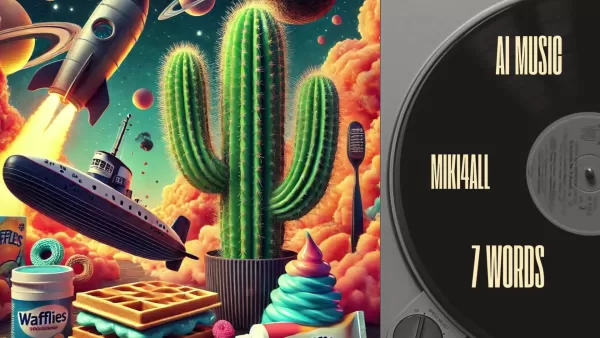
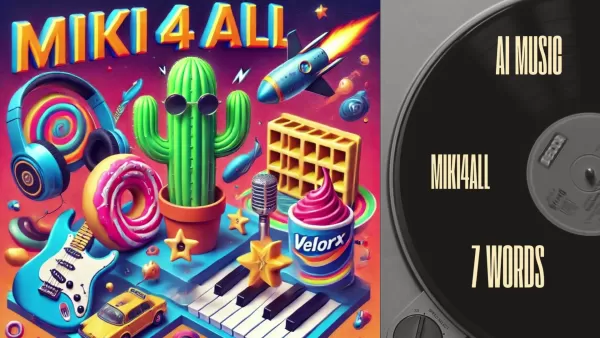
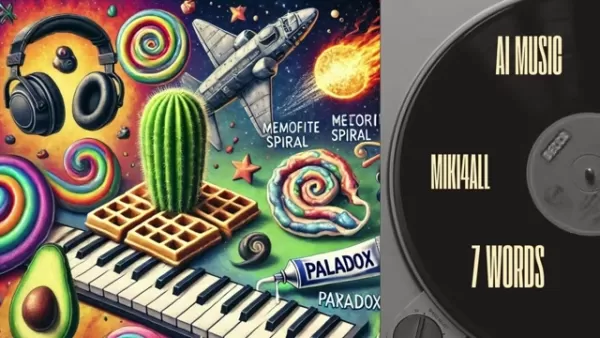
The track is paired with a suite of AI-generated visuals that echo its unconventional spirit. These images construct a dreamscape where normal logic is suspended and unexpected pairings dominate. The visuals take viewers on a trip through surreal scenarios that defy conventional perception. The AI has produced imagery that is both fanciful and slightly disconcerting, featuring a bold and vibrant color scheme.
- Unexpected Object Placement:A recurring theme is the insertion of common objects into strange settings. Waffles drift in the sky next to rockets, and toothpaste tubes adorn alien scenery.
- Clashing Themes: The scenes frequently combine themes that are not usually associated. A desert environment might be superimposed with cosmic events, or commonplace items might be positioned against deep-sea exploration backdrops.
- Vivid Colors and Textures: The images are filled with intense, striking colors and detailed textures. This produces a multi-sensory experience that intensifies the track's surreal vibe.
- AI-Generated Art Style: The visuals display the characteristic hallmarks of AI-created art, including subtle imperfections and a dreamlike quality that distinguishes them from conventional imagery.
These visual components are not just supplementary; they are essential to the holistic '7 Words' experience. The imagery transforms the track from a purely auditory encounter into an immersive world that stimulates multiple senses. They capture the song's essence, which is about venturing into the unexpected and questioning standard perspectives.
Understanding the Significance of AI in Modern Music
The Role of AI in Music Production
AI has grown into a highly useful asset in music production, providing support across multiple stages.
AI tools can help with functions like:
- Composition and Arrangement: AI can produce melodies, chord progressions, and rhythmic patterns based on set guidelines, giving musicians a creative launchpad.
- Sound Design: AI algorithms can invent unique audio effects and textures, broadening a track's sonic range.
- Mixing and Mastering: AI can automate certain mixing and mastering tasks, improving the overall balance and audio quality.
In contemporary music production, AI supports artists in composing, designing sounds, and finalizing tracks, boosting creative potential and simplifying workflows. These innovations are paving the way for more distinctive and widely available music production. Several platforms provide sophisticated AI-powered audio and music solutions:
Website Description Amper Music Offers AI-driven tools for producing custom music, ideal for video games, commercials, and film scores. Jukebox (OpenAI) An AI system that produces music, including vocals, across a wide spectrum of genres and artistic approaches. AIVA An AI composition engine that creates original music for films, video games, and advertising. LANDR Provides automated, AI-enhanced mixing and mastering services to improve track quality. iZotope Ozone Includes AI-guided mastering features that help users attain studio-grade sound by automatically fine-tuning EQ, dynamics, and stereo width.
The function of AI in music production is continuously developing, encouraging a synergistic relationship between artists and technology, leading to groundbreaking and previously unimaginable musical works.
The Upsides and Downsides of AI-Generated Music
Pros
Greater efficiency in the music production process
Lower barriers to entry for those without formal training
Development of innovative audio textures and genres
Improved creative partnership between people and algorithms
Customized musical listening and creation experiences
Cons
Issues related to copyright and intellectual property
Possible shortcomings in conveying genuine emotion
Danger of becoming excessively dependent on technology
Apprehensions about the impact on employment for human musicians
Difficulties in adequately representing cultural and individual subtleties
Frequently Asked Questions About AI Music
What exactly is meant by 'AI Music'?
AI music refers to compositions developed with artificial intelligence, where algorithms and machine learning models are used to write, generate, or refine musical works. This can include AI creating melodies and harmonies or assisting with technical processes like mixing and mastering. Fundamentally, AI acts as an instrument to support and expand the creative process, challenging the limits of musical convention. Models like generative adversarial networks (GANs) and recurrent neural networks (RNNs) analyze extensive music databases, identify patterns, and generate innovative new pieces.
Does AI music mean the end of human musicians?
Although AI undoubtedly brings disruptive innovation, it is unlikely to replace human musicians entirely. Instead, it can function as a creative partner, providing new methods for artistic experimentation. Musicians can use AI tools to test novel sounds, optimize their workflow, and discover new musical territories. This cooperative dynamic enables unique auditory experiences that were once inconceivable. Thus, AI is more apt to reshape the music industry rather than render its human contributors obsolete.
What are the ethical considerations of AI music?
AI music introduces several ethical questions, especially concerning copyright and authorship. As AI systems grow more capable, identifying the true originator of a musical work becomes ambiguous. Debates center on whether credit belongs to the AI, its developer, or the user who prompted the creation. Furthermore, there are worries about AI inadvertently replicating protected content. As this field progresses, tackling these ethical dilemmas will be vital for maintaining fairness, safeguarding artists' rights, and nurturing a vibrant, innovative creative ecosystem.
How accessible is AI music creation for the average person?
Creating music with AI is becoming increasingly approachable for the general public. A wide range of user-friendly AI music applications are now on the market, designed for individuals with different levels of musical knowledge. These platforms typically boast simple interfaces, pre-designed templates, and adjustable settings that allow anyone to compose music, even without deep musical background. By making music production more democratic, AI enables people to manifest their creativity, pursue musical concepts, and create polished final tracks.
Related Questions on Artificial Intelligence Music
Can AI Really Capture the Nuance and Emotion of Human Music?
Whether AI can truly replicate the subtlety and emotional resonance of human-composed music is a nuanced topic with diverse opinions. Presently, AI can create technically proficient pieces and imitate multiple styles, yet some contend it lacks the profound emotional connection and originality found in human artistry. Music made by people often communicates personal stories, cultural backgrounds, and emotional intricacies that are challenging for AI to comprehend fully. Nonetheless, AI technology is constantly improving, and future developments might allow it to generate more emotionally impactful compositions. For the time being, the distinctive expressive quality of human musicians remains a defining characteristic.
What are the benefits of using AI in music education?
AI provides significant advantages in music education, improving learning outcomes and delivering customized teaching. AI-based applications can provide responsive feedback, individualized practice routines, and personalized educational trajectories, meeting the specific needs and preferences of each learner. AI can also help with music notation, theoretical analysis, and composition, offering students practical insights and skill development. Incorporating AI into music instruction allows teachers to build a more interactive, effective, and student-focused educational setting, helping learners reach their full musical potential. AI holds great potential for educators needing to develop customized learning resources for a diverse student body.
Related article
 Stripe to Acquire OpenRouter as AI Model Routing Gains Momentum
Stripe has agreed to acquire OpenRouter, an AI model-routing platform that gives developers access to hundreds of models through a single interface. The deal adds model selection and routing to Stripe’s existing work around AI usage and token-based b
Former OpenAI Researcher Barrett Zoph Returns to Google to Support Gemini Development
Barret Zoph, who previously abruptly left and joined OpenAI due to a disagreement with Thinking Machines Lab CEO Miriam Mularati, has once again changed employers. Alphabet's Google announced that Zoph will return as Vice President of Research, bring
How Recursive Intelligence Raised $335M at $4B Valuation in 4 Months
The co-founders of startup Ricursive Intelligence seemed destined to be co-founders.Anna Goldie, CEO, and Azalia Mirhoseini, CTO, are so well-known in the AI community that they were among those AI engineers who “got those weird emails from Zuckerber
Related Special Topic Recommendations
Design & Art
Stripe to Acquire OpenRouter as AI Model Routing Gains Momentum
Stripe has agreed to acquire OpenRouter, an AI model-routing platform that gives developers access to hundreds of models through a single interface. The deal adds model selection and routing to Stripe’s existing work around AI usage and token-based b
Former OpenAI Researcher Barrett Zoph Returns to Google to Support Gemini Development
Barret Zoph, who previously abruptly left and joined OpenAI due to a disagreement with Thinking Machines Lab CEO Miriam Mularati, has once again changed employers. Alphabet's Google announced that Zoph will return as Vice President of Research, bring
How Recursive Intelligence Raised $335M at $4B Valuation in 4 Months
The co-founders of startup Ricursive Intelligence seemed destined to be co-founders.Anna Goldie, CEO, and Azalia Mirhoseini, CTO, are so well-known in the AI community that they were among those AI engineers who “got those weird emails from Zuckerber
Related Special Topic Recommendations
Design & Art
 Top AI Illustration Tools: Create Editorial Scenes and Cover Art Faster
2026 Latest Top-rated AI Illustration Tools: Our curated list features the best powerfully designed tools for creating stunning editorial scenes and eye-catching cover art quickly. Each option has gone through rigorous real-world tests, offering a free vs paid comparison to help you find the perfect match for your workflow. Try these must-try solutions today to unlock your AI edge and boost your creative productivity. Explore now at XIX.AI.
 10 tools
 xix.ai
Education and Learning
Top AI Tutors for Exam Prep: Practice Math, Science, and English
xix.ai
Education and Learning
Top AI Tutors for Exam Prep: Practice Math, Science, and English
2026 Latest Top-Rated Best AI Tutors for Exam Prep are here on XIX.AI! Our curated list features powerful game-changing tools that offer free vs paid comparison, real-world tests, and weekly updated rankings. They help boost your writing efficiency, simplify complex topic learning, and unlock your academic potential. Explore now to Discover your perfect exam prep tool and Start creating today to Unlock your AI edge!
10 tools
xix.ai
Finance
AI Budget Planning Tools for Personal Money Management
2026 Latest Best Top-Rated AI Budget Planning Tools for Personal Money Management are here on XIX.AI! This curated collection features powerful, game-changing solutions that help you conduct real-world tests, understand spending habits, and create personalized plans to boost productivity. Enjoy a free vs paid comparison along with detailed rankings. Must-try tools designed to simplify money management and unlock your AI edge. Explore now!
11 tools
xix.ai
Health & Wellness
AI Sleep Tracking Assistants: Improve Recovery with Better Bedtime Habits
2026 Latest Best Top-Rated AI Sleep Tracking Assistants curated for ultimate recovery. This fully updated weekly guide features powerful tools that deliver real-world tests, free vs paid comparison, and detailed rankings to help you find the must-try solution that boosts sleep quality and supports better bedtime habits. Explore now at XIX.AI to Unlock your AI edge.
10 tools
xix.ai
Data Analysis
AI SQL Copilots for Product and Revenue Analytics
2026 Latest Best Top-Rated AI SQL Copilots for Product and Revenue Analytics! XIX.AI has curated a powerful, game-changing collection of must-try tools that undergo real-world tests through weekly updated rankings. These tools help users boost productivity significantly by accelerating data analysis, streamlining complex queries, and generating accurate insights to drive smarter business decisions. Explore now to Discover your perfect tool for unlocking your AI edge!
14 tools
xix.ai
Education and Learning
Best AI Homework Helpers That Teach: Learn Concepts, Not Just Answers
2026 Latest Best Top-Rated AI Homework Helpers That Teach Core Concepts Not Just Answers Powerful Tools for Students Must-Try Curated List Weekly Updated Free vs Paid Comparison Real-World Tests Accurate Rankings to Help You Unlock Your Full Learning Potential Explore now to Discover your perfect tool for smarter studying.
10 tools
xix.ai

 Comments (0)
0/500
Comments (0)
0/500
The intersection of artificial intelligence and music is producing captivating and often surprising outcomes. Miki4All’s '7 Words' perfectly embodies this movement, merging eccentric lyrics, surreal imagery, and a unique sonic identity. This piece explores the many dimensions of this AI-created song, analyzing its creative approach, the technology that powered it, and its place within the fast-changing world of AI-generated music. We'll examine its core components: paradox, velcro, submarine, toothpaste, meteorite, cactus, and a deliberately restricted vocabulary.
Key Points
'7 Words' by Miki4All highlights the power of AI in music composition.
The song merges distinctive audio textures with vivid, dreamlike visuals.
Central themes involve paradox, underwater journeys, and unusual everyday items.
Merging these disparate ideas illustrates AI's capacity for original conceptualization.
The field of AI music is advancing swiftly, creating fresh opportunities for artistic innovation.
Diving into the World of Miki4All's '7 Words'
What is AI Music?
AI music signifies a fundamental change in the creation, composition, and consumption of music. In contrast to traditional methods that depend entirely on human ingenuity, AI music utilizes algorithms and machine learning to produce compositions. This approach enables computers to process enormous collections of existing music, recognize structural patterns, and subsequently craft new works that either follow or break from those templates. Key methodologies in AI music generation include:
Generative Adversarial Networks (GANs): These systems involve two neural networks, a generator and a discriminator, that work in opposition. The generator produces new music, and the discriminator assesses its authenticity, driving iterative refinement.
Recurrent Neural Networks (RNNs): RNNs are optimized for sequential data, making them well-suited for composing music. They can anticipate subsequent notes or chords in a sequence by analyzing prior ones, effectively replicating music's time-based nature.
Markov Models: These probabilistic models forecast future events based on present conditions, enabling AI to construct melodies and harmonies from learned statistical patterns.
Rule-Based Systems: These approaches utilize pre-established musical rules and structures to direct the composition, guaranteeing the output aligns with particular styles or genres.
The emergence of AI music prompts important discussions about originality, creativity, and the industry's future. As these tools grow more advanced, they provide artists with new ways to partner with technology, experiment with unheard sounds, and expand the frontiers of musical art. Yet, they also introduce challenges surrounding copyright, authorship, and the possible impact on human musicians. Regardless of these hurdles, AI's capacity to transform music is clear, pointing toward a future of collaborative creation between humans and machines that yields stunning and innovative auditory experiences.
This domain of AI music is incredibly dynamic, fusing technical advancement with artistic exploration, unlocking new creative pathways, and redefining our understanding of music.
The Creative Ingredients of '7 Words'
Miki4All’s '7 Words' serves as a compelling case study in how AI can fuse apparently unrelated ideas into something new and stimulating. The track artfully intertwines seven specific components, each adding to its surreal and absorbing character. The song appears to investigate different themes and motifs, building a playful and slightly absurd narrative through its lyrical and visual combinations.
Paradox: The concept of paradox suggests conflicting ideas coexisting, generating intellectual curiosity and engagement. The song plays with contradictions, encouraging listeners to reflect on multifaceted scenarios.
Velcro: Commonly known for its fastening ability, velcro might represent connection, attachment, or the unification of different parts. In '7 Words,' it could symbolize the linking of concepts or musical elements.
Submarine: A submarine conjures notions of deep-sea voyages, mystery, and ventures into uncharted territory. Its inclusion implies a dive into subconscious realms or a search for deeper significance.
Toothpaste: A routine household item, toothpaste adds a touch of the mundane and cleanliness. Its use creates a contrast, placing the ordinary alongside the exceptional.
Meteorite: Symbolizing cosmic events and extraterrestrial origins, a meteorite introduces drama, consequence, and transformative power. It stands for events that fundamentally alter the normal course.
Cactus: Native to arid environments, the cactus embodies toughness, adaptation, and endurance under difficult circumstances. It represents steadfastness and survival.
Limited WORD list: The fundamental idea is that the entire song, while occasionally abstract, is built from these key elements. This constraint pushes the AI to innovate, crafting art from minimal resources, which is the core beauty of this process.
Each component enriches the eclectic mix of ideas, deepening the track's overarching narrative. By fusing these themes, Miki4All’s '7 Words' constructs a captivating story that is both entertaining and intellectually engaging. The lyrics, though surreal, are firmly rooted in these foundational concepts.
The Surreal Visual Landscape
The track is paired with a suite of AI-generated visuals that echo its unconventional spirit. These images construct a dreamscape where normal logic is suspended and unexpected pairings dominate. The visuals take viewers on a trip through surreal scenarios that defy conventional perception. The AI has produced imagery that is both fanciful and slightly disconcerting, featuring a bold and vibrant color scheme.
- Unexpected Object Placement:A recurring theme is the insertion of common objects into strange settings. Waffles drift in the sky next to rockets, and toothpaste tubes adorn alien scenery.
- Clashing Themes: The scenes frequently combine themes that are not usually associated. A desert environment might be superimposed with cosmic events, or commonplace items might be positioned against deep-sea exploration backdrops.
- Vivid Colors and Textures: The images are filled with intense, striking colors and detailed textures. This produces a multi-sensory experience that intensifies the track's surreal vibe.
- AI-Generated Art Style: The visuals display the characteristic hallmarks of AI-created art, including subtle imperfections and a dreamlike quality that distinguishes them from conventional imagery.
These visual components are not just supplementary; they are essential to the holistic '7 Words' experience. The imagery transforms the track from a purely auditory encounter into an immersive world that stimulates multiple senses. They capture the song's essence, which is about venturing into the unexpected and questioning standard perspectives.
Understanding the Significance of AI in Modern Music
The Role of AI in Music Production
AI has grown into a highly useful asset in music production, providing support across multiple stages.
AI tools can help with functions like:
- Composition and Arrangement: AI can produce melodies, chord progressions, and rhythmic patterns based on set guidelines, giving musicians a creative launchpad.
- Sound Design: AI algorithms can invent unique audio effects and textures, broadening a track's sonic range.
- Mixing and Mastering: AI can automate certain mixing and mastering tasks, improving the overall balance and audio quality.
In contemporary music production, AI supports artists in composing, designing sounds, and finalizing tracks, boosting creative potential and simplifying workflows. These innovations are paving the way for more distinctive and widely available music production. Several platforms provide sophisticated AI-powered audio and music solutions:
| Website | Description |
|---|---|
| Amper Music | Offers AI-driven tools for producing custom music, ideal for video games, commercials, and film scores. |
| Jukebox (OpenAI) | An AI system that produces music, including vocals, across a wide spectrum of genres and artistic approaches. |
| AIVA | An AI composition engine that creates original music for films, video games, and advertising. |
| LANDR | Provides automated, AI-enhanced mixing and mastering services to improve track quality. |
| iZotope Ozone | Includes AI-guided mastering features that help users attain studio-grade sound by automatically fine-tuning EQ, dynamics, and stereo width. |
The function of AI in music production is continuously developing, encouraging a synergistic relationship between artists and technology, leading to groundbreaking and previously unimaginable musical works.
The Upsides and Downsides of AI-Generated Music
Pros
Greater efficiency in the music production process
Lower barriers to entry for those without formal training
Development of innovative audio textures and genres
Improved creative partnership between people and algorithms
Customized musical listening and creation experiences
Cons
Issues related to copyright and intellectual property
Possible shortcomings in conveying genuine emotion
Danger of becoming excessively dependent on technology
Apprehensions about the impact on employment for human musicians
Difficulties in adequately representing cultural and individual subtleties
Frequently Asked Questions About AI Music
What exactly is meant by 'AI Music'?
AI music refers to compositions developed with artificial intelligence, where algorithms and machine learning models are used to write, generate, or refine musical works. This can include AI creating melodies and harmonies or assisting with technical processes like mixing and mastering. Fundamentally, AI acts as an instrument to support and expand the creative process, challenging the limits of musical convention. Models like generative adversarial networks (GANs) and recurrent neural networks (RNNs) analyze extensive music databases, identify patterns, and generate innovative new pieces.
Does AI music mean the end of human musicians?
Although AI undoubtedly brings disruptive innovation, it is unlikely to replace human musicians entirely. Instead, it can function as a creative partner, providing new methods for artistic experimentation. Musicians can use AI tools to test novel sounds, optimize their workflow, and discover new musical territories. This cooperative dynamic enables unique auditory experiences that were once inconceivable. Thus, AI is more apt to reshape the music industry rather than render its human contributors obsolete.
What are the ethical considerations of AI music?
AI music introduces several ethical questions, especially concerning copyright and authorship. As AI systems grow more capable, identifying the true originator of a musical work becomes ambiguous. Debates center on whether credit belongs to the AI, its developer, or the user who prompted the creation. Furthermore, there are worries about AI inadvertently replicating protected content. As this field progresses, tackling these ethical dilemmas will be vital for maintaining fairness, safeguarding artists' rights, and nurturing a vibrant, innovative creative ecosystem.
How accessible is AI music creation for the average person?
Creating music with AI is becoming increasingly approachable for the general public. A wide range of user-friendly AI music applications are now on the market, designed for individuals with different levels of musical knowledge. These platforms typically boast simple interfaces, pre-designed templates, and adjustable settings that allow anyone to compose music, even without deep musical background. By making music production more democratic, AI enables people to manifest their creativity, pursue musical concepts, and create polished final tracks.
Related Questions on Artificial Intelligence Music
Can AI Really Capture the Nuance and Emotion of Human Music?
Whether AI can truly replicate the subtlety and emotional resonance of human-composed music is a nuanced topic with diverse opinions. Presently, AI can create technically proficient pieces and imitate multiple styles, yet some contend it lacks the profound emotional connection and originality found in human artistry. Music made by people often communicates personal stories, cultural backgrounds, and emotional intricacies that are challenging for AI to comprehend fully. Nonetheless, AI technology is constantly improving, and future developments might allow it to generate more emotionally impactful compositions. For the time being, the distinctive expressive quality of human musicians remains a defining characteristic.
What are the benefits of using AI in music education?
AI provides significant advantages in music education, improving learning outcomes and delivering customized teaching. AI-based applications can provide responsive feedback, individualized practice routines, and personalized educational trajectories, meeting the specific needs and preferences of each learner. AI can also help with music notation, theoretical analysis, and composition, offering students practical insights and skill development. Incorporating AI into music instruction allows teachers to build a more interactive, effective, and student-focused educational setting, helping learners reach their full musical potential. AI holds great potential for educators needing to develop customized learning resources for a diverse student body.








 Stripe to Acquire OpenRouter as AI Model Routing Gains Momentum
Stripe has agreed to acquire OpenRouter, an AI model-routing platform that gives developers access to hundreds of models through a single interface. The deal adds model selection and routing to Stripe’s existing work around AI usage and token-based b
Stripe to Acquire OpenRouter as AI Model Routing Gains Momentum
Stripe has agreed to acquire OpenRouter, an AI model-routing platform that gives developers access to hundreds of models through a single interface. The deal adds model selection and routing to Stripe’s existing work around AI usage and token-based b
 Former OpenAI Researcher Barrett Zoph Returns to Google to Support Gemini Development
Barret Zoph, who previously abruptly left and joined OpenAI due to a disagreement with Thinking Machines Lab CEO Miriam Mularati, has once again changed employers. Alphabet's Google announced that Zoph will return as Vice President of Research, bring
Former OpenAI Researcher Barrett Zoph Returns to Google to Support Gemini Development
Barret Zoph, who previously abruptly left and joined OpenAI due to a disagreement with Thinking Machines Lab CEO Miriam Mularati, has once again changed employers. Alphabet's Google announced that Zoph will return as Vice President of Research, bring
 How Recursive Intelligence Raised $335M at $4B Valuation in 4 Months
The co-founders of startup Ricursive Intelligence seemed destined to be co-founders.Anna Goldie, CEO, and Azalia Mirhoseini, CTO, are so well-known in the AI community that they were among those AI engineers who “got those weird emails from Zuckerber
How Recursive Intelligence Raised $335M at $4B Valuation in 4 Months
The co-founders of startup Ricursive Intelligence seemed destined to be co-founders.Anna Goldie, CEO, and Azalia Mirhoseini, CTO, are so well-known in the AI community that they were among those AI engineers who “got those weird emails from Zuckerber
2026 Latest Top-rated AI Illustration Tools: Our curated list features the best powerfully designed tools for creating stunning editorial scenes and eye-catching cover art quickly. Each option has gone through rigorous real-world tests, offering a free vs paid comparison to help you find the perfect match for your workflow. Try these must-try solutions today to unlock your AI edge and boost your creative productivity. Explore now at XIX.AI.
10 tools
xix.ai
2026 Latest Top-Rated Best AI Tutors for Exam Prep are here on XIX.AI! Our curated list features powerful game-changing tools that offer free vs paid comparison, real-world tests, and weekly updated rankings. They help boost your writing efficiency, simplify complex topic learning, and unlock your academic potential. Explore now to Discover your perfect exam prep tool and Start creating today to Unlock your AI edge!
10 tools
xix.ai

2026 Latest Best Top-Rated AI Budget Planning Tools for Personal Money Management are here on XIX.AI! This curated collection features powerful, game-changing solutions that help you conduct real-world tests, understand spending habits, and create personalized plans to boost productivity. Enjoy a free vs paid comparison along with detailed rankings. Must-try tools designed to simplify money management and unlock your AI edge. Explore now!
11 tools
xix.ai

2026 Latest Best Top-Rated AI Sleep Tracking Assistants curated for ultimate recovery. This fully updated weekly guide features powerful tools that deliver real-world tests, free vs paid comparison, and detailed rankings to help you find the must-try solution that boosts sleep quality and supports better bedtime habits. Explore now at XIX.AI to Unlock your AI edge.
10 tools
xix.ai

2026 Latest Best Top-Rated AI SQL Copilots for Product and Revenue Analytics! XIX.AI has curated a powerful, game-changing collection of must-try tools that undergo real-world tests through weekly updated rankings. These tools help users boost productivity significantly by accelerating data analysis, streamlining complex queries, and generating accurate insights to drive smarter business decisions. Explore now to Discover your perfect tool for unlocking your AI edge!
14 tools
xix.ai
2026 Latest Best Top-Rated AI Homework Helpers That Teach Core Concepts Not Just Answers Powerful Tools for Students Must-Try Curated List Weekly Updated Free vs Paid Comparison Real-World Tests Accurate Rankings to Help You Unlock Your Full Learning Potential Explore now to Discover your perfect tool for smarter studying.
10 tools
xix.ai












