


 Home
HomeAI Knowledge Graphs Boost YouTube Viewer Engagement
In today's digital landscape, gaining valuable insights from video content is essential for staying informed and competitive. This article examines how to effectively use the combined power of Artificial Intelligence (AI) and knowledge graphs to interact with and visualize YouTube video content. We'll explore practical tools and methods that enable you to not only comprehend video material but also engage with it in a more interactive and meaningful way. From spotting AI trends to visualizing intricate data relationships, this guide offers a thorough look at maximizing the potential of YouTube's extensive information repository.
Key Points
Leveraging AI to examine and engage with YouTube video material.
Using knowledge graphs to visualize video content for clearer comprehension.
Investigating the fusion of AI and knowledge graphs to boost learning outcomes.
Employing advanced tools to extract meaningful insights from YouTube videos.
Applying these methods to the AI field to remain current with industry developments.
Unlocking YouTube Insights with AI and Knowledge Graphs
What is AI-Powered YouTube Interaction?
AI-powered YouTube interaction refers to using artificial intelligence technologies to examine, interpret, and engage with video content on the YouTube platform. This extends beyond passive viewing, involving AI algorithms to extract valuable information, pinpoint key themes, and illustrate connections between different concepts presented in videos. By integrating AI, users can pose specific questions about video content and receive contextual answers, substantially enhancing learning and research processes. This makes grasping complex subjects and keeping up with current trends more accessible. For example, AI can rapidly identify prominent trends in AI research discussed across multiple YouTube videos, saving substantial time compared to manual review.
The foundation of this technology lies in its capacity to process and comprehend natural language, extract pertinent data, and generate visual information representations. AI algorithms can transcribe spoken content, assess expressed sentiments, and recognize key entities and relationships within videos. This data is then structured into a Knowledge Graph, enabling users to explore content in an organized, interactive format.
Additionally, AI can personalize the learning experience. By monitoring user interactions and preferences, the system can suggest relevant videos and highlight the most applicable information. This tailored approach ensures users quickly find content matching their interests and requirements. Overall, AI-powered YouTube interaction marks a significant evolution in how we consume and interact with online video content, making it a potent resource for learning, research, and staying informed.
Combining AI with platforms like YouTube creates tremendous potential for education and professional growth. Consider a student researching a complex topic like quantum physics. Instead of manually reviewing hours of video lectures and documentaries, they can use AI-powered tools to swiftly identify core concepts, understand connections between different theories, and even ask specific questions to clarify their understanding. Similarly, professionals can utilize these tools to stay current with field developments, spot emerging trends, and gain insights from global experts. The possible applications are nearly limitless, and as AI technology advances, we can anticipate even more sophisticated tools for video content interaction.
The Role of Knowledge Graphs in Visualizing Video Content
Knowledge graphs are instrumental in visualizing and understanding YouTube video content. A knowledge graph is a structured information representation consisting of entities (such as concepts, people, or objects) and their interrelationships. When applied to video content, knowledge graphs help organize and illustrate key themes, ideas, and connections discussed in the video. This structured approach lets users quickly grasp main points and explore content more intuitively.
Creating a knowledge graph from a YouTube video reveals how different concepts interrelate. For instance, in an AI-focused video, a knowledge graph might display connections between machine learning, neural networks, and data modeling. This visual representation simplifies understanding complex relationships and dependencies within the subject matter.
Furthermore, knowledge graphs can identify the most significant or central themes in a video. By analyzing the graph's structure, it's possible to determine which entities and relationships are most frequently mentioned or interconnected. This helps users quickly focus on core topics while avoiding excessive detail.
Moreover, knowledge graphs enable a more interactive, exploratory learning approach. Instead of passively watching videos, users can actively navigate the knowledge graph, clicking different entities and relationships to learn more. This interactive method fosters curiosity and deeper content engagement. AI integration can offer real-time guidance and suggestions, helping users navigate the knowledge graph and uncover new insights.
The knowledge graph creation process typically involves multiple steps. First, video content is transcribed and analyzed using natural language processing (NLP) techniques to identify key entities, concepts, and relationships. Next, this information constructs the knowledge graph, with entities as nodes and relationships as edges. Finally, specialized software or tools visualize the knowledge graph, allowing user exploration and interaction. A key benefit of knowledge graphs is customizable visualization to suit different needs and preferences. Users can filter graphs to focus on specific topics or relationships, modify layouts to highlight various content aspects, and add extra information or annotations. This customization makes knowledge graphs powerful learning, research, and analysis tools.
Knowledge graphs are particularly valuable for analyzing large video collections. Combining knowledge graphs from multiple videos reveals trends, patterns, and inconsistencies across different sources. This benefits researchers, analysts, and anyone needing to make sense of substantial information volumes. In summary, knowledge graphs provide a robust method for visualizing and understanding YouTube video content. By organizing and structuring information in graph format, they simplify grasping complex concepts, exploring relationships, and identifying key themes, making them indispensable for learning, research, and analysis.
Benefits of Combining AI and Knowledge Graphs
Combining AI and knowledge graphs offers multiple advantages for enhancing the YouTube experience. AI provides the intelligence to analyze and understand video content, while knowledge graphs provide the structure and visualization to make that content accessible and comprehensible. Together, they create a powerful synergy that transforms how users interact with and learn from YouTube videos.
One primary benefit is improved information retrieval. AI can quickly identify key concepts and themes discussed in videos, while knowledge graphs organize this information structurally. This helps users find specific information faster, saving time and effort. For example, if a user wants to learn about a particular AI aspect like neural networks, they can use AI-powered search to quickly locate relevant videos, then explore knowledge graphs to understand key concepts and relationships.
Another advantage is enhanced learning. Knowledge graphs provide visual content representations, making complex concepts and relationships easier to grasp. AI can supply additional context and explanations, helping users deepen their understanding. This is especially useful for students and professionals needing to learn new topics quickly and effectively.
Furthermore, combining AI and knowledge graphs enables more interactive, engaging learning experiences. Users can actively explore knowledge graphs, ask questions, and receive personalized feedback. This interactive approach encourages curiosity and deeper content engagement, creating a more immersive and effective learning experience compared to passive video watching. Another significant benefit is identifying trends and patterns across multiple videos. By analyzing knowledge graphs from video collections, AI can detect common themes, emerging trends, and cross-source inconsistencies. This is valuable for researchers, analysts, and anyone needing to stay current with field developments.
For example, one can observe trends in Data Modeling, Human-Robot Interaction, and Chatbot Programming.
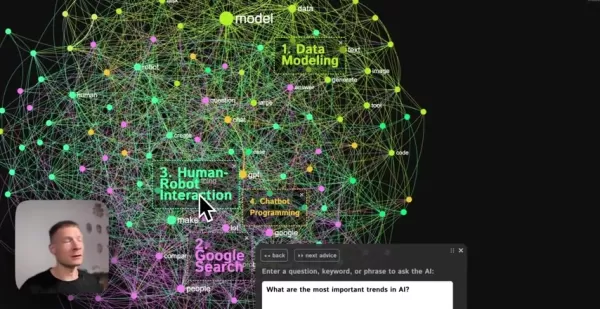
This insight level would be challenging or impossible to achieve through manual analysis alone. Additionally, combining AI and knowledge graphs can improve video recommendation quality. By understanding video content and user interests, AI can provide more relevant, personalized recommendations. This helps users discover new videos they might otherwise miss, expanding their knowledge and perspectives. The synergy between AI and knowledge graphs represents a major advancement in how we interact with and learn from YouTube videos. By combining AI intelligence with knowledge graph structure and visualization, we can unlock new levels of insight, engagement, and learning.
Practical Applications and Real-World Examples
AI-Powered Education and Training
One of the most promising applications of AI and knowledge graphs is in education and training. By leveraging these technologies, educators can create more engaging and effective learning experiences for all age groups. For example, AI-powered tutoring systems can provide personalized feedback and guidance, helping students master complex concepts. Knowledge graphs can visualize relationships between different topics, making it easier for students to understand how everything connects. Additionally, AI can automate many teaching-related administrative tasks like grading assignments and tracking student progress, freeing educators to focus on their primary role: teaching.
Imagine a student struggling with calculus concepts. Instead of relying solely on textbooks and lectures, they can use an AI-powered tutoring system providing personalized feedback and guidance. The system can identify student weaknesses and offer targeted exercises for improvement. Knowledge graphs can visualize relationships between different calculus concepts, helping students understand how everything fits together. This personalized, interactive approach can significantly improve student understanding and performance.
In the corporate world, AI and knowledge graphs can create more effective employee training programs. Companies can use these technologies to develop personalized learning paths tailored to individual employee needs and interests. AI can track employee progress and provide feedback, while knowledge graphs can visualize the company's knowledge base, making it easier for employees to find needed information. This can lead to improved employee performance, increased job satisfaction, and reduced training costs.
For example, a company could use AI and knowledge graphs to train its sales team on latest products and services. The company could develop personalized learning paths for each salesperson based on individual skills and experience. AI could track progress and provide feedback, while knowledge graphs could visualize the product catalog, making it easier for salespeople to find relevant information. This could improve sales performance and increase customer satisfaction.
AI can also create more immersive, engaging learning experiences. For instance, virtual reality (VR) simulations can create realistic training scenarios letting employees practice skills in safe, controlled environments. AI can analyze employee performance in VR simulations and provide feedback for skill improvement. This is particularly useful for training employees in high-risk industries like aviation and healthcare. Overall, AI-powered education and training represents a significant advancement in how we learn and develop skills. By leveraging these technologies, we can create more personalized, interactive, and effective learning experiences that help us achieve our goals.
AI in Business Intelligence and Market Analysis
AI and knowledge graphs are transforming how businesses gather and analyze information, providing valuable insights for strategic decision-making. By leveraging these technologies, companies can gain deeper understanding of customers, markets, and competitors, enabling more informed decisions and competitive advantages.
AI can analyze vast data amounts from various sources like customer surveys, social media, and market research reports. This data can identify trends, patterns, and anomalies difficult or impossible to detect through manual analysis. Knowledge graphs can organize and visualize this information, helping business analysts understand key relationships and dependencies. For example, a company can use AI and knowledge graphs to understand customer satisfaction factors. The company can analyze customer survey data, social media posts, and online reviews to identify key satisfaction drivers. Knowledge graphs can visualize relationships between these drivers, helping the company understand their interactions. This information can then improve products, services, and customer experience.
In market analysis, AI and knowledge graphs can identify emerging trends, assess market opportunities, and track competitor activities. AI can analyze market research reports, news articles, and social media posts to identify key market trends and developments. Knowledge graphs can visualize relationships between these trends, helping companies understand competitive landscapes. This information can then develop new products and services, enter new markets, and adjust business strategies.
For example, a company can use AI and knowledge graphs to assess new market potential. The company can analyze market research reports, news articles, and social media posts to understand key market trends and developments. Knowledge graphs can visualize relationships between these trends, helping the company understand market dynamics. This information can then develop business plans and assess success potential.
AI can also automate many business intelligence and market analysis tasks like data collection, data cleaning, and report generation. This frees business analysts to focus on more strategic activities like data interpretation and recommendation development. Overall, AI in business intelligence and market analysis represents a significant advancement in how companies gather and analyze information. By leveraging these technologies, companies can gain deeper understanding of customers, markets, and competitors, enabling more informed decisions and competitive advantages.
Visualizing Complex Data for Enhanced Understanding
Visualizing complex data is crucial for enhanced understanding, especially with large, intricate datasets. AI and knowledge graphs provide powerful tools for transforming raw data into meaningful visual representations, enabling users to identify patterns, trends, and relationships that might otherwise remain hidden. By leveraging these technologies, users can gain deeper data understanding and make more informed decisions.
One primary benefit of data visualization is easier pattern and trend identification. Humans are naturally visual creatures, better at recognizing patterns in visual representations than analyzing raw numbers. By transforming data into charts, graphs, and other visual formats, we can quickly identify key trends and developments. AI can automate visualization creation, making large dataset analysis easier and faster. For example, AI can automatically generate charts and graphs highlighting most important dataset trends. Knowledge graphs can visualize relationships between different dataset variables, making their interactions easier to understand.
Additionally, data visualization helps identify anomalies and outliers. These data points significantly deviate from the norm and often provide valuable insights. By visualizing data, we can quickly spot these anomalies and investigate further. AI can automatically detect dataset anomalies, making potential problem or opportunity identification easier. For example, AI can detect fraudulent transactions, identify network intrusions, or predict equipment failures.
Data visualization also simplifies communicating complex information to others. Charts and graphs are more effective than raw numbers for conveying information to non-technical audiences. By creating clear, concise visualizations, we can make it easier for others to understand data and make informed decisions. Knowledge graphs can visualize relationships between different concepts, making complex ideas easier to understand. For example, a knowledge graph can visualize relationships between scientific concepts, helping students understand subject matter. Overall, visualizing complex data is essential for enhanced understanding. By leveraging AI and knowledge graphs, we can transform raw data into meaningful visual representations, enabling us to identify patterns, trends, and relationships that might otherwise remain hidden. This can lead to improved decision-making, increased efficiency, and deeper understanding of our world.
Step-by-Step Guide to Using AI and Knowledge Graphs with YouTube
Step 1: Choosing the Right Tools
The first step in leveraging AI and knowledge graphs with YouTube is selecting appropriate tools. Several software platforms and APIs can help extract, analyze, and visualize video content. Consider these options:
- InfraNodus: Infranodus visualizes text data as network graphs. It can analyze YouTube video content by transcribing audio and creating knowledge graphs of main topics and relationships.
- Google Cloud Video Intelligence API: This API uses machine learning to extract video content insights, including object and face detection, speech transcription, and content categorization.
- IBM Watson Natural Language Understanding: This service uses natural language processing (NLP) to analyze text data and extract key concepts, entities, and relationships. It can analyze YouTube video transcripts and create knowledge graphs.
- Neo4j: This graph database management system stores and queries knowledge graphs. It provides a powerful, flexible platform for managing complex entity relationships.
When choosing tools, consider your specific needs and technical expertise. Some tools are more user-friendly, while others offer advanced features and customization options. Also consider tool costs, as some platforms charge per use or offer subscription-based pricing. To decide which tool to use, please consider the features listed in the table below.
Tool Description Features InfraNodus A text network analysis tool that visualizes text data as network graphs. - Text transcription, Knowledge graph creation, Topic and relationship identification. Google Cloud Video Intelligence Uses machine learning to extract video content insights. - Object and face detection, Speech transcription, Content categorization. IBM Watson NLU Uses natural language processing (NLP) to analyze text data and extract key concepts, entities, and relationships. - Key concept extraction, Entity recognition, Relationship identification. Neo4j A graph database management system for storing and querying knowledge graphs. - Knowledge graph storage, Complex relationship querying, Flexible management platform.
Pricing Structures of AI and Knowledge Graph Tools
Understanding the Costs Involved
When implementing AI and knowledge graph technologies for YouTube content analysis, understanding various tool pricing structures is essential for budget planning and resource allocation. Here are common pricing models:
- Subscription-Based Pricing: Many AI and knowledge graph platforms offer subscription plans providing service access for recurring fees, typically monthly or annually. These plans often include usage limits like API call numbers or processed data amounts. Subscription-based pricing can be cost-effective for consistent, predictable usage.
- Usage-Based Pricing: Some tools charge based on actual usage, like analyzed video numbers, processed data amounts, or made API calls. Usage-based pricing benefits occasional or variable usage since you only pay for what you use. However, closely monitor usage to avoid unexpected costs.
- Freemium Models: Certain platforms offer freemium models providing limited features and free usage, with paid plan upgrades for advanced capabilities and higher usage limits. Freemium models are good starting points for exploring tools and assessing suitability.
- Custom Pricing: For enterprise-level deployments or specialized requirements, some vendors offer custom pricing plans tailored to organizational needs. Custom pricing may involve negotiating features, usage limits, and support levels to align with your budget and objectives.
Carefully evaluate different tool pricing structures and compare them based on expected usage patterns and budget constraints. Also consider factors like data storage costs, API access, and technical support when deciding.
Advantages and Disadvantages of Using AI and Knowledge Graphs
Pros
Enhanced Understanding of Video Content
Improved Information Retrieval and Search
Automated Data Analysis and Insights
Personalized Learning and Recommendations
Identification of Trends and Patterns
Cons
Complexity of Implementation
High Cost of Some Tools
Data Privacy Concerns
Risk of Bias in AI Algorithms
Dependence on Data Quality
Key Features to Look for in AI and Knowledge Graph Tools
Essential Capabilities for Effective Analysis
When selecting AI and knowledge graph tools for YouTube content analysis, consider key features enabling effective analysis and insights. Here are essential capabilities:
- Natural Language Processing (NLP): NLP capabilities are crucial for extracting meaningful information from video transcripts and other textual data. Look for tools offering advanced NLP features like sentiment analysis, topic extraction, entity recognition, and relationship extraction.
- Knowledge Graph Creation: Automatic knowledge graph creation from video content is key. Look for tools identifying key video entities and relationships and organizing them into structured knowledge graphs.
- Data Visualization: Data visualization capabilities are essential for exploring and understanding knowledge graphs. Look for tools offering interactive visualizations like network graphs enabling exploration of entity relationships.
- Customization Options: Customization options are important for tailoring analysis to specific needs. Look for tools allowing knowledge graph customization, data filtering, and additional information or annotation additions.
- Integration with YouTube API: Seamless YouTube API integration is essential for accessing video content and metadata. Look for tools providing easy YouTube video access and enabling analysis without manual downloading or data entry.
- Scalability and Performance: Scalability and performance are important for analyzing large video collections. Look for tools handling large datasets and providing fast, efficient analysis.
By considering these key features, you can select AI and knowledge graph tools enabling valuable YouTube content insight extraction and more informed decisions.
Diverse Applications of AI and Knowledge Graphs with YouTube
Unlocking Potential Across Various Domains
Combining AI and knowledge graphs with YouTube opens numerous use cases across various domains. Here are examples:
- Market Research: Companies can use AI and knowledge graphs to analyze YouTube videos and understand customer preferences, identify emerging trends, and track competitor activities. This information can develop new products, improve marketing strategies, and gain competitive advantages.
- Education: Educators can use AI and knowledge graphs to create more engaging, effective student learning experiences. They can analyze educational videos, create knowledge graphs of key concepts, and provide personalized student feedback.
- Journalism: Journalists can use AI and knowledge graphs to analyze YouTube videos and uncover hidden stories, identify key sources, and verify information. This can help produce more accurate, insightful news reports.
- Healthcare: Healthcare professionals can use AI and knowledge graphs to analyze YouTube videos and stay updated on latest medical research, identify emerging treatments, and improve patient care. This can help provide more effective, evidence-based care.
- Entertainment: Content creators can use AI and knowledge graphs to analyze YouTube videos and understand audience preferences, identify popular topics, and optimize content for maximum engagement. This can help create more successful videos and grow audiences.
These are just some ways AI and knowledge graphs can be used with YouTube. As AI technology evolves, we can expect more innovative, transformative use cases to emerge.
Frequently Asked Questions
What are the key benefits of using AI with YouTube content?
AI enhances YouTube content analysis by automating data extraction, providing sentiment analysis, and identifying trends. It improves search accuracy, personalizes recommendations, and helps content creators optimize videos for better engagement. AI capabilities significantly reduce manual effort while offering deeper insights into viewer behavior and content performance.
How do knowledge graphs improve video content understanding?
Knowledge graphs organize video content into structured, interconnected networks that visually represent relationships between topics, entities, and keywords. This structure helps users quickly grasp complex subjects, identify key themes, and explore related content, improving comprehension and retention. Knowledge graphs transform passive viewing into interactive learning experiences.
Can AI and knowledge graphs help in market research using YouTube videos?
Yes, AI and knowledge graphs can transform market research using YouTube videos by providing insights into consumer preferences, identifying emerging trends, and tracking competitor activities. AI tools analyze video content, comments, and metadata to extract valuable market data. Knowledge graphs organize this information, making it easier to visualize market landscapes and identify innovation and growth opportunities.
What types of AI tools are best suited for YouTube video analysis?
The best AI tools for YouTube video analysis include those with natural language processing (NLP), machine learning (ML), and computer vision capabilities. NLP tools extract text and sentiment, ML algorithms identify patterns and trends, and computer vision tools recognize objects and faces within videos. These tools work together to provide comprehensive YouTube video content analysis.
How can educators use AI and knowledge graphs to enhance learning?
Educators can use AI and knowledge graphs to personalize learning experiences, automate grading, and create interactive study materials. AI tools can analyze student performance data to identify areas needing improvement, while knowledge graphs visually represent course content, helping students understand complex relationships. This integration transforms traditional teaching methods into dynamic, adaptive learning environments.
Related Questions
How can I leverage AI to improve my YouTube channel's SEO?
To leverage AI for enhancing your YouTube channel's SEO, start by using AI-powered tools to analyze your video content and identify relevant keywords. These tools can evaluate your video titles, descriptions, tags, and even spoken content to suggest keywords likely to improve search rankings. Additionally, AI can help understand viewer behavior by analyzing metrics like watch time, audience retention, and engagement. By understanding what resonates with your audience, you can optimize content strategy to create more engaging videos that attract and retain viewers. Moreover, AI can assist in creating compelling video descriptions and titles that are both informative and search-engine optimized. By incorporating relevant keywords and phrases, you can increase video visibility and attract more organic traffic. Furthermore, AI can help identify trending topics and themes within your niche, allowing you to create timely, target-audience-relevant content. By staying ahead of the curve and creating videos addressing current interests and needs, you can increase channel visibility and attract new subscribers. Beyond keyword optimization and content strategy, AI can also improve overall video quality. AI-powered editing tools can automatically enhance video and audio quality, remove background noise, and improve viewing experiences. By investing in high-quality video production, you can increase viewer engagement and improve channel reputation. Moreover, AI can assist in creating eye-catching thumbnails that attract viewer attention and encourage clicks. Using AI-powered design tools, you can create visually appealing, informative, search-engine-optimized thumbnails. Furthermore, AI can help promote videos on other social media platforms by automatically generating engaging captions and descriptions tailored to each platform. By cross-promoting videos on multiple channels, you can increase visibility and attract wider audiences. In summary, leveraging AI for YouTube SEO involves a multifaceted approach encompassing keyword optimization, content strategy, video quality, thumbnail design, and social media promotion. By embracing these AI-powered tools and techniques, you can significantly improve channel visibility, attract more viewers, and grow your audience. AI use ensures your content is not only relevant and engaging but also search-engine optimized, maximizing its potential to reach wider audiences. Incorporating AI into your YouTube strategy is no longer a luxury but a necessity for staying competitive in today's crowded online landscape. The ability to quickly analyze data, identify trends, and optimize content is crucial for attracting and retaining viewers, and AI provides the tools and insights needed to achieve these goals effectively.
Related article
 Anthropic Expands Claude AI Coding Tools to Japan in Push for Overseas Growth
Anthropic, a prominent U.S. artificial intelligence firm, is intensifying its global outreach. On Wednesday, the company hosted a major developer gathering, "Code with Claude," in Tokyo, drawing close to 500 software engineers. This initiative seeks
India’s Software Giant Cuts Hiring, Promises No Layoffs as AI Agents Scale Up
As artificial intelligence reshapes traditional labor-intensive business models, Tata Consultancy Services (TCS), a premier Indian software outsourcing firm, has unveiled its strategic response. During Tuesday’s annual general meeting, the chairman o
China Locks AI Models During Gaokam to Block Instant Homework Help
With the 2026 Gaokao fast approaching, rumors regarding the suspension of AI tools during the exam period have ignited intense online debate. In response to public concern, major AI platforms and educational apps have clarified their stance: rather t
Related Special Topic Recommendations
Design & Art
Anthropic Expands Claude AI Coding Tools to Japan in Push for Overseas Growth
Anthropic, a prominent U.S. artificial intelligence firm, is intensifying its global outreach. On Wednesday, the company hosted a major developer gathering, "Code with Claude," in Tokyo, drawing close to 500 software engineers. This initiative seeks
India’s Software Giant Cuts Hiring, Promises No Layoffs as AI Agents Scale Up
As artificial intelligence reshapes traditional labor-intensive business models, Tata Consultancy Services (TCS), a premier Indian software outsourcing firm, has unveiled its strategic response. During Tuesday’s annual general meeting, the chairman o
China Locks AI Models During Gaokam to Block Instant Homework Help
With the 2026 Gaokao fast approaching, rumors regarding the suspension of AI tools during the exam period have ignited intense online debate. In response to public concern, major AI platforms and educational apps have clarified their stance: rather t
Related Special Topic Recommendations
Design & Art
 Best AI Style Transfer Tools for Creative Experiments
2026 Latest Best Top-rated AI Style Transfer Tools for Creative Experiments! XIX.AI has curated a powerful, game-changing collection of must-try tools that deliver exceptional results through real-world tests and rigorous rankings. These top solutions help creatives boost productivity significantly by accelerating content creation and unlocking endless creative possibilities. Explore now to discover your perfect tool and start creating today!
 9 tools
 xix.ai
Comic Creation
Best AI Dialogue Bubble Tools for Visual Storytelling
xix.ai
Comic Creation
Best AI Dialogue Bubble Tools for Visual Storytelling
2026 Latest Best Top-Rated AI Dialogue Bubble Tools for Visual Storytelling are here on XIX.AI! This curated collection features powerful, game-changing tools that help creators boost productivity and overcome creative bottlenecks. Get a free vs paid comparison, see real-world tests, and check the latest rankings to find the must-try solutions perfect for crafting engaging visual narratives. Explore now to discover your ideal tool!
10 tools
xix.ai
Meeting Assistant
Top AI Meeting Summary Tools: Track Decisions and Follow-Ups Clearly
2026 Latest Top-Rated Best AI Meeting Summary Tools for Clear Decision Tracking and Effortless Follow-Ups. This curated list showcases powerful, game-changing solutions that boost productivity dramatically by automating meeting notes, identifying key action items, and streamlining team coordination across all projects. Get a free vs paid comparison along with real-world tests and weekly updated rankings to help you find the perfect tool. Explore now to unlock your AI edge!
9 tools
xix.ai
Data Analysis
Best AI Data Cleaning Tools: Fix Missing Values and Duplicates Fast
2026 Latest Best Top-rated AI Data Cleaning Tools for quick fixing of missing values and duplicates. This curated list showcases powerful, game-changing solutions that boost productivity significantly. Each option has undergone rigorous real-world tests to ensure reliability. Get a free vs paid comparison and discover the must-try tool that fits your needs best. Explore now at XIX.AI to Unlock your AI edge.
11 tools
xix.ai
Design & Art
Best AI Creative Ideation Tools for Artists: Break Through Visual Blocks
2026 Latest Best Top-Rated AI Creative Ideation Tools for Artists are curated by XIX.AI to help creators break through visual blocks and boost creativity instantly. These powerful game-changing tools offer real-world tests, detailed free vs paid comparison, and weekly updated rankings. Discover your perfect tool to accelerate content creation and unlock your AI edge today. Explore now!
14 tools
xix.ai
Music composition
AI Beat Makers for TikTok Background Tracks, Reels Audio, and Creator Promo Music
2026 Latest Best AI Beat Makers for TikTok Background Tracks, Reels Audio, and Creator Promo Music! XIX.AI has curated a top-rated list of powerful game-changing tools that go through real-world tests to deliver flawless music for every content need. You’ll find detailed free vs paid comparison data, weekly updated rankings, and must-try options to help you boost creativity and productivity. Explore now to discover your perfect tool!
11 tools
xix.ai

 Comments (0)
0/500
Comments (0)
0/500
In today's digital landscape, gaining valuable insights from video content is essential for staying informed and competitive. This article examines how to effectively use the combined power of Artificial Intelligence (AI) and knowledge graphs to interact with and visualize YouTube video content. We'll explore practical tools and methods that enable you to not only comprehend video material but also engage with it in a more interactive and meaningful way. From spotting AI trends to visualizing intricate data relationships, this guide offers a thorough look at maximizing the potential of YouTube's extensive information repository.
Key Points
Leveraging AI to examine and engage with YouTube video material.
Using knowledge graphs to visualize video content for clearer comprehension.
Investigating the fusion of AI and knowledge graphs to boost learning outcomes.
Employing advanced tools to extract meaningful insights from YouTube videos.
Applying these methods to the AI field to remain current with industry developments.
Unlocking YouTube Insights with AI and Knowledge Graphs
What is AI-Powered YouTube Interaction?
AI-powered YouTube interaction refers to using artificial intelligence technologies to examine, interpret, and engage with video content on the YouTube platform. This extends beyond passive viewing, involving AI algorithms to extract valuable information, pinpoint key themes, and illustrate connections between different concepts presented in videos. By integrating AI, users can pose specific questions about video content and receive contextual answers, substantially enhancing learning and research processes. This makes grasping complex subjects and keeping up with current trends more accessible. For example, AI can rapidly identify prominent trends in AI research discussed across multiple YouTube videos, saving substantial time compared to manual review.
The foundation of this technology lies in its capacity to process and comprehend natural language, extract pertinent data, and generate visual information representations. AI algorithms can transcribe spoken content, assess expressed sentiments, and recognize key entities and relationships within videos. This data is then structured into a Knowledge Graph, enabling users to explore content in an organized, interactive format.
Additionally, AI can personalize the learning experience. By monitoring user interactions and preferences, the system can suggest relevant videos and highlight the most applicable information. This tailored approach ensures users quickly find content matching their interests and requirements. Overall, AI-powered YouTube interaction marks a significant evolution in how we consume and interact with online video content, making it a potent resource for learning, research, and staying informed.
Combining AI with platforms like YouTube creates tremendous potential for education and professional growth. Consider a student researching a complex topic like quantum physics. Instead of manually reviewing hours of video lectures and documentaries, they can use AI-powered tools to swiftly identify core concepts, understand connections between different theories, and even ask specific questions to clarify their understanding. Similarly, professionals can utilize these tools to stay current with field developments, spot emerging trends, and gain insights from global experts. The possible applications are nearly limitless, and as AI technology advances, we can anticipate even more sophisticated tools for video content interaction.
The Role of Knowledge Graphs in Visualizing Video Content
Knowledge graphs are instrumental in visualizing and understanding YouTube video content. A knowledge graph is a structured information representation consisting of entities (such as concepts, people, or objects) and their interrelationships. When applied to video content, knowledge graphs help organize and illustrate key themes, ideas, and connections discussed in the video. This structured approach lets users quickly grasp main points and explore content more intuitively.
Creating a knowledge graph from a YouTube video reveals how different concepts interrelate. For instance, in an AI-focused video, a knowledge graph might display connections between machine learning, neural networks, and data modeling. This visual representation simplifies understanding complex relationships and dependencies within the subject matter.
Furthermore, knowledge graphs can identify the most significant or central themes in a video. By analyzing the graph's structure, it's possible to determine which entities and relationships are most frequently mentioned or interconnected. This helps users quickly focus on core topics while avoiding excessive detail.
Moreover, knowledge graphs enable a more interactive, exploratory learning approach. Instead of passively watching videos, users can actively navigate the knowledge graph, clicking different entities and relationships to learn more. This interactive method fosters curiosity and deeper content engagement. AI integration can offer real-time guidance and suggestions, helping users navigate the knowledge graph and uncover new insights.
The knowledge graph creation process typically involves multiple steps. First, video content is transcribed and analyzed using natural language processing (NLP) techniques to identify key entities, concepts, and relationships. Next, this information constructs the knowledge graph, with entities as nodes and relationships as edges. Finally, specialized software or tools visualize the knowledge graph, allowing user exploration and interaction. A key benefit of knowledge graphs is customizable visualization to suit different needs and preferences. Users can filter graphs to focus on specific topics or relationships, modify layouts to highlight various content aspects, and add extra information or annotations. This customization makes knowledge graphs powerful learning, research, and analysis tools.
Knowledge graphs are particularly valuable for analyzing large video collections. Combining knowledge graphs from multiple videos reveals trends, patterns, and inconsistencies across different sources. This benefits researchers, analysts, and anyone needing to make sense of substantial information volumes. In summary, knowledge graphs provide a robust method for visualizing and understanding YouTube video content. By organizing and structuring information in graph format, they simplify grasping complex concepts, exploring relationships, and identifying key themes, making them indispensable for learning, research, and analysis.
Benefits of Combining AI and Knowledge Graphs
Combining AI and knowledge graphs offers multiple advantages for enhancing the YouTube experience. AI provides the intelligence to analyze and understand video content, while knowledge graphs provide the structure and visualization to make that content accessible and comprehensible. Together, they create a powerful synergy that transforms how users interact with and learn from YouTube videos.
One primary benefit is improved information retrieval. AI can quickly identify key concepts and themes discussed in videos, while knowledge graphs organize this information structurally. This helps users find specific information faster, saving time and effort. For example, if a user wants to learn about a particular AI aspect like neural networks, they can use AI-powered search to quickly locate relevant videos, then explore knowledge graphs to understand key concepts and relationships.
Another advantage is enhanced learning. Knowledge graphs provide visual content representations, making complex concepts and relationships easier to grasp. AI can supply additional context and explanations, helping users deepen their understanding. This is especially useful for students and professionals needing to learn new topics quickly and effectively.
Furthermore, combining AI and knowledge graphs enables more interactive, engaging learning experiences. Users can actively explore knowledge graphs, ask questions, and receive personalized feedback. This interactive approach encourages curiosity and deeper content engagement, creating a more immersive and effective learning experience compared to passive video watching. Another significant benefit is identifying trends and patterns across multiple videos. By analyzing knowledge graphs from video collections, AI can detect common themes, emerging trends, and cross-source inconsistencies. This is valuable for researchers, analysts, and anyone needing to stay current with field developments.
For example, one can observe trends in Data Modeling, Human-Robot Interaction, and Chatbot Programming.
This insight level would be challenging or impossible to achieve through manual analysis alone. Additionally, combining AI and knowledge graphs can improve video recommendation quality. By understanding video content and user interests, AI can provide more relevant, personalized recommendations. This helps users discover new videos they might otherwise miss, expanding their knowledge and perspectives. The synergy between AI and knowledge graphs represents a major advancement in how we interact with and learn from YouTube videos. By combining AI intelligence with knowledge graph structure and visualization, we can unlock new levels of insight, engagement, and learning.
Practical Applications and Real-World Examples
AI-Powered Education and Training
One of the most promising applications of AI and knowledge graphs is in education and training. By leveraging these technologies, educators can create more engaging and effective learning experiences for all age groups. For example, AI-powered tutoring systems can provide personalized feedback and guidance, helping students master complex concepts. Knowledge graphs can visualize relationships between different topics, making it easier for students to understand how everything connects. Additionally, AI can automate many teaching-related administrative tasks like grading assignments and tracking student progress, freeing educators to focus on their primary role: teaching.
Imagine a student struggling with calculus concepts. Instead of relying solely on textbooks and lectures, they can use an AI-powered tutoring system providing personalized feedback and guidance. The system can identify student weaknesses and offer targeted exercises for improvement. Knowledge graphs can visualize relationships between different calculus concepts, helping students understand how everything fits together. This personalized, interactive approach can significantly improve student understanding and performance.
In the corporate world, AI and knowledge graphs can create more effective employee training programs. Companies can use these technologies to develop personalized learning paths tailored to individual employee needs and interests. AI can track employee progress and provide feedback, while knowledge graphs can visualize the company's knowledge base, making it easier for employees to find needed information. This can lead to improved employee performance, increased job satisfaction, and reduced training costs.
For example, a company could use AI and knowledge graphs to train its sales team on latest products and services. The company could develop personalized learning paths for each salesperson based on individual skills and experience. AI could track progress and provide feedback, while knowledge graphs could visualize the product catalog, making it easier for salespeople to find relevant information. This could improve sales performance and increase customer satisfaction.
AI can also create more immersive, engaging learning experiences. For instance, virtual reality (VR) simulations can create realistic training scenarios letting employees practice skills in safe, controlled environments. AI can analyze employee performance in VR simulations and provide feedback for skill improvement. This is particularly useful for training employees in high-risk industries like aviation and healthcare. Overall, AI-powered education and training represents a significant advancement in how we learn and develop skills. By leveraging these technologies, we can create more personalized, interactive, and effective learning experiences that help us achieve our goals.
AI in Business Intelligence and Market Analysis
AI and knowledge graphs are transforming how businesses gather and analyze information, providing valuable insights for strategic decision-making. By leveraging these technologies, companies can gain deeper understanding of customers, markets, and competitors, enabling more informed decisions and competitive advantages.
AI can analyze vast data amounts from various sources like customer surveys, social media, and market research reports. This data can identify trends, patterns, and anomalies difficult or impossible to detect through manual analysis. Knowledge graphs can organize and visualize this information, helping business analysts understand key relationships and dependencies. For example, a company can use AI and knowledge graphs to understand customer satisfaction factors. The company can analyze customer survey data, social media posts, and online reviews to identify key satisfaction drivers. Knowledge graphs can visualize relationships between these drivers, helping the company understand their interactions. This information can then improve products, services, and customer experience.
In market analysis, AI and knowledge graphs can identify emerging trends, assess market opportunities, and track competitor activities. AI can analyze market research reports, news articles, and social media posts to identify key market trends and developments. Knowledge graphs can visualize relationships between these trends, helping companies understand competitive landscapes. This information can then develop new products and services, enter new markets, and adjust business strategies.
For example, a company can use AI and knowledge graphs to assess new market potential. The company can analyze market research reports, news articles, and social media posts to understand key market trends and developments. Knowledge graphs can visualize relationships between these trends, helping the company understand market dynamics. This information can then develop business plans and assess success potential.
AI can also automate many business intelligence and market analysis tasks like data collection, data cleaning, and report generation. This frees business analysts to focus on more strategic activities like data interpretation and recommendation development. Overall, AI in business intelligence and market analysis represents a significant advancement in how companies gather and analyze information. By leveraging these technologies, companies can gain deeper understanding of customers, markets, and competitors, enabling more informed decisions and competitive advantages.
Visualizing Complex Data for Enhanced Understanding
Visualizing complex data is crucial for enhanced understanding, especially with large, intricate datasets. AI and knowledge graphs provide powerful tools for transforming raw data into meaningful visual representations, enabling users to identify patterns, trends, and relationships that might otherwise remain hidden. By leveraging these technologies, users can gain deeper data understanding and make more informed decisions.
One primary benefit of data visualization is easier pattern and trend identification. Humans are naturally visual creatures, better at recognizing patterns in visual representations than analyzing raw numbers. By transforming data into charts, graphs, and other visual formats, we can quickly identify key trends and developments. AI can automate visualization creation, making large dataset analysis easier and faster. For example, AI can automatically generate charts and graphs highlighting most important dataset trends. Knowledge graphs can visualize relationships between different dataset variables, making their interactions easier to understand.
Additionally, data visualization helps identify anomalies and outliers. These data points significantly deviate from the norm and often provide valuable insights. By visualizing data, we can quickly spot these anomalies and investigate further. AI can automatically detect dataset anomalies, making potential problem or opportunity identification easier. For example, AI can detect fraudulent transactions, identify network intrusions, or predict equipment failures.
Data visualization also simplifies communicating complex information to others. Charts and graphs are more effective than raw numbers for conveying information to non-technical audiences. By creating clear, concise visualizations, we can make it easier for others to understand data and make informed decisions. Knowledge graphs can visualize relationships between different concepts, making complex ideas easier to understand. For example, a knowledge graph can visualize relationships between scientific concepts, helping students understand subject matter. Overall, visualizing complex data is essential for enhanced understanding. By leveraging AI and knowledge graphs, we can transform raw data into meaningful visual representations, enabling us to identify patterns, trends, and relationships that might otherwise remain hidden. This can lead to improved decision-making, increased efficiency, and deeper understanding of our world.
Step-by-Step Guide to Using AI and Knowledge Graphs with YouTube
Step 1: Choosing the Right Tools
The first step in leveraging AI and knowledge graphs with YouTube is selecting appropriate tools. Several software platforms and APIs can help extract, analyze, and visualize video content. Consider these options:
- InfraNodus: Infranodus visualizes text data as network graphs. It can analyze YouTube video content by transcribing audio and creating knowledge graphs of main topics and relationships.
- Google Cloud Video Intelligence API: This API uses machine learning to extract video content insights, including object and face detection, speech transcription, and content categorization.
- IBM Watson Natural Language Understanding: This service uses natural language processing (NLP) to analyze text data and extract key concepts, entities, and relationships. It can analyze YouTube video transcripts and create knowledge graphs.
- Neo4j: This graph database management system stores and queries knowledge graphs. It provides a powerful, flexible platform for managing complex entity relationships.
When choosing tools, consider your specific needs and technical expertise. Some tools are more user-friendly, while others offer advanced features and customization options. Also consider tool costs, as some platforms charge per use or offer subscription-based pricing. To decide which tool to use, please consider the features listed in the table below.
| Tool | Description | Features |
|---|---|---|
| InfraNodus | A text network analysis tool that visualizes text data as network graphs. | - Text transcription, Knowledge graph creation, Topic and relationship identification. |
| Google Cloud Video Intelligence | Uses machine learning to extract video content insights. | - Object and face detection, Speech transcription, Content categorization. |
| IBM Watson NLU | Uses natural language processing (NLP) to analyze text data and extract key concepts, entities, and relationships. | - Key concept extraction, Entity recognition, Relationship identification. |
| Neo4j | A graph database management system for storing and querying knowledge graphs. | - Knowledge graph storage, Complex relationship querying, Flexible management platform. |
Pricing Structures of AI and Knowledge Graph Tools
Understanding the Costs Involved
When implementing AI and knowledge graph technologies for YouTube content analysis, understanding various tool pricing structures is essential for budget planning and resource allocation. Here are common pricing models:
- Subscription-Based Pricing: Many AI and knowledge graph platforms offer subscription plans providing service access for recurring fees, typically monthly or annually. These plans often include usage limits like API call numbers or processed data amounts. Subscription-based pricing can be cost-effective for consistent, predictable usage.
- Usage-Based Pricing: Some tools charge based on actual usage, like analyzed video numbers, processed data amounts, or made API calls. Usage-based pricing benefits occasional or variable usage since you only pay for what you use. However, closely monitor usage to avoid unexpected costs.
- Freemium Models: Certain platforms offer freemium models providing limited features and free usage, with paid plan upgrades for advanced capabilities and higher usage limits. Freemium models are good starting points for exploring tools and assessing suitability.
- Custom Pricing: For enterprise-level deployments or specialized requirements, some vendors offer custom pricing plans tailored to organizational needs. Custom pricing may involve negotiating features, usage limits, and support levels to align with your budget and objectives.
Carefully evaluate different tool pricing structures and compare them based on expected usage patterns and budget constraints. Also consider factors like data storage costs, API access, and technical support when deciding.
Advantages and Disadvantages of Using AI and Knowledge Graphs
Pros
Enhanced Understanding of Video Content
Improved Information Retrieval and Search
Automated Data Analysis and Insights
Personalized Learning and Recommendations
Identification of Trends and Patterns
Cons
Complexity of Implementation
High Cost of Some Tools
Data Privacy Concerns
Risk of Bias in AI Algorithms
Dependence on Data Quality
Key Features to Look for in AI and Knowledge Graph Tools
Essential Capabilities for Effective Analysis
When selecting AI and knowledge graph tools for YouTube content analysis, consider key features enabling effective analysis and insights. Here are essential capabilities:
- Natural Language Processing (NLP): NLP capabilities are crucial for extracting meaningful information from video transcripts and other textual data. Look for tools offering advanced NLP features like sentiment analysis, topic extraction, entity recognition, and relationship extraction.
- Knowledge Graph Creation: Automatic knowledge graph creation from video content is key. Look for tools identifying key video entities and relationships and organizing them into structured knowledge graphs.
- Data Visualization: Data visualization capabilities are essential for exploring and understanding knowledge graphs. Look for tools offering interactive visualizations like network graphs enabling exploration of entity relationships.
- Customization Options: Customization options are important for tailoring analysis to specific needs. Look for tools allowing knowledge graph customization, data filtering, and additional information or annotation additions.
- Integration with YouTube API: Seamless YouTube API integration is essential for accessing video content and metadata. Look for tools providing easy YouTube video access and enabling analysis without manual downloading or data entry.
- Scalability and Performance: Scalability and performance are important for analyzing large video collections. Look for tools handling large datasets and providing fast, efficient analysis.
By considering these key features, you can select AI and knowledge graph tools enabling valuable YouTube content insight extraction and more informed decisions.
Diverse Applications of AI and Knowledge Graphs with YouTube
Unlocking Potential Across Various Domains
Combining AI and knowledge graphs with YouTube opens numerous use cases across various domains. Here are examples:
- Market Research: Companies can use AI and knowledge graphs to analyze YouTube videos and understand customer preferences, identify emerging trends, and track competitor activities. This information can develop new products, improve marketing strategies, and gain competitive advantages.
- Education: Educators can use AI and knowledge graphs to create more engaging, effective student learning experiences. They can analyze educational videos, create knowledge graphs of key concepts, and provide personalized student feedback.
- Journalism: Journalists can use AI and knowledge graphs to analyze YouTube videos and uncover hidden stories, identify key sources, and verify information. This can help produce more accurate, insightful news reports.
- Healthcare: Healthcare professionals can use AI and knowledge graphs to analyze YouTube videos and stay updated on latest medical research, identify emerging treatments, and improve patient care. This can help provide more effective, evidence-based care.
- Entertainment: Content creators can use AI and knowledge graphs to analyze YouTube videos and understand audience preferences, identify popular topics, and optimize content for maximum engagement. This can help create more successful videos and grow audiences.
These are just some ways AI and knowledge graphs can be used with YouTube. As AI technology evolves, we can expect more innovative, transformative use cases to emerge.
Frequently Asked Questions
What are the key benefits of using AI with YouTube content?
AI enhances YouTube content analysis by automating data extraction, providing sentiment analysis, and identifying trends. It improves search accuracy, personalizes recommendations, and helps content creators optimize videos for better engagement. AI capabilities significantly reduce manual effort while offering deeper insights into viewer behavior and content performance.
How do knowledge graphs improve video content understanding?
Knowledge graphs organize video content into structured, interconnected networks that visually represent relationships between topics, entities, and keywords. This structure helps users quickly grasp complex subjects, identify key themes, and explore related content, improving comprehension and retention. Knowledge graphs transform passive viewing into interactive learning experiences.
Can AI and knowledge graphs help in market research using YouTube videos?
Yes, AI and knowledge graphs can transform market research using YouTube videos by providing insights into consumer preferences, identifying emerging trends, and tracking competitor activities. AI tools analyze video content, comments, and metadata to extract valuable market data. Knowledge graphs organize this information, making it easier to visualize market landscapes and identify innovation and growth opportunities.
What types of AI tools are best suited for YouTube video analysis?
The best AI tools for YouTube video analysis include those with natural language processing (NLP), machine learning (ML), and computer vision capabilities. NLP tools extract text and sentiment, ML algorithms identify patterns and trends, and computer vision tools recognize objects and faces within videos. These tools work together to provide comprehensive YouTube video content analysis.
How can educators use AI and knowledge graphs to enhance learning?
Educators can use AI and knowledge graphs to personalize learning experiences, automate grading, and create interactive study materials. AI tools can analyze student performance data to identify areas needing improvement, while knowledge graphs visually represent course content, helping students understand complex relationships. This integration transforms traditional teaching methods into dynamic, adaptive learning environments.
Related Questions
How can I leverage AI to improve my YouTube channel's SEO?
To leverage AI for enhancing your YouTube channel's SEO, start by using AI-powered tools to analyze your video content and identify relevant keywords. These tools can evaluate your video titles, descriptions, tags, and even spoken content to suggest keywords likely to improve search rankings. Additionally, AI can help understand viewer behavior by analyzing metrics like watch time, audience retention, and engagement. By understanding what resonates with your audience, you can optimize content strategy to create more engaging videos that attract and retain viewers. Moreover, AI can assist in creating compelling video descriptions and titles that are both informative and search-engine optimized. By incorporating relevant keywords and phrases, you can increase video visibility and attract more organic traffic. Furthermore, AI can help identify trending topics and themes within your niche, allowing you to create timely, target-audience-relevant content. By staying ahead of the curve and creating videos addressing current interests and needs, you can increase channel visibility and attract new subscribers. Beyond keyword optimization and content strategy, AI can also improve overall video quality. AI-powered editing tools can automatically enhance video and audio quality, remove background noise, and improve viewing experiences. By investing in high-quality video production, you can increase viewer engagement and improve channel reputation. Moreover, AI can assist in creating eye-catching thumbnails that attract viewer attention and encourage clicks. Using AI-powered design tools, you can create visually appealing, informative, search-engine-optimized thumbnails. Furthermore, AI can help promote videos on other social media platforms by automatically generating engaging captions and descriptions tailored to each platform. By cross-promoting videos on multiple channels, you can increase visibility and attract wider audiences. In summary, leveraging AI for YouTube SEO involves a multifaceted approach encompassing keyword optimization, content strategy, video quality, thumbnail design, and social media promotion. By embracing these AI-powered tools and techniques, you can significantly improve channel visibility, attract more viewers, and grow your audience. AI use ensures your content is not only relevant and engaging but also search-engine optimized, maximizing its potential to reach wider audiences. Incorporating AI into your YouTube strategy is no longer a luxury but a necessity for staying competitive in today's crowded online landscape. The ability to quickly analyze data, identify trends, and optimize content is crucial for attracting and retaining viewers, and AI provides the tools and insights needed to achieve these goals effectively.








 Anthropic Expands Claude AI Coding Tools to Japan in Push for Overseas Growth
Anthropic, a prominent U.S. artificial intelligence firm, is intensifying its global outreach. On Wednesday, the company hosted a major developer gathering, "Code with Claude," in Tokyo, drawing close to 500 software engineers. This initiative seeks
Anthropic Expands Claude AI Coding Tools to Japan in Push for Overseas Growth
Anthropic, a prominent U.S. artificial intelligence firm, is intensifying its global outreach. On Wednesday, the company hosted a major developer gathering, "Code with Claude," in Tokyo, drawing close to 500 software engineers. This initiative seeks
 India’s Software Giant Cuts Hiring, Promises No Layoffs as AI Agents Scale Up
As artificial intelligence reshapes traditional labor-intensive business models, Tata Consultancy Services (TCS), a premier Indian software outsourcing firm, has unveiled its strategic response. During Tuesday’s annual general meeting, the chairman o
India’s Software Giant Cuts Hiring, Promises No Layoffs as AI Agents Scale Up
As artificial intelligence reshapes traditional labor-intensive business models, Tata Consultancy Services (TCS), a premier Indian software outsourcing firm, has unveiled its strategic response. During Tuesday’s annual general meeting, the chairman o
 China Locks AI Models During Gaokam to Block Instant Homework Help
With the 2026 Gaokao fast approaching, rumors regarding the suspension of AI tools during the exam period have ignited intense online debate. In response to public concern, major AI platforms and educational apps have clarified their stance: rather t
China Locks AI Models During Gaokam to Block Instant Homework Help
With the 2026 Gaokao fast approaching, rumors regarding the suspension of AI tools during the exam period have ignited intense online debate. In response to public concern, major AI platforms and educational apps have clarified their stance: rather t

2026 Latest Best Top-rated AI Style Transfer Tools for Creative Experiments! XIX.AI has curated a powerful, game-changing collection of must-try tools that deliver exceptional results through real-world tests and rigorous rankings. These top solutions help creatives boost productivity significantly by accelerating content creation and unlocking endless creative possibilities. Explore now to discover your perfect tool and start creating today!
9 tools
xix.ai

2026 Latest Best Top-Rated AI Dialogue Bubble Tools for Visual Storytelling are here on XIX.AI! This curated collection features powerful, game-changing tools that help creators boost productivity and overcome creative bottlenecks. Get a free vs paid comparison, see real-world tests, and check the latest rankings to find the must-try solutions perfect for crafting engaging visual narratives. Explore now to discover your ideal tool!
10 tools
xix.ai
2026 Latest Top-Rated Best AI Meeting Summary Tools for Clear Decision Tracking and Effortless Follow-Ups. This curated list showcases powerful, game-changing solutions that boost productivity dramatically by automating meeting notes, identifying key action items, and streamlining team coordination across all projects. Get a free vs paid comparison along with real-world tests and weekly updated rankings to help you find the perfect tool. Explore now to unlock your AI edge!
9 tools
xix.ai

2026 Latest Best Top-rated AI Data Cleaning Tools for quick fixing of missing values and duplicates. This curated list showcases powerful, game-changing solutions that boost productivity significantly. Each option has undergone rigorous real-world tests to ensure reliability. Get a free vs paid comparison and discover the must-try tool that fits your needs best. Explore now at XIX.AI to Unlock your AI edge.
11 tools
xix.ai

2026 Latest Best Top-Rated AI Creative Ideation Tools for Artists are curated by XIX.AI to help creators break through visual blocks and boost creativity instantly. These powerful game-changing tools offer real-world tests, detailed free vs paid comparison, and weekly updated rankings. Discover your perfect tool to accelerate content creation and unlock your AI edge today. Explore now!
14 tools
xix.ai

2026 Latest Best AI Beat Makers for TikTok Background Tracks, Reels Audio, and Creator Promo Music! XIX.AI has curated a top-rated list of powerful game-changing tools that go through real-world tests to deliver flawless music for every content need. You’ll find detailed free vs paid comparison data, weekly updated rankings, and must-try options to help you boost creativity and productivity. Explore now to discover your perfect tool!
11 tools
xix.ai












