


 Home
HomeDeepSeek R1 Open-Source AI Challenges GPT-4 Capabilities
As artificial intelligence continues to advance at breakneck speed, a formidable new player has entered the arena to rival established commercial models. Chinese startup DeepSeek has launched its R1 reasoning model - an open-source solution demonstrating comparable capabilities to industry leaders like OpenAI, Anthropic, and Google. This groundbreaking release has generated significant buzz within the AI community, fueling discussions about open-source alternatives democratizing access to cutting-edge AI technologies.
Key Points
DeepSeek R1 represents an open-source AI breakthrough developed by emerging Chinese startup DeepSeek.
The R1 model demonstrates competitive performance against leading AI solutions from OpenAI, Anthropic, and Google.
While showcasing advanced reasoning skills, DeepSeek R1 currently lacks native tool integration capabilities.
PydanticAI graphs provide frameworks for structuring agent workflows to enhance AI model integration.
Understanding DeepSeek R1's capabilities and implementing graph-based architectures proves crucial for leveraging next-generation AI solutions.
DeepSeek R1: A Challenger Appears [t:00]
The Emergence of DeepSeek R1
DeepSeek's R1 reasoning model launch has significantly disrupted the AI landscape previously dominated by established players like OpenAI and Google. These tech giants have traditionally set industry standards with their proprietary models.

The introduction of R1 challenges this paradigm, presenting a more accessible open-source alternative for advanced AI development.
What is DeepSeek?
Previously unknown outside China, DeepSeek has emerged as a serious competitor in the AI space through its R1 model release. The model's performance demonstrates DeepSeek's technological sophistication.
DeepSeek distinguishes itself from typical research labs as a properly funded commercial entity.
R1 Claims: Open Source Model Revolutionizing AI
DeepSeek sets itself apart through its commitment to open-source principles. By releasing R1's architecture and code base, DeepSeek enables global researchers and developers to freely access, modify, and build upon its technology.

The R1 launch has generated significant media attention globally, with publications highlighting its challenge to US technological dominance.
China Taking AI Development Seriously
Microsoft CEO Satya Nadella acknowledges China's technological advancements merit serious consideration. Multiple reports indicate China's AI breakthroughs represent significant leaps forward in the global AI race.
DeepSeek R1 vs the Competition: A Performance Overview [t:114]
Benchmarking R1
DeepSeek's published benchmarks demonstrate R1's competitive performance against leading commercial and open-source models.
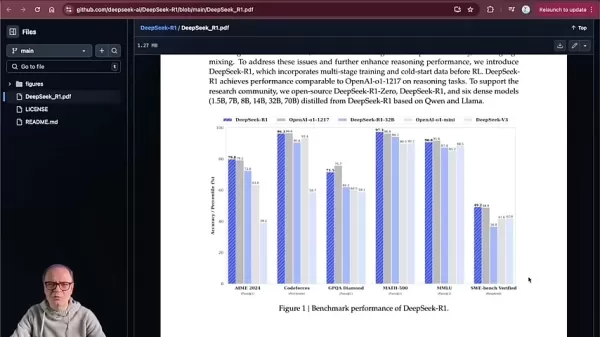
Performance metrics show R1 rivaling OpenAI's solutions alongside six dense models developed from Qwen and Llama foundations.
Parameter Overview of DeepSeek R1
The current DeepSeek R1 architecture offers six parameter variants ranging from 1 billion to 70 billion, all built upon Qwen and Llama foundations.
How to Use the DeepSeek Model With Python and PydanticAI [t:124]
Import Libraries
Python implementation for constructing Multi-Agent, Multi-Model Reasoning Graphs:
from __future__ import annotations as _annotationsimport osimport reimport requestsimport asynciofrom colorama import Forefrom dotenv import load_dotenvfrom enum import Enumfrom bs4 import BeautifulSoupfrom dataclasses import dataclass, fieldfrom typing import Unionfrom pydantic_ai import Agent, RunContextfrom pydantic_ai.tools import ToolDefinitionfrom pydantic_ai.messages import ModelMessagefrom pydantic_graph import BaseNode, End, Graph, GraphRunContextfrom pydantic_ai.models.openai import OpenAIModelfrom pydantic_ai.models.ollama import OllamaModelfrom tavily import TavilyClient
Initialize the Tavily Client
# Load the environment variablesload_dotenv()# Initialize the Tavily Clienttavily_client = TavilyClient(api_key=os.getenv("TAVILY_API_KEY"))
Intialize the DeepSeek R1 model on Ollama
# Initialize the DeepSeek R1 model on Ollamareasoning_model = OllamaModel( model_name='deepseek-r1', base_url='http://0.0.0.0:11434/v1')
Define a Product Class
# Product class@dataclassclass Product: name: str url: str keywords: list[str] num_rounds: int = 0
Pros and Cons of DeepSeek R1
Pros
Competitive performance matching leading proprietary models from Google, OpenAI, and Anthropic
Six dense model variants available for community development based on Qwen and Llama
Open-source access enabling broader developer adoption and modification
Cons
Requires PydanticAI integration to maximize effectiveness
Current release represents early-stage development requiring refinement
Frequently Asked Questions
What are the limitations of DeepSeek R1?
DeepSeek R1 currently lacks native support for function calling and structured outputs despite its advanced reasoning capabilities.
What are PydanticAI Graphs?
PydanticAI graphs facilitate structured workflows coordinating multiple agents toward common objectives.
Enhancing DeepSeek R1 Capabilities: Using PydanticAI Graphs
How can PydanticAI improve DeepSeek R1?
While DeepSeek R1 exhibits impressive reasoning capacity, its inability to natively handle function calls and structured outputs limits integration possibilities. PydanticAI's graph architecture offers solutions by enabling:
Real-time data access: Incorporating search tools like Tavily to expand DeepSeek R1's knowledge base
System integration: Connecting with APIs and external services for automated workflows
Structured outputs: Converting natural language into usable formats like JSON
Related article
 Inside Details Exposed About Next-Gen Gemini: Strained Computing Power, Internal Teams Disagreed on Development Priorities and Resource Allocation
Reports indicate that the launch of Google’s highly anticipated next-generation Gemini model has been pushed back. Internal disagreements over development priorities and resource allocation, combined with limited computing capacity and complex approv
OpenAI Dismisses Growth Slowdown Concerns, Says Multiple Business Units Accelerating
In response to external scrutiny regarding decelerating sales growth and missed internal benchmarks, AI leader OpenAI issued a confident statement on Tuesday, April 28. The company clarified that its consumer products and enterprise services are adva
Alibaba Super Cup: Qwen3.8-Max Debuts with Boosted Coding and Office Tools
Alibaba has officially unveiled Qwen3.8-Max, a next-generation foundation large model boasting 2.4 trillion parameters. This significant AI advancement delivers substantial performance gains in core areas like coding and professional office tasks, sh
Related Special Topic Recommendations
Music composition
Inside Details Exposed About Next-Gen Gemini: Strained Computing Power, Internal Teams Disagreed on Development Priorities and Resource Allocation
Reports indicate that the launch of Google’s highly anticipated next-generation Gemini model has been pushed back. Internal disagreements over development priorities and resource allocation, combined with limited computing capacity and complex approv
OpenAI Dismisses Growth Slowdown Concerns, Says Multiple Business Units Accelerating
In response to external scrutiny regarding decelerating sales growth and missed internal benchmarks, AI leader OpenAI issued a confident statement on Tuesday, April 28. The company clarified that its consumer products and enterprise services are adva
Alibaba Super Cup: Qwen3.8-Max Debuts with Boosted Coding and Office Tools
Alibaba has officially unveiled Qwen3.8-Max, a next-generation foundation large model boasting 2.4 trillion parameters. This significant AI advancement delivers substantial performance gains in core areas like coding and professional office tasks, sh
Related Special Topic Recommendations
Music composition
 Best AI Melody Writing Tools for Song Drafts
2026 Latest Best Top-Rated AI Melody Writing Tools for Song Drafts! XIX.AI has curated a highly powerful game-changing collection that goes through rigorous real-world tests to deliver the best writing experience. You can find detailed free vs paid comparisons, accurate rankings, and must-try options designed to help you create stunning song drafts effortlessly and boost your creative productivity significantly. Explore now to discover your perfect tool!
 8 tools
 xix.ai
chatbot
Best AI Conversation Trainer Tools for Interview Practice
xix.ai
chatbot
Best AI Conversation Trainer Tools for Interview Practice
2026 Latest Best Top-rated AI Conversation Trainer Tools for Interview Practice are here on XIX.AI! This curated collection features powerful, game-changing tools that go through rigorous real-world tests to deliver accurate feedback. You’ll find a free vs paid comparison and detailed rankings to help you choose the must-try option that boosts your confidence and skills. Explore now to Discover your perfect tool for interview success!
12 tools
xix.ai
Design & Art
Best AI Style Transfer Tools for Creative Experiments
2026 Latest Best Top-rated AI Style Transfer Tools for Creative Experiments! XIX.AI has curated a powerful, game-changing collection of must-try tools that deliver exceptional results through real-world tests and rigorous rankings. These top solutions help creatives boost productivity significantly by accelerating content creation and unlocking endless creative possibilities. Explore now to discover your perfect tool and start creating today!
9 tools
xix.ai
Comic Creation
Best AI Dialogue Bubble Tools for Visual Storytelling
2026 Latest Best Top-Rated AI Dialogue Bubble Tools for Visual Storytelling are here on XIX.AI! This curated collection features powerful, game-changing tools that help creators boost productivity and overcome creative bottlenecks. Get a free vs paid comparison, see real-world tests, and check the latest rankings to find the must-try solutions perfect for crafting engaging visual narratives. Explore now to discover your ideal tool!
10 tools
xix.ai
Meeting Assistant
Top AI Meeting Summary Tools: Track Decisions and Follow-Ups Clearly
2026 Latest Top-Rated Best AI Meeting Summary Tools for Clear Decision Tracking and Effortless Follow-Ups. This curated list showcases powerful, game-changing solutions that boost productivity dramatically by automating meeting notes, identifying key action items, and streamlining team coordination across all projects. Get a free vs paid comparison along with real-world tests and weekly updated rankings to help you find the perfect tool. Explore now to unlock your AI edge!
9 tools
xix.ai
Data Analysis
Best AI Data Cleaning Tools: Fix Missing Values and Duplicates Fast
2026 Latest Best Top-rated AI Data Cleaning Tools for quick fixing of missing values and duplicates. This curated list showcases powerful, game-changing solutions that boost productivity significantly. Each option has undergone rigorous real-world tests to ensure reliability. Get a free vs paid comparison and discover the must-try tool that fits your needs best. Explore now at XIX.AI to Unlock your AI edge.
11 tools
xix.ai

 Comments (3)
0/500
Comments (3)
0/500
![KevinWalker]()
DeepSeek R1 is shaking things up! 🤯 Open-source reasoning models are becoming so powerful, it's wild to see them rivaling GPT-4. This could really democratize AI access, but I'm curious about the long-term sustainability of such aggressive open strategies. 🚀
![AndrewAllen]()
Le R1 en open-source qui défie les géants commerciaux ? Je trouve ça incroyable, surtout venant d'une startup chinoise. Ça prouve que l'innovation dans l'IA ne se limite pas à Silicon Valley... Mais je me demande si ces modèles open-source peuvent vraiment être aussi robustes et bien hébergés que ceux des grands acteurs. Ça me donne envie de tester leur modèle moi-même pour voir ses performances sur des tâches complexes. 👨💻 #OpenSourceIA
![PaulBrown]()
これは本当に興味深いですね!深層学習モデルがオープンソース化されることで、研究開発のスピードがさらに加速する可能性があります。ただ、倫理的なガイドラインが追いついていない部分も気になります。GPT-4と比べてどのような差があるのか、実際に試してみたいです!🤔
As artificial intelligence continues to advance at breakneck speed, a formidable new player has entered the arena to rival established commercial models. Chinese startup DeepSeek has launched its R1 reasoning model - an open-source solution demonstrating comparable capabilities to industry leaders like OpenAI, Anthropic, and Google. This groundbreaking release has generated significant buzz within the AI community, fueling discussions about open-source alternatives democratizing access to cutting-edge AI technologies.
Key Points
DeepSeek R1 represents an open-source AI breakthrough developed by emerging Chinese startup DeepSeek.
The R1 model demonstrates competitive performance against leading AI solutions from OpenAI, Anthropic, and Google.
While showcasing advanced reasoning skills, DeepSeek R1 currently lacks native tool integration capabilities.
PydanticAI graphs provide frameworks for structuring agent workflows to enhance AI model integration.
Understanding DeepSeek R1's capabilities and implementing graph-based architectures proves crucial for leveraging next-generation AI solutions.
DeepSeek R1: A Challenger Appears [t:00]
The Emergence of DeepSeek R1
DeepSeek's R1 reasoning model launch has significantly disrupted the AI landscape previously dominated by established players like OpenAI and Google. These tech giants have traditionally set industry standards with their proprietary models.
The introduction of R1 challenges this paradigm, presenting a more accessible open-source alternative for advanced AI development.
What is DeepSeek?
Previously unknown outside China, DeepSeek has emerged as a serious competitor in the AI space through its R1 model release. The model's performance demonstrates DeepSeek's technological sophistication.
DeepSeek distinguishes itself from typical research labs as a properly funded commercial entity.
R1 Claims: Open Source Model Revolutionizing AI
DeepSeek sets itself apart through its commitment to open-source principles. By releasing R1's architecture and code base, DeepSeek enables global researchers and developers to freely access, modify, and build upon its technology.
The R1 launch has generated significant media attention globally, with publications highlighting its challenge to US technological dominance.
China Taking AI Development Seriously
Microsoft CEO Satya Nadella acknowledges China's technological advancements merit serious consideration. Multiple reports indicate China's AI breakthroughs represent significant leaps forward in the global AI race.
DeepSeek R1 vs the Competition: A Performance Overview [t:114]
Benchmarking R1
DeepSeek's published benchmarks demonstrate R1's competitive performance against leading commercial and open-source models.
Performance metrics show R1 rivaling OpenAI's solutions alongside six dense models developed from Qwen and Llama foundations.
Parameter Overview of DeepSeek R1
The current DeepSeek R1 architecture offers six parameter variants ranging from 1 billion to 70 billion, all built upon Qwen and Llama foundations.
How to Use the DeepSeek Model With Python and PydanticAI [t:124]
Import Libraries
Python implementation for constructing Multi-Agent, Multi-Model Reasoning Graphs:
from __future__ import annotations as _annotationsimport osimport reimport requestsimport asynciofrom colorama import Forefrom dotenv import load_dotenvfrom enum import Enumfrom bs4 import BeautifulSoupfrom dataclasses import dataclass, fieldfrom typing import Unionfrom pydantic_ai import Agent, RunContextfrom pydantic_ai.tools import ToolDefinitionfrom pydantic_ai.messages import ModelMessagefrom pydantic_graph import BaseNode, End, Graph, GraphRunContextfrom pydantic_ai.models.openai import OpenAIModelfrom pydantic_ai.models.ollama import OllamaModelfrom tavily import TavilyClient
Initialize the Tavily Client
# Load the environment variablesload_dotenv()# Initialize the Tavily Clienttavily_client = TavilyClient(api_key=os.getenv("TAVILY_API_KEY"))
Intialize the DeepSeek R1 model on Ollama
# Initialize the DeepSeek R1 model on Ollamareasoning_model = OllamaModel( model_name='deepseek-r1', base_url='http://0.0.0.0:11434/v1')
Define a Product Class
# Product class@dataclassclass Product: name: str url: str keywords: list[str] num_rounds: int = 0
Pros and Cons of DeepSeek R1
Pros
Competitive performance matching leading proprietary models from Google, OpenAI, and Anthropic
Six dense model variants available for community development based on Qwen and Llama
Open-source access enabling broader developer adoption and modification
Cons
Requires PydanticAI integration to maximize effectiveness
Current release represents early-stage development requiring refinement
Frequently Asked Questions
What are the limitations of DeepSeek R1?
DeepSeek R1 currently lacks native support for function calling and structured outputs despite its advanced reasoning capabilities.
What are PydanticAI Graphs?
PydanticAI graphs facilitate structured workflows coordinating multiple agents toward common objectives.
Enhancing DeepSeek R1 Capabilities: Using PydanticAI Graphs
How can PydanticAI improve DeepSeek R1?
While DeepSeek R1 exhibits impressive reasoning capacity, its inability to natively handle function calls and structured outputs limits integration possibilities. PydanticAI's graph architecture offers solutions by enabling:
Real-time data access: Incorporating search tools like Tavily to expand DeepSeek R1's knowledge base
System integration: Connecting with APIs and external services for automated workflows
Structured outputs: Converting natural language into usable formats like JSON








 Inside Details Exposed About Next-Gen Gemini: Strained Computing Power, Internal Teams Disagreed on Development Priorities and Resource Allocation
Reports indicate that the launch of Google’s highly anticipated next-generation Gemini model has been pushed back. Internal disagreements over development priorities and resource allocation, combined with limited computing capacity and complex approv
Inside Details Exposed About Next-Gen Gemini: Strained Computing Power, Internal Teams Disagreed on Development Priorities and Resource Allocation
Reports indicate that the launch of Google’s highly anticipated next-generation Gemini model has been pushed back. Internal disagreements over development priorities and resource allocation, combined with limited computing capacity and complex approv
 OpenAI Dismisses Growth Slowdown Concerns, Says Multiple Business Units Accelerating
In response to external scrutiny regarding decelerating sales growth and missed internal benchmarks, AI leader OpenAI issued a confident statement on Tuesday, April 28. The company clarified that its consumer products and enterprise services are adva
OpenAI Dismisses Growth Slowdown Concerns, Says Multiple Business Units Accelerating
In response to external scrutiny regarding decelerating sales growth and missed internal benchmarks, AI leader OpenAI issued a confident statement on Tuesday, April 28. The company clarified that its consumer products and enterprise services are adva
 Alibaba Super Cup: Qwen3.8-Max Debuts with Boosted Coding and Office Tools
Alibaba has officially unveiled Qwen3.8-Max, a next-generation foundation large model boasting 2.4 trillion parameters. This significant AI advancement delivers substantial performance gains in core areas like coding and professional office tasks, sh
Alibaba Super Cup: Qwen3.8-Max Debuts with Boosted Coding and Office Tools
Alibaba has officially unveiled Qwen3.8-Max, a next-generation foundation large model boasting 2.4 trillion parameters. This significant AI advancement delivers substantial performance gains in core areas like coding and professional office tasks, sh

2026 Latest Best Top-Rated AI Melody Writing Tools for Song Drafts! XIX.AI has curated a highly powerful game-changing collection that goes through rigorous real-world tests to deliver the best writing experience. You can find detailed free vs paid comparisons, accurate rankings, and must-try options designed to help you create stunning song drafts effortlessly and boost your creative productivity significantly. Explore now to discover your perfect tool!
8 tools
xix.ai

2026 Latest Best Top-rated AI Conversation Trainer Tools for Interview Practice are here on XIX.AI! This curated collection features powerful, game-changing tools that go through rigorous real-world tests to deliver accurate feedback. You’ll find a free vs paid comparison and detailed rankings to help you choose the must-try option that boosts your confidence and skills. Explore now to Discover your perfect tool for interview success!
12 tools
xix.ai

2026 Latest Best Top-rated AI Style Transfer Tools for Creative Experiments! XIX.AI has curated a powerful, game-changing collection of must-try tools that deliver exceptional results through real-world tests and rigorous rankings. These top solutions help creatives boost productivity significantly by accelerating content creation and unlocking endless creative possibilities. Explore now to discover your perfect tool and start creating today!
9 tools
xix.ai

2026 Latest Best Top-Rated AI Dialogue Bubble Tools for Visual Storytelling are here on XIX.AI! This curated collection features powerful, game-changing tools that help creators boost productivity and overcome creative bottlenecks. Get a free vs paid comparison, see real-world tests, and check the latest rankings to find the must-try solutions perfect for crafting engaging visual narratives. Explore now to discover your ideal tool!
10 tools
xix.ai
2026 Latest Top-Rated Best AI Meeting Summary Tools for Clear Decision Tracking and Effortless Follow-Ups. This curated list showcases powerful, game-changing solutions that boost productivity dramatically by automating meeting notes, identifying key action items, and streamlining team coordination across all projects. Get a free vs paid comparison along with real-world tests and weekly updated rankings to help you find the perfect tool. Explore now to unlock your AI edge!
9 tools
xix.ai

2026 Latest Best Top-rated AI Data Cleaning Tools for quick fixing of missing values and duplicates. This curated list showcases powerful, game-changing solutions that boost productivity significantly. Each option has undergone rigorous real-world tests to ensure reliability. Get a free vs paid comparison and discover the must-try tool that fits your needs best. Explore now at XIX.AI to Unlock your AI edge.
11 tools
xix.ai

DeepSeek R1 is shaking things up! 🤯 Open-source reasoning models are becoming so powerful, it's wild to see them rivaling GPT-4. This could really democratize AI access, but I'm curious about the long-term sustainability of such aggressive open strategies. 🚀
Le R1 en open-source qui défie les géants commerciaux ? Je trouve ça incroyable, surtout venant d'une startup chinoise. Ça prouve que l'innovation dans l'IA ne se limite pas à Silicon Valley... Mais je me demande si ces modèles open-source peuvent vraiment être aussi robustes et bien hébergés que ceux des grands acteurs. Ça me donne envie de tester leur modèle moi-même pour voir ses performances sur des tâches complexes. 👨💻 #OpenSourceIA
これは本当に興味深いですね!深層学習モデルがオープンソース化されることで、研究開発のスピードがさらに加速する可能性があります。ただ、倫理的なガイドラインが追いついていない部分も気になります。GPT-4と比べてどのような差があるのか、実際に試してみたいです!🤔












