

 Home
Deep Cogito Unveils Hybrid AI Models with Advanced Reasoning Capabilities
Deep Cogito, a new AI innovator, has launched a series of openly accessible AI models that seamlessly switch between reasoning and non-reasoning modes.
Reasoning models, such as OpenAI’s o1, excel in fields like mathematics and physics by methodically verifying solutions step by step. However, this precision demands greater computational resources and time. To address this, companies like Anthropic are developing hybrid architectures that blend reasoning with standard components, enabling quick responses to simple queries and deeper analysis for complex ones.
Deep Cogito’s models, named Cogito 1, are all hybrid designs. The company claims they surpass top open models of similar size, including those from Meta and DeepSeek.
“Each model can respond instantly or reflect before answering, mimicking reasoning models,” Deep Cogito stated in a blog post. “They were crafted by a compact team in just 75 days.”
Cogito 1 models range from 3 billion to 70 billion parameters, with plans for models up to 671 billion parameters in the near future. More parameters typically enhance a model’s problem-solving prowess.
Cogito 1 builds on Meta’s Llama and Alibaba’s Qwen models, with Deep Cogito applying innovative training techniques to improve performance and enable switchable reasoning.
Internal benchmarks show the largest model, Cogito 70B, with reasoning enabled, outperforms DeepSeek’s R1 on select math and language tasks. Without reasoning, it also surpasses Meta’s Llama 4 Scout on LiveBench, a broad AI evaluation.
All Cogito 1 models are available for download or accessible via APIs on Fireworks AI and Together AI cloud platforms.
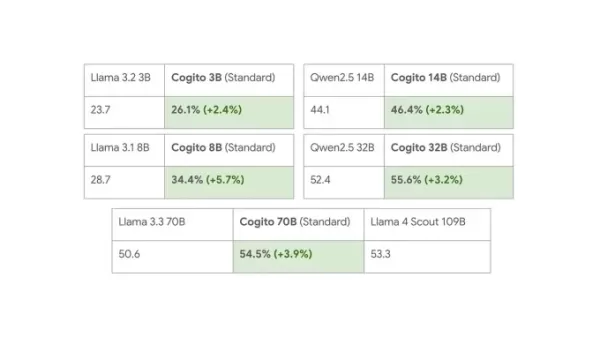
Cogito 1’s performance compared to other popular openly available AI modelsImage Credits:Deep Cogito “We’re still early in our scaling journey, using only a fraction of the compute typically allocated for large language model training,” Deep Cogito noted in its blog. “We’re exploring new post-training methods for self-improvement.”
Founded in June 2024 in San Francisco, per California filings, Deep Cogito was established by Drishan Arora, a former Google senior software engineer, and Dhruv Malhotra, previously a product manager at Google’s DeepMind, where he focused on generative search.
Backed by South Park Commons, according to PitchBook, Deep Cogito aims to pioneer “general superintelligence”—AI that outperforms most humans and unlocks unprecedented capabilities.
Related article
 Stripe to Acquire OpenRouter as AI Model Routing Gains Momentum
Stripe has agreed to acquire OpenRouter, an AI model-routing platform that gives developers access to hundreds of models through a single interface. The deal adds model selection and routing to Stripe’s existing work around AI usage and token-based b
Former OpenAI Researcher Barrett Zoph Returns to Google to Support Gemini Development
Barret Zoph, who previously abruptly left and joined OpenAI due to a disagreement with Thinking Machines Lab CEO Miriam Mularati, has once again changed employers. Alphabet's Google announced that Zoph will return as Vice President of Research, bring
How Recursive Intelligence Raised $335M at $4B Valuation in 4 Months
The co-founders of startup Ricursive Intelligence seemed destined to be co-founders.Anna Goldie, CEO, and Azalia Mirhoseini, CTO, are so well-known in the AI community that they were among those AI engineers who “got those weird emails from Zuckerber
Related Special Topic Recommendations
Design & Art
 Top AI Illustration Tools: Create Editorial Scenes and Cover Art Faster
2026 Latest Top-rated AI Illustration Tools: Our curated list features the best powerfully designed tools for creating stunning editorial scenes and eye-catching cover art quickly. Each option has gone through rigorous real-world tests, offering a free vs paid comparison to help you find the perfect match for your workflow. Try these must-try solutions today to unlock your AI edge and boost your creative productivity. Explore now at XIX.AI.
 10 tools
 xix.ai
Education and Learning
Top AI Tutors for Exam Prep: Practice Math, Science, and English
2026 Latest Top-Rated Best AI Tutors for Exam Prep are here on XIX.AI! Our curated list features powerful game-changing tools that offer free vs paid comparison, real-world tests, and weekly updated rankings. They help boost your writing efficiency, simplify complex topic learning, and unlock your academic potential. Explore now to Discover your perfect exam prep tool and Start creating today to Unlock your AI edge!
10 tools
xix.ai
Finance
AI Budget Planning Tools for Personal Money Management
2026 Latest Best Top-Rated AI Budget Planning Tools for Personal Money Management are here on XIX.AI! This curated collection features powerful, game-changing solutions that help you conduct real-world tests, understand spending habits, and create personalized plans to boost productivity. Enjoy a free vs paid comparison along with detailed rankings. Must-try tools designed to simplify money management and unlock your AI edge. Explore now!
11 tools
xix.ai
Health & Wellness
AI Sleep Tracking Assistants: Improve Recovery with Better Bedtime Habits
2026 Latest Best Top-Rated AI Sleep Tracking Assistants curated for ultimate recovery. This fully updated weekly guide features powerful tools that deliver real-world tests, free vs paid comparison, and detailed rankings to help you find the must-try solution that boosts sleep quality and supports better bedtime habits. Explore now at XIX.AI to Unlock your AI edge.
10 tools
xix.ai
Data Analysis
AI SQL Copilots for Product and Revenue Analytics
2026 Latest Best Top-Rated AI SQL Copilots for Product and Revenue Analytics! XIX.AI has curated a powerful, game-changing collection of must-try tools that undergo real-world tests through weekly updated rankings. These tools help users boost productivity significantly by accelerating data analysis, streamlining complex queries, and generating accurate insights to drive smarter business decisions. Explore now to Discover your perfect tool for unlocking your AI edge!
14 tools
xix.ai
Education and Learning
Best AI Homework Helpers That Teach: Learn Concepts, Not Just Answers
2026 Latest Best Top-Rated AI Homework Helpers That Teach Core Concepts Not Just Answers Powerful Tools for Students Must-Try Curated List Weekly Updated Free vs Paid Comparison Real-World Tests Accurate Rankings to Help You Unlock Your Full Learning Potential Explore now to Discover your perfect tool for smarter studying.
10 tools
xix.ai

 Comments (0)
0/500
Deep Cogito, a new AI innovator, has launched a series of openly accessible AI models that seamlessly switch between reasoning and non-reasoning modes.
Reasoning models, such as OpenAI’s o1, excel in fields like mathematics and physics by methodically verifying solutions step by step. However, this precision demands greater computational resources and time. To address this, companies like Anthropic are developing hybrid architectures that blend reasoning with standard components, enabling quick responses to simple queries and deeper analysis for complex ones.
Deep Cogito’s models, named Cogito 1, are all hybrid designs. The company claims they surpass top open models of similar size, including those from Meta and DeepSeek.
“Each model can respond instantly or reflect before answering, mimicking reasoning models,” Deep Cogito stated in a blog post. “They were crafted by a compact team in just 75 days.”
Cogito 1 models range from 3 billion to 70 billion parameters, with plans for models up to 671 billion parameters in the near future. More parameters typically enhance a model’s problem-solving prowess.
Cogito 1 builds on Meta’s Llama and Alibaba’s Qwen models, with Deep Cogito applying innovative training techniques to improve performance and enable switchable reasoning.
Internal benchmarks show the largest model, Cogito 70B, with reasoning enabled, outperforms DeepSeek’s R1 on select math and language tasks. Without reasoning, it also surpasses Meta’s Llama 4 Scout on LiveBench, a broad AI evaluation.
All Cogito 1 models are available for download or accessible via APIs on Fireworks AI and Together AI cloud platforms.
“We’re still early in our scaling journey, using only a fraction of the compute typically allocated for large language model training,” Deep Cogito noted in its blog. “We’re exploring new post-training methods for self-improvement.”
Founded in June 2024 in San Francisco, per California filings, Deep Cogito was established by Drishan Arora, a former Google senior software engineer, and Dhruv Malhotra, previously a product manager at Google’s DeepMind, where he focused on generative search.
Backed by South Park Commons, according to PitchBook, Deep Cogito aims to pioneer “general superintelligence”—AI that outperforms most humans and unlocks unprecedented capabilities.








 Stripe to Acquire OpenRouter as AI Model Routing Gains Momentum
Stripe has agreed to acquire OpenRouter, an AI model-routing platform that gives developers access to hundreds of models through a single interface. The deal adds model selection and routing to Stripe’s existing work around AI usage and token-based b
 Former OpenAI Researcher Barrett Zoph Returns to Google to Support Gemini Development
Barret Zoph, who previously abruptly left and joined OpenAI due to a disagreement with Thinking Machines Lab CEO Miriam Mularati, has once again changed employers. Alphabet's Google announced that Zoph will return as Vice President of Research, bring
 How Recursive Intelligence Raised $335M at $4B Valuation in 4 Months
The co-founders of startup Ricursive Intelligence seemed destined to be co-founders.Anna Goldie, CEO, and Azalia Mirhoseini, CTO, are so well-known in the AI community that they were among those AI engineers who “got those weird emails from Zuckerber

2026 Latest Top-rated AI Illustration Tools: Our curated list features the best powerfully designed tools for creating stunning editorial scenes and eye-catching cover art quickly. Each option has gone through rigorous real-world tests, offering a free vs paid comparison to help you find the perfect match for your workflow. Try these must-try solutions today to unlock your AI edge and boost your creative productivity. Explore now at XIX.AI.
10 tools
xix.ai

2026 Latest Top-Rated Best AI Tutors for Exam Prep are here on XIX.AI! Our curated list features powerful game-changing tools that offer free vs paid comparison, real-world tests, and weekly updated rankings. They help boost your writing efficiency, simplify complex topic learning, and unlock your academic potential. Explore now to Discover your perfect exam prep tool and Start creating today to Unlock your AI edge!
10 tools
xix.ai

2026 Latest Best Top-Rated AI Budget Planning Tools for Personal Money Management are here on XIX.AI! This curated collection features powerful, game-changing solutions that help you conduct real-world tests, understand spending habits, and create personalized plans to boost productivity. Enjoy a free vs paid comparison along with detailed rankings. Must-try tools designed to simplify money management and unlock your AI edge. Explore now!
11 tools
xix.ai

2026 Latest Best Top-Rated AI Sleep Tracking Assistants curated for ultimate recovery. This fully updated weekly guide features powerful tools that deliver real-world tests, free vs paid comparison, and detailed rankings to help you find the must-try solution that boosts sleep quality and supports better bedtime habits. Explore now at XIX.AI to Unlock your AI edge.
10 tools
xix.ai

2026 Latest Best Top-Rated AI SQL Copilots for Product and Revenue Analytics! XIX.AI has curated a powerful, game-changing collection of must-try tools that undergo real-world tests through weekly updated rankings. These tools help users boost productivity significantly by accelerating data analysis, streamlining complex queries, and generating accurate insights to drive smarter business decisions. Explore now to Discover your perfect tool for unlocking your AI edge!
14 tools
xix.ai

2026 Latest Best Top-Rated AI Homework Helpers That Teach Core Concepts Not Just Answers Powerful Tools for Students Must-Try Curated List Weekly Updated Free vs Paid Comparison Real-World Tests Accurate Rankings to Help You Unlock Your Full Learning Potential Explore now to Discover your perfect tool for smarter studying.
10 tools
xix.ai