


 Home
HomeClaude Code Unveils Routines for Uninterrupted Cloud Mac Work
AIbase Report | April 15, 2026
Say goodbye to manual cron jobs and server maintenance—let AI fix bugs, review pull requests, and clear your backlog while you sleep.
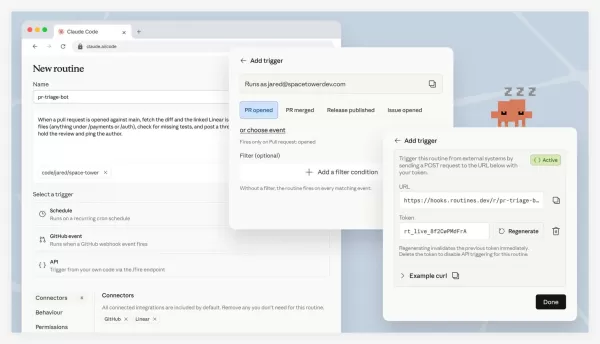
On April 14, Anthropic introduced Routines in Claude Code as a research preview. In short, you bundle prompts, code repositories, and connectors into one package, save it, and Claude runs automatically based on a schedule, API calls, or GitHub events—all on Anthropic's cloud so you can shut down your local machine.
What exactly is it?
Previously, developers who wanted scheduled Claude Code tasks had to create their own setup: write cron jobs, rent servers, configure MCP servers, and tie everything together. Anthropic acknowledged in their blog that this complexity was a major barrier. While developers already used Claude Code to automate software workflows, they previously had to manage cron jobs, infrastructure, and extra tools like MCP servers themselves.
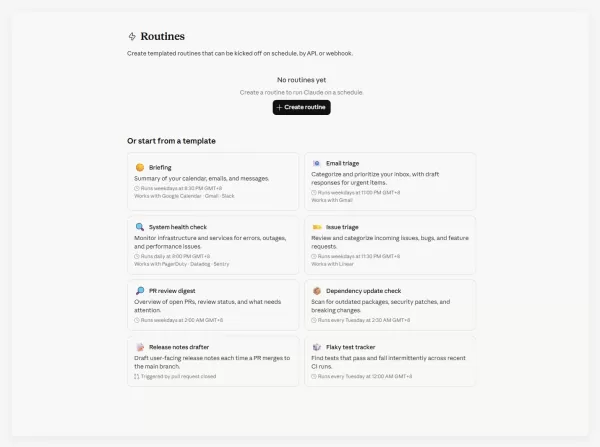
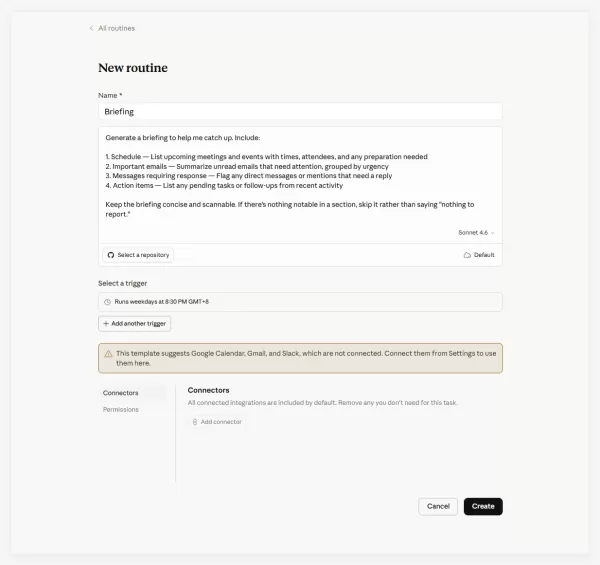
Routines bundles everything together. Configure it once, and you have a reusable Claude session template with repository permissions and connectors—it knows where to look, which tools to use, and what the objective is.
Three triggering methods cover most common automation scenarios:
Scheduled runs. Hourly, nightly, weekly, or custom cron jobs in CLI (minimum 1-hour interval). The official example: every night at 2 AM, pull the highest-priority bug from Linear, attempt a fix, and open a draft PR. You simply review it the next morning.
API-triggered. Each Routine gets its own endpoint and authentication token. Send a POST message, and receive a session URL. Datadog alerts, CI/CD hooks, internal dashboards, or any HTTP-capable system can directly call Claude.
GitHub event–triggered. After installing the Claude GitHub App, events like pull_request, push, issue, and check run become triggers, filterable by author, tag, branch, or draft status. For example, monitor a sensitive directory: flag any PR touching the /auth-provider module, summarize changes, and post to #auth-changes. Each matching PR gets its own session, and Claude continues to track follow-up comments and CI failures.
Who Can Use It and How Often?
The research preview is open only to Pro, Max, Team, and Enterprise subscribers, with daily run limits: 5 for Pro, 15 for Max, and 25 for Team and Enterprise. Additional runs incur extra charges. All Routine usage draws from the same subscription quota as regular sessions.
GitHub-triggered routines also have hourly rate limits; events beyond the window are discarded. If your repository is highly active, set up filters in advance to avoid burning runs on irrelevant PRs.
A key default security setting: Claude can only push to branches prefixed with claude/ and never modifies main directly. This is a safe default; unless your review process is robust, it's best to keep it enabled.
Access it at claude.ai/code/routines, or type /schedule in the Claude Code CLI.
What Early Users Are Doing With It
Anthropic's blog and early adopters have revealed several proven use cases:
Nighttime backlog cleanup: Schedule the Routine to pull new issues, tag them, assign responsibilities, and push a summary to Slack by morning, giving the team a clear queue overview.Alert triage: Monitor the Routine's API endpoint; Claude can pull stack traces, associate recent commits, and pre-open a draft PR with a candidate fix, so the on-call engineer sees something ready upon arrival.Customized code reviews: Trigger on PR open, leave inline comments based on team checklists, and perform automated checks for security, performance, and style, letting humans focus on design.Deployment verification: Run a Routine after CD pipeline deployment to run smoke tests, scan logs for regressions, and post a go/no-go decision to the release channel.Documentation drift correction: Once a week, scan recently merged PRs for documentation that references changed APIs and automatically open update PRs.Cross-language SDK synchronization: When a PR merges in the Python SDK, the Routine applies the same change to the Go SDK and opens a corresponding PR, keeping both libraries in sync.The last example highlights a real pain point—any team maintaining multiple SDKs knows how tedious this synchronization is.
Community Reaction
After the official announcement, developers responded with one common sentiment: no more keeping Macs on overnight. The discussion quickly hit the Hacker News front page, raising key concerns: token consumption control, idempotency (repeated event triggers and potential chaos), and how Routines compares to multi-agent frameworks like OpenClaw.
Some developers have already scheduled their first Routines: one for PR reviews, one for issue triage, and one for post-deployment smoke testing. Non-engineers remarked this was the first time they believed "AI handling daily chores" was truly practical.
Some Observations
Routines doesn't introduce groundbreaking model capabilities, but it addresses a key gap: turning Claude Code from a terminal-dependent tool into an always-on background worker. This fits Anthropic's recent moves (redesigned desktop app, parallel session sidebar, Cowork GA)—shifting from real-time collaboration toward scheduled orchestration.
Naturally, the research preview comes with uncertainties. The /fire endpoint is served under the experimental-cc-routine-2026-04-01 beta header, and request/response formats, rate limits, and token semantics may change. Anthropic also noted plans to expand webhook triggers beyond GitHub in the future, though no timeline has been provided.
For teams already using Claude Code, this feature is worth testing now. For those on the sidelines, it brings the vision of "AI as a continuously running team member" significantly closer to reality.
Sources: Anthropic's official blog, Claude Code documentation (code.claude.com/docs/en/routines), @claudeai tweets, and reports from The Decoder, 9to5Mac, and others. Details are subject to the latest official documentation.
Related article
 Amazon Launches Free Alexa+ on Fire TV Without Prime Membership
AI is making its way into your television, whether you’re ready for it or not.On Wednesday, Amazon announced that its AI assistant, Alexa+, will be available on all compatible Fire TV devices in the U.S. at no cost, regardless of Prime subscription s
OpenAI Closes Gap With Anthropic Among Business Users, New Data Shows
With OpenAI and Anthropic still distant from their anticipated IPOs and the release of detailed financial reports, we must turn to alternative indicators to gauge their business performance. Ramp, a corporate credit card and expense management platfo
Nvidia CEO Jensen Huang tells Trump ‘we’re not going to let [an AI slowdown] happen’
During his appearance at the All-In Summit in Los Angeles on Monday, Nvidia CEO Jensen Huang received an unexpected call from President Donald Trump, one he couldn’t simply ignore.“I’m on stage with the besties,” Huang explained to Trump, referencing
Related Special Topic Recommendations
Marketing
Amazon Launches Free Alexa+ on Fire TV Without Prime Membership
AI is making its way into your television, whether you’re ready for it or not.On Wednesday, Amazon announced that its AI assistant, Alexa+, will be available on all compatible Fire TV devices in the U.S. at no cost, regardless of Prime subscription s
OpenAI Closes Gap With Anthropic Among Business Users, New Data Shows
With OpenAI and Anthropic still distant from their anticipated IPOs and the release of detailed financial reports, we must turn to alternative indicators to gauge their business performance. Ramp, a corporate credit card and expense management platfo
Nvidia CEO Jensen Huang tells Trump ‘we’re not going to let [an AI slowdown] happen’
During his appearance at the All-In Summit in Los Angeles on Monday, Nvidia CEO Jensen Huang received an unexpected call from President Donald Trump, one he couldn’t simply ignore.“I’m on stage with the besties,” Huang explained to Trump, referencing
Related Special Topic Recommendations
Marketing
 Best AI Persona Builders: Turn CRM Data into Actionable Profiles
2026 Latest Best Top-rated AI Persona Builders help you turn valuable CRM data into actionable customer profiles quickly. This curated list showcases powerful, game-changing tools that go through real-world tests to deliver accurate insights. Get a free vs paid comparison and discover which option suits your needs best. XIX.AI is also included in this must-try selection. Explore now to Unlock your AI edge!
 9 tools
 xix.ai
Data Analysis
AI SQL Analysis Tools for Business Intelligence Teams
xix.ai
Data Analysis
AI SQL Analysis Tools for Business Intelligence Teams
2026 Latest Best Top-rated AI SQL Analysis Tools for Business Intelligence Teams! XIX.AI has curated a powerful, game-changing collection that goes through rigorous real-world tests. You’ll find a free vs paid comparison, detailed rankings, and in-depth insights to help you boost productivity significantly. Must-try options are available to unlock your AI edge. Explore now!
11 tools
xix.ai
Image editing
Best AI Batch Background Removal Tools for Catalog Images
2026 Latest Best Top-rated AI Batch Background Removal Tools for Catalog Images are curated by XIX.AI for quick, powerful removal of backgrounds from multiple images at once. These tools offer real-world tests and free vs paid comparison to help you find the most efficient solution that boosts your productivity significantly. Must-try options are regularly updated weekly. Explore now to Discover your perfect tool and Unlock your AI edge.
14 tools
xix.ai
Academic Research
AI Academic Writing Helpers: Improve Abstracts and Paper Structure
2026 Latest Best Top-Rated AI Academic Writing Helpers for Students & Researchers! XIX.AI has curated a powerful, game-changing collection of tools that undergo real-world tests to boost writing efficiency significantly. You’ll find detailed free vs paid comparison, weekly updated rankings, and insights on how these tools can help refine abstracts, structure papers, and overcome common academic writing challenges. Must-try for anyone aiming to unlock their AI edge in academic work. Explore now!
8 tools
xix.ai
Comic Creation
Best AI Comic Generators: Turn Story Ideas into Illustrated Panels
2026 Latest Best Top-rated AI Comic Generators ranked by actual user performance. This curated collection features powerful game-changing tools that help creators turn unique story ideas into polished illustrated panels fast, boosting productivity significantly. XIX.AI offers a detailed free vs paid comparison along with real-world tests to guide your choice. Explore now and Discover your perfect tool to unlock your AI edge in comic creation.
15 tools
xix.ai
Animation Creation
AI Scene Animation Tools for Social Media Content
2026 Latest Best Top-rated AI Scene Animation Tools for Social Media Content are curated here by XIX.AI. These powerful game-changing tools offer real-world tests and detailed free vs paid comparison, helping creators boost productivity significantly. Explore now to unlock your AI edge.
9 tools
xix.ai

 Comments (0)
0/500
Comments (0)
0/500
AIbase Report | April 15, 2026
Say goodbye to manual cron jobs and server maintenance—let AI fix bugs, review pull requests, and clear your backlog while you sleep.
On April 14, Anthropic introduced Routines in Claude Code as a research preview. In short, you bundle prompts, code repositories, and connectors into one package, save it, and Claude runs automatically based on a schedule, API calls, or GitHub events—all on Anthropic's cloud so you can shut down your local machine.
What exactly is it?
Previously, developers who wanted scheduled Claude Code tasks had to create their own setup: write cron jobs, rent servers, configure MCP servers, and tie everything together. Anthropic acknowledged in their blog that this complexity was a major barrier. While developers already used Claude Code to automate software workflows, they previously had to manage cron jobs, infrastructure, and extra tools like MCP servers themselves.
Routines bundles everything together. Configure it once, and you have a reusable Claude session template with repository permissions and connectors—it knows where to look, which tools to use, and what the objective is.
Three triggering methods cover most common automation scenarios:
Scheduled runs. Hourly, nightly, weekly, or custom cron jobs in CLI (minimum 1-hour interval). The official example: every night at 2 AM, pull the highest-priority bug from Linear, attempt a fix, and open a draft PR. You simply review it the next morning.
API-triggered. Each Routine gets its own endpoint and authentication token. Send a POST message, and receive a session URL. Datadog alerts, CI/CD hooks, internal dashboards, or any HTTP-capable system can directly call Claude.
GitHub event–triggered. After installing the Claude GitHub App, events like pull_request, push, issue, and check run become triggers, filterable by author, tag, branch, or draft status. For example, monitor a sensitive directory: flag any PR touching the /auth-provider module, summarize changes, and post to #auth-changes. Each matching PR gets its own session, and Claude continues to track follow-up comments and CI failures.
Who Can Use It and How Often?
The research preview is open only to Pro, Max, Team, and Enterprise subscribers, with daily run limits: 5 for Pro, 15 for Max, and 25 for Team and Enterprise. Additional runs incur extra charges. All Routine usage draws from the same subscription quota as regular sessions.
GitHub-triggered routines also have hourly rate limits; events beyond the window are discarded. If your repository is highly active, set up filters in advance to avoid burning runs on irrelevant PRs.
A key default security setting: Claude can only push to branches prefixed with claude/ and never modifies main directly. This is a safe default; unless your review process is robust, it's best to keep it enabled.
Access it at claude.ai/code/routines, or type /schedule in the Claude Code CLI.
What Early Users Are Doing With It
Anthropic's blog and early adopters have revealed several proven use cases:
Nighttime backlog cleanup: Schedule the Routine to pull new issues, tag them, assign responsibilities, and push a summary to Slack by morning, giving the team a clear queue overview.Alert triage: Monitor the Routine's API endpoint; Claude can pull stack traces, associate recent commits, and pre-open a draft PR with a candidate fix, so the on-call engineer sees something ready upon arrival.Customized code reviews: Trigger on PR open, leave inline comments based on team checklists, and perform automated checks for security, performance, and style, letting humans focus on design.Deployment verification: Run a Routine after CD pipeline deployment to run smoke tests, scan logs for regressions, and post a go/no-go decision to the release channel.Documentation drift correction: Once a week, scan recently merged PRs for documentation that references changed APIs and automatically open update PRs.Cross-language SDK synchronization: When a PR merges in the Python SDK, the Routine applies the same change to the Go SDK and opens a corresponding PR, keeping both libraries in sync.The last example highlights a real pain point—any team maintaining multiple SDKs knows how tedious this synchronization is.
Community Reaction
After the official announcement, developers responded with one common sentiment: no more keeping Macs on overnight. The discussion quickly hit the Hacker News front page, raising key concerns: token consumption control, idempotency (repeated event triggers and potential chaos), and how Routines compares to multi-agent frameworks like OpenClaw.
Some developers have already scheduled their first Routines: one for PR reviews, one for issue triage, and one for post-deployment smoke testing. Non-engineers remarked this was the first time they believed "AI handling daily chores" was truly practical.
Some Observations
Routines doesn't introduce groundbreaking model capabilities, but it addresses a key gap: turning Claude Code from a terminal-dependent tool into an always-on background worker. This fits Anthropic's recent moves (redesigned desktop app, parallel session sidebar, Cowork GA)—shifting from real-time collaboration toward scheduled orchestration.
Naturally, the research preview comes with uncertainties. The /fire endpoint is served under the experimental-cc-routine-2026-04-01 beta header, and request/response formats, rate limits, and token semantics may change. Anthropic also noted plans to expand webhook triggers beyond GitHub in the future, though no timeline has been provided.
For teams already using Claude Code, this feature is worth testing now. For those on the sidelines, it brings the vision of "AI as a continuously running team member" significantly closer to reality.
Sources: Anthropic's official blog, Claude Code documentation (code.claude.com/docs/en/routines), @claudeai tweets, and reports from The Decoder, 9to5Mac, and others. Details are subject to the latest official documentation.








 Amazon Launches Free Alexa+ on Fire TV Without Prime Membership
AI is making its way into your television, whether you’re ready for it or not.On Wednesday, Amazon announced that its AI assistant, Alexa+, will be available on all compatible Fire TV devices in the U.S. at no cost, regardless of Prime subscription s
Amazon Launches Free Alexa+ on Fire TV Without Prime Membership
AI is making its way into your television, whether you’re ready for it or not.On Wednesday, Amazon announced that its AI assistant, Alexa+, will be available on all compatible Fire TV devices in the U.S. at no cost, regardless of Prime subscription s
 OpenAI Closes Gap With Anthropic Among Business Users, New Data Shows
With OpenAI and Anthropic still distant from their anticipated IPOs and the release of detailed financial reports, we must turn to alternative indicators to gauge their business performance. Ramp, a corporate credit card and expense management platfo
OpenAI Closes Gap With Anthropic Among Business Users, New Data Shows
With OpenAI and Anthropic still distant from their anticipated IPOs and the release of detailed financial reports, we must turn to alternative indicators to gauge their business performance. Ramp, a corporate credit card and expense management platfo
![Nvidia CEO Jensen Huang tells Trump ‘we’re not going to let [an AI slowdown] happen’](https://img.xix.ai/uploads/79/6aa87327d0e12.webp) Nvidia CEO Jensen Huang tells Trump ‘we’re not going to let [an AI slowdown] happen’
During his appearance at the All-In Summit in Los Angeles on Monday, Nvidia CEO Jensen Huang received an unexpected call from President Donald Trump, one he couldn’t simply ignore.“I’m on stage with the besties,” Huang explained to Trump, referencing
Nvidia CEO Jensen Huang tells Trump ‘we’re not going to let [an AI slowdown] happen’
During his appearance at the All-In Summit in Los Angeles on Monday, Nvidia CEO Jensen Huang received an unexpected call from President Donald Trump, one he couldn’t simply ignore.“I’m on stage with the besties,” Huang explained to Trump, referencing

2026 Latest Best Top-rated AI Persona Builders help you turn valuable CRM data into actionable customer profiles quickly. This curated list showcases powerful, game-changing tools that go through real-world tests to deliver accurate insights. Get a free vs paid comparison and discover which option suits your needs best. XIX.AI is also included in this must-try selection. Explore now to Unlock your AI edge!
9 tools
xix.ai

2026 Latest Best Top-rated AI SQL Analysis Tools for Business Intelligence Teams! XIX.AI has curated a powerful, game-changing collection that goes through rigorous real-world tests. You’ll find a free vs paid comparison, detailed rankings, and in-depth insights to help you boost productivity significantly. Must-try options are available to unlock your AI edge. Explore now!
11 tools
xix.ai

2026 Latest Best Top-rated AI Batch Background Removal Tools for Catalog Images are curated by XIX.AI for quick, powerful removal of backgrounds from multiple images at once. These tools offer real-world tests and free vs paid comparison to help you find the most efficient solution that boosts your productivity significantly. Must-try options are regularly updated weekly. Explore now to Discover your perfect tool and Unlock your AI edge.
14 tools
xix.ai

2026 Latest Best Top-Rated AI Academic Writing Helpers for Students & Researchers! XIX.AI has curated a powerful, game-changing collection of tools that undergo real-world tests to boost writing efficiency significantly. You’ll find detailed free vs paid comparison, weekly updated rankings, and insights on how these tools can help refine abstracts, structure papers, and overcome common academic writing challenges. Must-try for anyone aiming to unlock their AI edge in academic work. Explore now!
8 tools
xix.ai

2026 Latest Best Top-rated AI Comic Generators ranked by actual user performance. This curated collection features powerful game-changing tools that help creators turn unique story ideas into polished illustrated panels fast, boosting productivity significantly. XIX.AI offers a detailed free vs paid comparison along with real-world tests to guide your choice. Explore now and Discover your perfect tool to unlock your AI edge in comic creation.
15 tools
xix.ai

2026 Latest Best Top-rated AI Scene Animation Tools for Social Media Content are curated here by XIX.AI. These powerful game-changing tools offer real-world tests and detailed free vs paid comparison, helping creators boost productivity significantly. Explore now to unlock your AI edge.
9 tools
xix.ai












