


 Home
HomeChrome Launches Prompt API, Ushering Native Browser AI Era with Gemini Nano
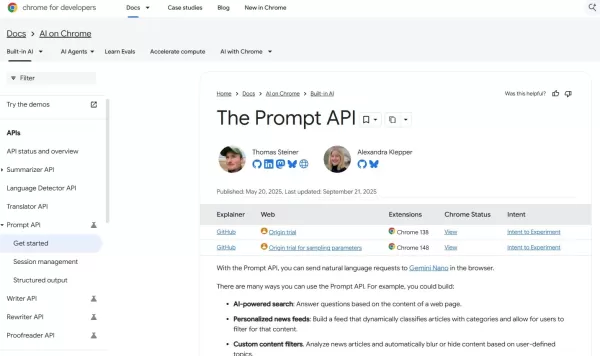
The Google Chrome browser has officially launched the Prompt API, enabling developers to directly invoke the built-in Gemini Nano model with simple JavaScript code on web pages, bringing AI capabilities directly to the client side. This announcement has sparked significant discussion on Hacker News and is quickly gaining widespread attention, viewed as a major step in democratizing AI within the browser.
What is the Prompt API?
The Prompt API is a component of Chrome's built-in AI framework. It allows web applications to send natural language instructions to the Gemini Nano lightweight language model embedded directly in the browser. Gemini Nano is a compact model from Google, optimized for on-device use, and runs locally on the user's machine without requiring cloud servers.
This represents a fundamental shift from traditional AI integration methods. Previously, developers had to rely on external APIs like OpenAI or Claude, navigating challenges such as cross-origin restrictions, API key management, costs, and data privacy. Now, similar functionality can be achieved with just a few lines of code:
constsession=awaitai.languageModel.create();
The model operates within the browser via technologies like WebAssembly or WebGPU. All data remains on the user's device, significantly enhancing privacy protection and enabling offline use cases.
Core Advantages: Privacy, Security, and Ease of Use
Local Execution with Privacy First: The Gemini Nano model downloads automatically based on the user's device (with a size of several gigabytes). All inference happens locally, meaning user input is never sent to the cloud. This directly addresses widespread concerns among businesses and individuals about data leakage with cloud-based AI.
Lower Development Barrier: There's no need to budget for server costs, manage API keys, or account for network latency. AI capability becomes a native browser feature, akin to the foundational role of JavaScript. Developers can quickly implement features like text translation, summarization, content rewriting, and semantic search, paving the way for more complex local AI applications.
Broad Application Potential: This capability can be leveraged everywhere from browser extensions to standard web pages. Early innovations are already emerging, such as real-time content summarization, offline chatbots, and client-side semantic filtering.
Current Status and Limitations
Currently, the Prompt API is in an experimental/early availability phase. It is primarily accessible by enabling experimental flags (via chrome://flags) in Chrome Canary, the Dev channel, or specific versions like Chrome 137+. The model's capabilities are more limited compared to cloud-based large language models, and sufficient device performance (including memory and GPU acceleration) is required. Google has launched an Origin Trial, allowing developers to test and provide feedback in production environments.
Official Chrome documentation notes that the browser handles model downloads automatically, with a potential short wait on first use. This feature is expected to gradually roll out to stable channels and potentially expand to more platforms in the future.
Industry Impact: AI as a Foundational Browser Capability
Industry observers see the Prompt API as a turning point for browser-based AI. As AI becomes a standard web capability like JavaScript, a new wave of innovation in web applications is anticipated. Microsoft Edge is exploring similar interfaces, accelerating the industry-wide shift toward "on-device AI."
This development not only lowers the barrier to using AI but also promotes the creation of privacy-conscious, offline-friendly web experiences. Future browsers may integrate more AI primitives, making intelligent features accessible to both end-users and developers.
AIbase Commentary: Chrome's move accelerates the shift of AI from the cloud to the edge. While current capabilities are limited, its symbolic importance is substantial—browsers are evolving from mere presentation tools into intelligent platforms. Developers are encouraged to monitor progress closely and engage in early testing to seize opportunities in the next generation of web AI applications.
Link: https://developer.chrome.com/docs/ai/prompt-api
Related article
 Former OpenAI Researcher Barrett Zoph Returns to Google to Support Gemini Development
Barret Zoph, who previously abruptly left and joined OpenAI due to a disagreement with Thinking Machines Lab CEO Miriam Mularati, has once again changed employers. Alphabet's Google announced that Zoph will return as Vice President of Research, bring
How Recursive Intelligence Raised $335M at $4B Valuation in 4 Months
The co-founders of startup Ricursive Intelligence seemed destined to be co-founders.Anna Goldie, CEO, and Azalia Mirhoseini, CTO, are so well-known in the AI community that they were among those AI engineers who “got those weird emails from Zuckerber
AI race won’t wait, nor will this TechCrunch Disrupt 25% discount
Every founder building in AI right now is asking the same question: Are we moving fast enough, and effectively enough? TechCrunch Disrupt 2026 puts you in the same room as the people wrestling with that existential question at the highest levels. Fro
Related Special Topic Recommendations
Design & Art
Former OpenAI Researcher Barrett Zoph Returns to Google to Support Gemini Development
Barret Zoph, who previously abruptly left and joined OpenAI due to a disagreement with Thinking Machines Lab CEO Miriam Mularati, has once again changed employers. Alphabet's Google announced that Zoph will return as Vice President of Research, bring
How Recursive Intelligence Raised $335M at $4B Valuation in 4 Months
The co-founders of startup Ricursive Intelligence seemed destined to be co-founders.Anna Goldie, CEO, and Azalia Mirhoseini, CTO, are so well-known in the AI community that they were among those AI engineers who “got those weird emails from Zuckerber
AI race won’t wait, nor will this TechCrunch Disrupt 25% discount
Every founder building in AI right now is asking the same question: Are we moving fast enough, and effectively enough? TechCrunch Disrupt 2026 puts you in the same room as the people wrestling with that existential question at the highest levels. Fro
Related Special Topic Recommendations
Design & Art
 Top AI Illustration Tools: Create Editorial Scenes and Cover Art Faster
2026 Latest Top-rated AI Illustration Tools: Our curated list features the best powerfully designed tools for creating stunning editorial scenes and eye-catching cover art quickly. Each option has gone through rigorous real-world tests, offering a free vs paid comparison to help you find the perfect match for your workflow. Try these must-try solutions today to unlock your AI edge and boost your creative productivity. Explore now at XIX.AI.
 10 tools
 xix.ai
Education and Learning
Top AI Tutors for Exam Prep: Practice Math, Science, and English
xix.ai
Education and Learning
Top AI Tutors for Exam Prep: Practice Math, Science, and English
2026 Latest Top-Rated Best AI Tutors for Exam Prep are here on XIX.AI! Our curated list features powerful game-changing tools that offer free vs paid comparison, real-world tests, and weekly updated rankings. They help boost your writing efficiency, simplify complex topic learning, and unlock your academic potential. Explore now to Discover your perfect exam prep tool and Start creating today to Unlock your AI edge!
10 tools
xix.ai
Finance
AI Budget Planning Tools for Personal Money Management
2026 Latest Best Top-Rated AI Budget Planning Tools for Personal Money Management are here on XIX.AI! This curated collection features powerful, game-changing solutions that help you conduct real-world tests, understand spending habits, and create personalized plans to boost productivity. Enjoy a free vs paid comparison along with detailed rankings. Must-try tools designed to simplify money management and unlock your AI edge. Explore now!
11 tools
xix.ai
Health & Wellness
AI Sleep Tracking Assistants: Improve Recovery with Better Bedtime Habits
2026 Latest Best Top-Rated AI Sleep Tracking Assistants curated for ultimate recovery. This fully updated weekly guide features powerful tools that deliver real-world tests, free vs paid comparison, and detailed rankings to help you find the must-try solution that boosts sleep quality and supports better bedtime habits. Explore now at XIX.AI to Unlock your AI edge.
10 tools
xix.ai
Data Analysis
AI SQL Copilots for Product and Revenue Analytics
2026 Latest Best Top-Rated AI SQL Copilots for Product and Revenue Analytics! XIX.AI has curated a powerful, game-changing collection of must-try tools that undergo real-world tests through weekly updated rankings. These tools help users boost productivity significantly by accelerating data analysis, streamlining complex queries, and generating accurate insights to drive smarter business decisions. Explore now to Discover your perfect tool for unlocking your AI edge!
14 tools
xix.ai
Education and Learning
Best AI Homework Helpers That Teach: Learn Concepts, Not Just Answers
2026 Latest Best Top-Rated AI Homework Helpers That Teach Core Concepts Not Just Answers Powerful Tools for Students Must-Try Curated List Weekly Updated Free vs Paid Comparison Real-World Tests Accurate Rankings to Help You Unlock Your Full Learning Potential Explore now to Discover your perfect tool for smarter studying.
10 tools
xix.ai

 Comments (1)
0/500
Comments (1)
0/500
![WalterWalker]()
ChromeがPrompt APIを公式リリースか!Gemini NanoをJSで直接呼び出せるなんて、クライアントサイドAIの時代が来た感じ。ローカルで動くからプライバシー面でも安心だし、オフラインでも使えるのは嬉しいね。ただ、端末の負荷が心配だけど、これからのWeb開発の標準になりそう?🤖✨
The Google Chrome browser has officially launched the Prompt API, enabling developers to directly invoke the built-in Gemini Nano model with simple JavaScript code on web pages, bringing AI capabilities directly to the client side. This announcement has sparked significant discussion on Hacker News and is quickly gaining widespread attention, viewed as a major step in democratizing AI within the browser.
What is the Prompt API?
The Prompt API is a component of Chrome's built-in AI framework. It allows web applications to send natural language instructions to the Gemini Nano lightweight language model embedded directly in the browser. Gemini Nano is a compact model from Google, optimized for on-device use, and runs locally on the user's machine without requiring cloud servers.
This represents a fundamental shift from traditional AI integration methods. Previously, developers had to rely on external APIs like OpenAI or Claude, navigating challenges such as cross-origin restrictions, API key management, costs, and data privacy. Now, similar functionality can be achieved with just a few lines of code:
constsession=awaitai.languageModel.create();
The model operates within the browser via technologies like WebAssembly or WebGPU. All data remains on the user's device, significantly enhancing privacy protection and enabling offline use cases.
Core Advantages: Privacy, Security, and Ease of Use
Local Execution with Privacy First: The Gemini Nano model downloads automatically based on the user's device (with a size of several gigabytes). All inference happens locally, meaning user input is never sent to the cloud. This directly addresses widespread concerns among businesses and individuals about data leakage with cloud-based AI.
Lower Development Barrier: There's no need to budget for server costs, manage API keys, or account for network latency. AI capability becomes a native browser feature, akin to the foundational role of JavaScript. Developers can quickly implement features like text translation, summarization, content rewriting, and semantic search, paving the way for more complex local AI applications.
Broad Application Potential: This capability can be leveraged everywhere from browser extensions to standard web pages. Early innovations are already emerging, such as real-time content summarization, offline chatbots, and client-side semantic filtering.
Current Status and Limitations
Currently, the Prompt API is in an experimental/early availability phase. It is primarily accessible by enabling experimental flags (via chrome://flags) in Chrome Canary, the Dev channel, or specific versions like Chrome 137+. The model's capabilities are more limited compared to cloud-based large language models, and sufficient device performance (including memory and GPU acceleration) is required. Google has launched an Origin Trial, allowing developers to test and provide feedback in production environments.
Official Chrome documentation notes that the browser handles model downloads automatically, with a potential short wait on first use. This feature is expected to gradually roll out to stable channels and potentially expand to more platforms in the future.
Industry Impact: AI as a Foundational Browser Capability
Industry observers see the Prompt API as a turning point for browser-based AI. As AI becomes a standard web capability like JavaScript, a new wave of innovation in web applications is anticipated. Microsoft Edge is exploring similar interfaces, accelerating the industry-wide shift toward "on-device AI."
This development not only lowers the barrier to using AI but also promotes the creation of privacy-conscious, offline-friendly web experiences. Future browsers may integrate more AI primitives, making intelligent features accessible to both end-users and developers.
AIbase Commentary: Chrome's move accelerates the shift of AI from the cloud to the edge. While current capabilities are limited, its symbolic importance is substantial—browsers are evolving from mere presentation tools into intelligent platforms. Developers are encouraged to monitor progress closely and engage in early testing to seize opportunities in the next generation of web AI applications.
Link: https://developer.chrome.com/docs/ai/prompt-api








 Former OpenAI Researcher Barrett Zoph Returns to Google to Support Gemini Development
Barret Zoph, who previously abruptly left and joined OpenAI due to a disagreement with Thinking Machines Lab CEO Miriam Mularati, has once again changed employers. Alphabet's Google announced that Zoph will return as Vice President of Research, bring
Former OpenAI Researcher Barrett Zoph Returns to Google to Support Gemini Development
Barret Zoph, who previously abruptly left and joined OpenAI due to a disagreement with Thinking Machines Lab CEO Miriam Mularati, has once again changed employers. Alphabet's Google announced that Zoph will return as Vice President of Research, bring
 How Recursive Intelligence Raised $335M at $4B Valuation in 4 Months
The co-founders of startup Ricursive Intelligence seemed destined to be co-founders.Anna Goldie, CEO, and Azalia Mirhoseini, CTO, are so well-known in the AI community that they were among those AI engineers who “got those weird emails from Zuckerber
How Recursive Intelligence Raised $335M at $4B Valuation in 4 Months
The co-founders of startup Ricursive Intelligence seemed destined to be co-founders.Anna Goldie, CEO, and Azalia Mirhoseini, CTO, are so well-known in the AI community that they were among those AI engineers who “got those weird emails from Zuckerber
 AI race won’t wait, nor will this TechCrunch Disrupt 25% discount
Every founder building in AI right now is asking the same question: Are we moving fast enough, and effectively enough? TechCrunch Disrupt 2026 puts you in the same room as the people wrestling with that existential question at the highest levels. Fro
AI race won’t wait, nor will this TechCrunch Disrupt 25% discount
Every founder building in AI right now is asking the same question: Are we moving fast enough, and effectively enough? TechCrunch Disrupt 2026 puts you in the same room as the people wrestling with that existential question at the highest levels. Fro

2026 Latest Top-rated AI Illustration Tools: Our curated list features the best powerfully designed tools for creating stunning editorial scenes and eye-catching cover art quickly. Each option has gone through rigorous real-world tests, offering a free vs paid comparison to help you find the perfect match for your workflow. Try these must-try solutions today to unlock your AI edge and boost your creative productivity. Explore now at XIX.AI.
10 tools
xix.ai

2026 Latest Top-Rated Best AI Tutors for Exam Prep are here on XIX.AI! Our curated list features powerful game-changing tools that offer free vs paid comparison, real-world tests, and weekly updated rankings. They help boost your writing efficiency, simplify complex topic learning, and unlock your academic potential. Explore now to Discover your perfect exam prep tool and Start creating today to Unlock your AI edge!
10 tools
xix.ai

2026 Latest Best Top-Rated AI Budget Planning Tools for Personal Money Management are here on XIX.AI! This curated collection features powerful, game-changing solutions that help you conduct real-world tests, understand spending habits, and create personalized plans to boost productivity. Enjoy a free vs paid comparison along with detailed rankings. Must-try tools designed to simplify money management and unlock your AI edge. Explore now!
11 tools
xix.ai

2026 Latest Best Top-Rated AI Sleep Tracking Assistants curated for ultimate recovery. This fully updated weekly guide features powerful tools that deliver real-world tests, free vs paid comparison, and detailed rankings to help you find the must-try solution that boosts sleep quality and supports better bedtime habits. Explore now at XIX.AI to Unlock your AI edge.
10 tools
xix.ai

2026 Latest Best Top-Rated AI SQL Copilots for Product and Revenue Analytics! XIX.AI has curated a powerful, game-changing collection of must-try tools that undergo real-world tests through weekly updated rankings. These tools help users boost productivity significantly by accelerating data analysis, streamlining complex queries, and generating accurate insights to drive smarter business decisions. Explore now to Discover your perfect tool for unlocking your AI edge!
14 tools
xix.ai

2026 Latest Best Top-Rated AI Homework Helpers That Teach Core Concepts Not Just Answers Powerful Tools for Students Must-Try Curated List Weekly Updated Free vs Paid Comparison Real-World Tests Accurate Rankings to Help You Unlock Your Full Learning Potential Explore now to Discover your perfect tool for smarter studying.
10 tools
xix.ai

ChromeがPrompt APIを公式リリースか!Gemini NanoをJSで直接呼び出せるなんて、クライアントサイドAIの時代が来た感じ。ローカルで動くからプライバシー面でも安心だし、オフラインでも使えるのは嬉しいね。ただ、端末の負荷が心配だけど、これからのWeb開発の標準になりそう?🤖✨












