


 Home
HomeChina's Kimi K2.6-Code AI Model Launches as Programming Rival to Sonnet 4.6
Reports indicate that following GLM-5.1 and MiniMax2.7, Moonshot has officially launched a trillion-parameter large language model optimized for AI programming: Kimi K2.6-code-preview. The model is now accessible within Kimi Code, signifying the formal entry of domestic programming AI into the trillion-parameter era.
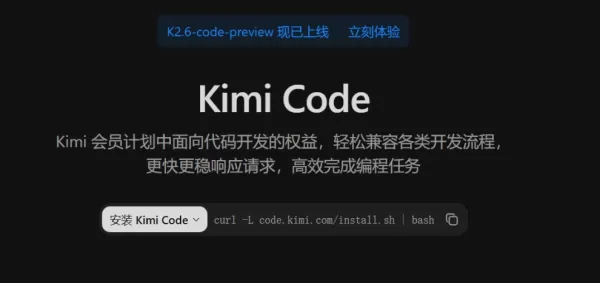
Core Evolution: Enhanced Reasoning and Reliability
Compared to its predecessors, K2.6-code-preview has undergone deep engineering optimization based on the trillion-parameter foundation (K2.5), with key advancements in three areas:
Reasoning Depth: It demonstrates stronger chain-of-thought capabilities, described by internal testers as having an "Opus-like" quality, with more rigorous logical reasoning.
Agent Planning: The model shows improved quality in global planning for AI agents handling complex projects.
Tool Calling: Reliability in multi-step tool calling is significantly enhanced, reducing error rates in long-chain tasks.
Benchmark Performance: A Top-Tier Rival to Sonnet4.6
Despite a relatively low-key official launch, community testing and ranking data place its performance firmly among the global elite:
Score Improvement: In developer evaluations, its score rose from 83 points for K2.5 to 89 points.
Leaderboard Standing: While K2.5 scored 76.8% on SWE-Bench Verified and 85% on LiveCodeBench, the new version is considered to match the practical performance level of Sonnet4.6.
Cost-Effectiveness: Compared to the expensive API costs of leading overseas models, Kimi has introduced a Kimi Code membership plan priced at 39 yuan per month, offering a highly cost-effective option for domestic developers.
Industry View: The "Pragmatic Turn" in Domestic Programming AI
Moonshot 's decision to serve subscription users directly via Kimi Code reflects an evolution in the commercialization strategy for domestic large models:
Scenario Focus: The focus shifts from merely showcasing parameter scale to deeply engaging with high-value programming scenarios through the specialized K2.6-code model.
Ecosystem Development: The low-barrier monthly subscription model aims to rapidly attract developer communities, fostering a closed-loop for AI-native application development within the Kimi ecosystem.
Conclusion: A Subtle Shift in the Programming Paradigm
With the introduction of Kimi K2.6-code, domestic AI programming tools now possess the capability to compete with global top-tier standards. For developers, this represents more than just another coding assistant; it is a "trillion-parameter intellectual partner" capable of understanding complex architectures and aiding in strategic decision-making.
Related article
 Anthropic Expands Claude AI Coding Tools to Japan in Push for Overseas Growth
Anthropic, a prominent U.S. artificial intelligence firm, is intensifying its global outreach. On Wednesday, the company hosted a major developer gathering, "Code with Claude," in Tokyo, drawing close to 500 software engineers. This initiative seeks
India’s Software Giant Cuts Hiring, Promises No Layoffs as AI Agents Scale Up
As artificial intelligence reshapes traditional labor-intensive business models, Tata Consultancy Services (TCS), a premier Indian software outsourcing firm, has unveiled its strategic response. During Tuesday’s annual general meeting, the chairman o
China Locks AI Models During Gaokam to Block Instant Homework Help
With the 2026 Gaokao fast approaching, rumors regarding the suspension of AI tools during the exam period have ignited intense online debate. In response to public concern, major AI platforms and educational apps have clarified their stance: rather t
Related Special Topic Recommendations
Design & Art
Anthropic Expands Claude AI Coding Tools to Japan in Push for Overseas Growth
Anthropic, a prominent U.S. artificial intelligence firm, is intensifying its global outreach. On Wednesday, the company hosted a major developer gathering, "Code with Claude," in Tokyo, drawing close to 500 software engineers. This initiative seeks
India’s Software Giant Cuts Hiring, Promises No Layoffs as AI Agents Scale Up
As artificial intelligence reshapes traditional labor-intensive business models, Tata Consultancy Services (TCS), a premier Indian software outsourcing firm, has unveiled its strategic response. During Tuesday’s annual general meeting, the chairman o
China Locks AI Models During Gaokam to Block Instant Homework Help
With the 2026 Gaokao fast approaching, rumors regarding the suspension of AI tools during the exam period have ignited intense online debate. In response to public concern, major AI platforms and educational apps have clarified their stance: rather t
Related Special Topic Recommendations
Design & Art
 Best AI Style Transfer Tools for Creative Experiments
2026 Latest Best Top-rated AI Style Transfer Tools for Creative Experiments! XIX.AI has curated a powerful, game-changing collection of must-try tools that deliver exceptional results through real-world tests and rigorous rankings. These top solutions help creatives boost productivity significantly by accelerating content creation and unlocking endless creative possibilities. Explore now to discover your perfect tool and start creating today!
 9 tools
 xix.ai
Comic Creation
Best AI Dialogue Bubble Tools for Visual Storytelling
xix.ai
Comic Creation
Best AI Dialogue Bubble Tools for Visual Storytelling
2026 Latest Best Top-Rated AI Dialogue Bubble Tools for Visual Storytelling are here on XIX.AI! This curated collection features powerful, game-changing tools that help creators boost productivity and overcome creative bottlenecks. Get a free vs paid comparison, see real-world tests, and check the latest rankings to find the must-try solutions perfect for crafting engaging visual narratives. Explore now to discover your ideal tool!
10 tools
xix.ai
Meeting Assistant
Top AI Meeting Summary Tools: Track Decisions and Follow-Ups Clearly
2026 Latest Top-Rated Best AI Meeting Summary Tools for Clear Decision Tracking and Effortless Follow-Ups. This curated list showcases powerful, game-changing solutions that boost productivity dramatically by automating meeting notes, identifying key action items, and streamlining team coordination across all projects. Get a free vs paid comparison along with real-world tests and weekly updated rankings to help you find the perfect tool. Explore now to unlock your AI edge!
9 tools
xix.ai
Data Analysis
Best AI Data Cleaning Tools: Fix Missing Values and Duplicates Fast
2026 Latest Best Top-rated AI Data Cleaning Tools for quick fixing of missing values and duplicates. This curated list showcases powerful, game-changing solutions that boost productivity significantly. Each option has undergone rigorous real-world tests to ensure reliability. Get a free vs paid comparison and discover the must-try tool that fits your needs best. Explore now at XIX.AI to Unlock your AI edge.
11 tools
xix.ai
Design & Art
Best AI Creative Ideation Tools for Artists: Break Through Visual Blocks
2026 Latest Best Top-Rated AI Creative Ideation Tools for Artists are curated by XIX.AI to help creators break through visual blocks and boost creativity instantly. These powerful game-changing tools offer real-world tests, detailed free vs paid comparison, and weekly updated rankings. Discover your perfect tool to accelerate content creation and unlock your AI edge today. Explore now!
14 tools
xix.ai
Music composition
AI Beat Makers for TikTok Background Tracks, Reels Audio, and Creator Promo Music
2026 Latest Best AI Beat Makers for TikTok Background Tracks, Reels Audio, and Creator Promo Music! XIX.AI has curated a top-rated list of powerful game-changing tools that go through real-world tests to deliver flawless music for every content need. You’ll find detailed free vs paid comparison data, weekly updated rankings, and must-try options to help you boost creativity and productivity. Explore now to discover your perfect tool!
11 tools
xix.ai

 Comments (1)
0/500
Comments (1)
0/500
![KevinSanchez]()
So Kimi finally dropped their trillion-parameter coding model? Honestly, the AI programming race is getting ridiculous—every week a new 'SOTA' pops up. I'm curious if K2.6 can actually handle real-world spaghetti code without hallucinating half the functions, or if it's just another benchmark overfit. Also, calling it a 'rival to Sonnet 4.6' feels like clickbait until I see third-party evals. 🤷♂️
Reports indicate that following GLM-5.1 and MiniMax2.7, Moonshot has officially launched a trillion-parameter large language model optimized for AI programming: Kimi K2.6-code-preview. The model is now accessible within Kimi Code, signifying the formal entry of domestic programming AI into the trillion-parameter era.
Core Evolution: Enhanced Reasoning and Reliability
Compared to its predecessors, K2.6-code-preview has undergone deep engineering optimization based on the trillion-parameter foundation (K2.5), with key advancements in three areas:
Reasoning Depth: It demonstrates stronger chain-of-thought capabilities, described by internal testers as having an "Opus-like" quality, with more rigorous logical reasoning.
Agent Planning: The model shows improved quality in global planning for AI agents handling complex projects.
Tool Calling: Reliability in multi-step tool calling is significantly enhanced, reducing error rates in long-chain tasks.
Benchmark Performance: A Top-Tier Rival to Sonnet4.6
Despite a relatively low-key official launch, community testing and ranking data place its performance firmly among the global elite:
Score Improvement: In developer evaluations, its score rose from 83 points for K2.5 to 89 points.
Leaderboard Standing: While K2.5 scored 76.8% on SWE-Bench Verified and 85% on LiveCodeBench, the new version is considered to match the practical performance level of Sonnet4.6.
Cost-Effectiveness: Compared to the expensive API costs of leading overseas models, Kimi has introduced a Kimi Code membership plan priced at 39 yuan per month, offering a highly cost-effective option for domestic developers.
Industry View: The "Pragmatic Turn" in Domestic Programming AI
Scenario Focus: The focus shifts from merely showcasing parameter scale to deeply engaging with high-value programming scenarios through the specialized K2.6-code model.
Ecosystem Development: The low-barrier monthly subscription model aims to rapidly attract developer communities, fostering a closed-loop for AI-native application development within the Kimi ecosystem.
Conclusion: A Subtle Shift in the Programming Paradigm
With the introduction of Kimi K2.6-code, domestic AI programming tools now possess the capability to compete with global top-tier standards. For developers, this represents more than just another coding assistant; it is a "trillion-parameter intellectual partner" capable of understanding complex architectures and aiding in strategic decision-making.








 Anthropic Expands Claude AI Coding Tools to Japan in Push for Overseas Growth
Anthropic, a prominent U.S. artificial intelligence firm, is intensifying its global outreach. On Wednesday, the company hosted a major developer gathering, "Code with Claude," in Tokyo, drawing close to 500 software engineers. This initiative seeks
Anthropic Expands Claude AI Coding Tools to Japan in Push for Overseas Growth
Anthropic, a prominent U.S. artificial intelligence firm, is intensifying its global outreach. On Wednesday, the company hosted a major developer gathering, "Code with Claude," in Tokyo, drawing close to 500 software engineers. This initiative seeks
 India’s Software Giant Cuts Hiring, Promises No Layoffs as AI Agents Scale Up
As artificial intelligence reshapes traditional labor-intensive business models, Tata Consultancy Services (TCS), a premier Indian software outsourcing firm, has unveiled its strategic response. During Tuesday’s annual general meeting, the chairman o
India’s Software Giant Cuts Hiring, Promises No Layoffs as AI Agents Scale Up
As artificial intelligence reshapes traditional labor-intensive business models, Tata Consultancy Services (TCS), a premier Indian software outsourcing firm, has unveiled its strategic response. During Tuesday’s annual general meeting, the chairman o
 China Locks AI Models During Gaokam to Block Instant Homework Help
With the 2026 Gaokao fast approaching, rumors regarding the suspension of AI tools during the exam period have ignited intense online debate. In response to public concern, major AI platforms and educational apps have clarified their stance: rather t
China Locks AI Models During Gaokam to Block Instant Homework Help
With the 2026 Gaokao fast approaching, rumors regarding the suspension of AI tools during the exam period have ignited intense online debate. In response to public concern, major AI platforms and educational apps have clarified their stance: rather t

2026 Latest Best Top-rated AI Style Transfer Tools for Creative Experiments! XIX.AI has curated a powerful, game-changing collection of must-try tools that deliver exceptional results through real-world tests and rigorous rankings. These top solutions help creatives boost productivity significantly by accelerating content creation and unlocking endless creative possibilities. Explore now to discover your perfect tool and start creating today!
9 tools
xix.ai

2026 Latest Best Top-Rated AI Dialogue Bubble Tools for Visual Storytelling are here on XIX.AI! This curated collection features powerful, game-changing tools that help creators boost productivity and overcome creative bottlenecks. Get a free vs paid comparison, see real-world tests, and check the latest rankings to find the must-try solutions perfect for crafting engaging visual narratives. Explore now to discover your ideal tool!
10 tools
xix.ai

2026 Latest Top-Rated Best AI Meeting Summary Tools for Clear Decision Tracking and Effortless Follow-Ups. This curated list showcases powerful, game-changing solutions that boost productivity dramatically by automating meeting notes, identifying key action items, and streamlining team coordination across all projects. Get a free vs paid comparison along with real-world tests and weekly updated rankings to help you find the perfect tool. Explore now to unlock your AI edge!
9 tools
xix.ai

2026 Latest Best Top-rated AI Data Cleaning Tools for quick fixing of missing values and duplicates. This curated list showcases powerful, game-changing solutions that boost productivity significantly. Each option has undergone rigorous real-world tests to ensure reliability. Get a free vs paid comparison and discover the must-try tool that fits your needs best. Explore now at XIX.AI to Unlock your AI edge.
11 tools
xix.ai

2026 Latest Best Top-Rated AI Creative Ideation Tools for Artists are curated by XIX.AI to help creators break through visual blocks and boost creativity instantly. These powerful game-changing tools offer real-world tests, detailed free vs paid comparison, and weekly updated rankings. Discover your perfect tool to accelerate content creation and unlock your AI edge today. Explore now!
14 tools
xix.ai

2026 Latest Best AI Beat Makers for TikTok Background Tracks, Reels Audio, and Creator Promo Music! XIX.AI has curated a top-rated list of powerful game-changing tools that go through real-world tests to deliver flawless music for every content need. You’ll find detailed free vs paid comparison data, weekly updated rankings, and must-try options to help you boost creativity and productivity. Explore now to discover your perfect tool!
11 tools
xix.ai

So Kimi finally dropped their trillion-parameter coding model? Honestly, the AI programming race is getting ridiculous—every week a new 'SOTA' pops up. I'm curious if K2.6 can actually handle real-world spaghetti code without hallucinating half the functions, or if it's just another benchmark overfit. Also, calling it a 'rival to Sonnet 4.6' feels like clickbait until I see third-party evals. 🤷♂️












