


 Home
Astropad's Workbench reframes remote desktop for AI agents, not IT support
Demand for Apple’s Mac Mini has surged, especially in China, as the compact computer becomes a go-to platform for testing autonomous AI agents like OpenClaw and similar systems. Now, Astropad is developing a remote desktop solution tailored specifically for this purpose.
On Tuesday, Astropad CEO Matt Ronge unveiled Astropad Workbench, a remote desktop solution for Apple devices that he describes as built “for the AI era.”
Although an AI agent running on a Mac Mini may not require its own display, the human operator will likely want to log in occasionally to review logs, monitor outputs, or restart stalled tasks, Ronge explains.
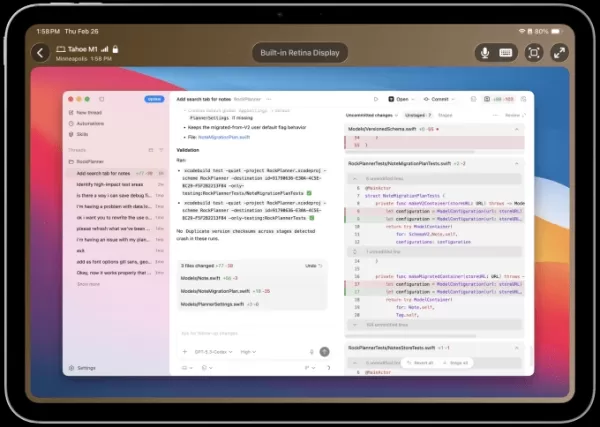
Image Credits:Astropad
The new remote desktop solution includes a range of features: high-fidelity streaming, voice-based prompts and commands, support for input methods like keyboard, Apple Pencil, or touch, and clients for both iPad and iPhone. The mobile client effectively puts the remote desktop tool in your pocket for access on the move.
If you run AI agents across multiple Macs, Workbench includes a device selector for easy switching between them.
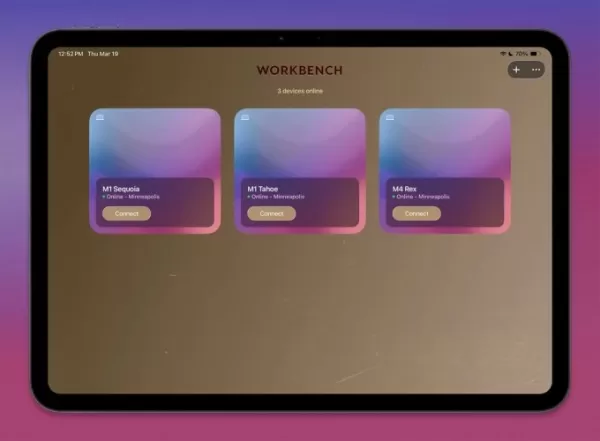
Image Credits:Astropad
The concept emerged because the Astropad team and their peers wanted this capability for themselves.
“At Astropad, we’ve heavily adopted AI and have been using agents. Sometimes, an agent runs a long task and you want to check on it,” says Ronge. “There wasn’t a good way to do that…existing remote desktop tools existed, but nothing was built specifically for this,” he continues. “You could use a terminal or something like Telegram chats, but those are limited. There are times you need to see what’s happening on your Mac, approve a dialog, save something, or just visually inspect the status.”
Workbench also uses Astropad’s proprietary low-latency display protocol, called LIQUID, which supports workflows for creative professionals. It maintains full fidelity even at Retina resolutions, according to Astropad, without blurring lines or pixelating data. This protocol already powers other Astropad products, such as Luna Display, which turns an iPad into a second monitor, and Astropad Studio, which allows using an iPad as a professional drawing tablet.
While monitoring an AI agent may not always demand a high-fidelity solution, Ronge notes it’s a welcome feature, especially when reviewing designs or mock-ups created by the AI agent.
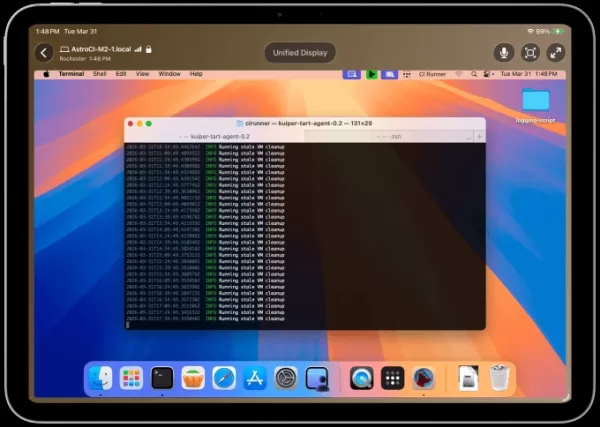
Image Credits:Astropad
Of course, remote desktop software has been around for a while, meaning Astropad faces well-established competitors like Jump Desktop, RustDesk, AnyDesk, Parsec, VNC-based solutions, and many others.
But Ronge argues those tools were not designed for the specific use of tracking AI agents via remote desktop. With Workbench, it’s straightforward to check log status, monitor AI agent progress, spot issues, restart stalled jobs, and make adjustments. And you can do all this from your iPhone or iPad.
“We’ve focused on iPad development for years—it’s been our entire company for the past decade. We bring a lot of experience in building quality iPad apps,” Ronge says. “We know how to create strong iOS apps…so we did that, and we also added a voice model.”
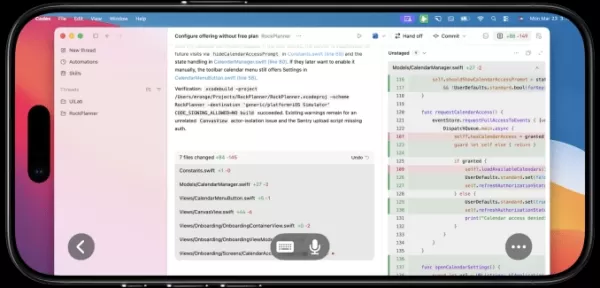
Image Credits:Astropad
The technology leverages Apple’s voice model, allowing you to speak to your phone and direct your AI agent by pressing the microphone button.
“It’s a very natural way to interact with agents. That’s the kind of feature existing remote desktop apps simply don’t have—they’re built for more traditional, enterprise-style remote desktop use.”
As a new release, some bugs and polishing are expected, but the team continues to refine the product. Next steps include launching support for Windows and Linux, as well as improving the iPhone app.
The software runs on macOS 15 and later, and iOS 26, and is available as a free download with 20 minutes of daily access. For unlimited access, the cost is $10 per month or $50 per year.
Astropad, a bootstrapped and profitable small tech company, has over 100,000 customers who have purchased its iPad hardware accessories and software. With Workbench, Ronge believes the company can reach both AI enthusiasts and businesses as remote support for AI agents becomes more common.
“I absolutely think businesses will buy it. The productivity gains I’m already seeing point straight to enterprise adoption. It’s just too powerful,” he notes.
Related article
 Stripe to Acquire OpenRouter as AI Model Routing Gains Momentum
Stripe has agreed to acquire OpenRouter, an AI model-routing platform that gives developers access to hundreds of models through a single interface. The deal adds model selection and routing to Stripe’s existing work around AI usage and token-based b
Google AI Overviews Gain Ground in Search Results
According to Similarweb’s 2026 Generative AI Landscape report, Google’s AI-generated summaries appeared in 43% of US searches, a significant rise from 15% recorded a year prior.While AI Overviews present generated summaries within standard search res
Ando Launches Team Messaging App Bridging Human and AI Collaboration
In 2025, as Sara Du assisted companies in developing MCP servers, a recurring question emerged: how could teams leverage AI agents directly within Slack? The path was obstructed by significant technical barriers, including the complexity of message s
Related Special Topic Recommendations
Design & Art
 Top AI Illustration Tools: Create Editorial Scenes and Cover Art Faster
2026 Latest Top-rated AI Illustration Tools: Our curated list features the best powerfully designed tools for creating stunning editorial scenes and eye-catching cover art quickly. Each option has gone through rigorous real-world tests, offering a free vs paid comparison to help you find the perfect match for your workflow. Try these must-try solutions today to unlock your AI edge and boost your creative productivity. Explore now at XIX.AI.
 10 tools
 xix.ai
Education and Learning
Top AI Tutors for Exam Prep: Practice Math, Science, and English
2026 Latest Top-Rated Best AI Tutors for Exam Prep are here on XIX.AI! Our curated list features powerful game-changing tools that offer free vs paid comparison, real-world tests, and weekly updated rankings. They help boost your writing efficiency, simplify complex topic learning, and unlock your academic potential. Explore now to Discover your perfect exam prep tool and Start creating today to Unlock your AI edge!
10 tools
xix.ai
Finance
AI Budget Planning Tools for Personal Money Management
2026 Latest Best Top-Rated AI Budget Planning Tools for Personal Money Management are here on XIX.AI! This curated collection features powerful, game-changing solutions that help you conduct real-world tests, understand spending habits, and create personalized plans to boost productivity. Enjoy a free vs paid comparison along with detailed rankings. Must-try tools designed to simplify money management and unlock your AI edge. Explore now!
11 tools
xix.ai
Health & Wellness
AI Sleep Tracking Assistants: Improve Recovery with Better Bedtime Habits
2026 Latest Best Top-Rated AI Sleep Tracking Assistants curated for ultimate recovery. This fully updated weekly guide features powerful tools that deliver real-world tests, free vs paid comparison, and detailed rankings to help you find the must-try solution that boosts sleep quality and supports better bedtime habits. Explore now at XIX.AI to Unlock your AI edge.
10 tools
xix.ai
Data Analysis
AI SQL Copilots for Product and Revenue Analytics
2026 Latest Best Top-Rated AI SQL Copilots for Product and Revenue Analytics! XIX.AI has curated a powerful, game-changing collection of must-try tools that undergo real-world tests through weekly updated rankings. These tools help users boost productivity significantly by accelerating data analysis, streamlining complex queries, and generating accurate insights to drive smarter business decisions. Explore now to Discover your perfect tool for unlocking your AI edge!
14 tools
xix.ai
Education and Learning
Best AI Homework Helpers That Teach: Learn Concepts, Not Just Answers
2026 Latest Best Top-Rated AI Homework Helpers That Teach Core Concepts Not Just Answers Powerful Tools for Students Must-Try Curated List Weekly Updated Free vs Paid Comparison Real-World Tests Accurate Rankings to Help You Unlock Your Full Learning Potential Explore now to Discover your perfect tool for smarter studying.
10 tools
xix.ai

 Comments (1)
0/500
![MarkGonzalez]()
Wait, so Astropad is basically building a remote desktop for AI bots instead of humans? That's a clever twist — I always thought remote desktop tools were just for IT guys fixing grandma's computer. 😂 The Mac Mini being the go-to AI testbed in China makes sense though, cheap and powerful enough to run OpenClaw. Curious how this changes the game for autonomous agents, maybe we'll see more tailored hardware for AI testing soon.
Demand for Apple’s Mac Mini has surged, especially in China, as the compact computer becomes a go-to platform for testing autonomous AI agents like OpenClaw and similar systems. Now, Astropad is developing a remote desktop solution tailored specifically for this purpose.
On Tuesday, Astropad CEO Matt Ronge unveiled Astropad Workbench, a remote desktop solution for Apple devices that he describes as built “for the AI era.”
Although an AI agent running on a Mac Mini may not require its own display, the human operator will likely want to log in occasionally to review logs, monitor outputs, or restart stalled tasks, Ronge explains.
Image Credits:Astropad
The new remote desktop solution includes a range of features: high-fidelity streaming, voice-based prompts and commands, support for input methods like keyboard, Apple Pencil, or touch, and clients for both iPad and iPhone. The mobile client effectively puts the remote desktop tool in your pocket for access on the move.
If you run AI agents across multiple Macs, Workbench includes a device selector for easy switching between them.
Image Credits:Astropad
The concept emerged because the Astropad team and their peers wanted this capability for themselves.
“At Astropad, we’ve heavily adopted AI and have been using agents. Sometimes, an agent runs a long task and you want to check on it,” says Ronge. “There wasn’t a good way to do that…existing remote desktop tools existed, but nothing was built specifically for this,” he continues. “You could use a terminal or something like Telegram chats, but those are limited. There are times you need to see what’s happening on your Mac, approve a dialog, save something, or just visually inspect the status.”
Workbench also uses Astropad’s proprietary low-latency display protocol, called LIQUID, which supports workflows for creative professionals. It maintains full fidelity even at Retina resolutions, according to Astropad, without blurring lines or pixelating data. This protocol already powers other Astropad products, such as Luna Display, which turns an iPad into a second monitor, and Astropad Studio, which allows using an iPad as a professional drawing tablet.
While monitoring an AI agent may not always demand a high-fidelity solution, Ronge notes it’s a welcome feature, especially when reviewing designs or mock-ups created by the AI agent.
Image Credits:Astropad
Of course, remote desktop software has been around for a while, meaning Astropad faces well-established competitors like Jump Desktop, RustDesk, AnyDesk, Parsec, VNC-based solutions, and many others.
But Ronge argues those tools were not designed for the specific use of tracking AI agents via remote desktop. With Workbench, it’s straightforward to check log status, monitor AI agent progress, spot issues, restart stalled jobs, and make adjustments. And you can do all this from your iPhone or iPad.
“We’ve focused on iPad development for years—it’s been our entire company for the past decade. We bring a lot of experience in building quality iPad apps,” Ronge says. “We know how to create strong iOS apps…so we did that, and we also added a voice model.”
Image Credits:Astropad
The technology leverages Apple’s voice model, allowing you to speak to your phone and direct your AI agent by pressing the microphone button.
“It’s a very natural way to interact with agents. That’s the kind of feature existing remote desktop apps simply don’t have—they’re built for more traditional, enterprise-style remote desktop use.”
As a new release, some bugs and polishing are expected, but the team continues to refine the product. Next steps include launching support for Windows and Linux, as well as improving the iPhone app.
The software runs on macOS 15 and later, and iOS 26, and is available as a free download with 20 minutes of daily access. For unlimited access, the cost is $10 per month or $50 per year.
Astropad, a bootstrapped and profitable small tech company, has over 100,000 customers who have purchased its iPad hardware accessories and software. With Workbench, Ronge believes the company can reach both AI enthusiasts and businesses as remote support for AI agents becomes more common.
“I absolutely think businesses will buy it. The productivity gains I’m already seeing point straight to enterprise adoption. It’s just too powerful,” he notes.








 Stripe to Acquire OpenRouter as AI Model Routing Gains Momentum
Stripe has agreed to acquire OpenRouter, an AI model-routing platform that gives developers access to hundreds of models through a single interface. The deal adds model selection and routing to Stripe’s existing work around AI usage and token-based b
 Google AI Overviews Gain Ground in Search Results
According to Similarweb’s 2026 Generative AI Landscape report, Google’s AI-generated summaries appeared in 43% of US searches, a significant rise from 15% recorded a year prior.While AI Overviews present generated summaries within standard search res
 Ando Launches Team Messaging App Bridging Human and AI Collaboration
In 2025, as Sara Du assisted companies in developing MCP servers, a recurring question emerged: how could teams leverage AI agents directly within Slack? The path was obstructed by significant technical barriers, including the complexity of message s

2026 Latest Top-rated AI Illustration Tools: Our curated list features the best powerfully designed tools for creating stunning editorial scenes and eye-catching cover art quickly. Each option has gone through rigorous real-world tests, offering a free vs paid comparison to help you find the perfect match for your workflow. Try these must-try solutions today to unlock your AI edge and boost your creative productivity. Explore now at XIX.AI.
10 tools
xix.ai

2026 Latest Top-Rated Best AI Tutors for Exam Prep are here on XIX.AI! Our curated list features powerful game-changing tools that offer free vs paid comparison, real-world tests, and weekly updated rankings. They help boost your writing efficiency, simplify complex topic learning, and unlock your academic potential. Explore now to Discover your perfect exam prep tool and Start creating today to Unlock your AI edge!
10 tools
xix.ai

2026 Latest Best Top-Rated AI Budget Planning Tools for Personal Money Management are here on XIX.AI! This curated collection features powerful, game-changing solutions that help you conduct real-world tests, understand spending habits, and create personalized plans to boost productivity. Enjoy a free vs paid comparison along with detailed rankings. Must-try tools designed to simplify money management and unlock your AI edge. Explore now!
11 tools
xix.ai

2026 Latest Best Top-Rated AI Sleep Tracking Assistants curated for ultimate recovery. This fully updated weekly guide features powerful tools that deliver real-world tests, free vs paid comparison, and detailed rankings to help you find the must-try solution that boosts sleep quality and supports better bedtime habits. Explore now at XIX.AI to Unlock your AI edge.
10 tools
xix.ai

2026 Latest Best Top-Rated AI SQL Copilots for Product and Revenue Analytics! XIX.AI has curated a powerful, game-changing collection of must-try tools that undergo real-world tests through weekly updated rankings. These tools help users boost productivity significantly by accelerating data analysis, streamlining complex queries, and generating accurate insights to drive smarter business decisions. Explore now to Discover your perfect tool for unlocking your AI edge!
14 tools
xix.ai

2026 Latest Best Top-Rated AI Homework Helpers That Teach Core Concepts Not Just Answers Powerful Tools for Students Must-Try Curated List Weekly Updated Free vs Paid Comparison Real-World Tests Accurate Rankings to Help You Unlock Your Full Learning Potential Explore now to Discover your perfect tool for smarter studying.
10 tools
xix.ai

Wait, so Astropad is basically building a remote desktop for AI bots instead of humans? That's a clever twist — I always thought remote desktop tools were just for IT guys fixing grandma's computer. 😂 The Mac Mini being the go-to AI testbed in China makes sense though, cheap and powerful enough to run OpenClaw. Curious how this changes the game for autonomous agents, maybe we'll see more tailored hardware for AI testing soon.












