


 Home
HomeApple App Store Reviews Could Be Slowed by AI Ambient Programming, Developers Caution
Since agent-based programming became mainstream in 2025, a methodology known as "vibe coding" has rapidly gained traction in the developer community. This new paradigm enables almost anyone to generate functional applications quickly through natural language descriptions.
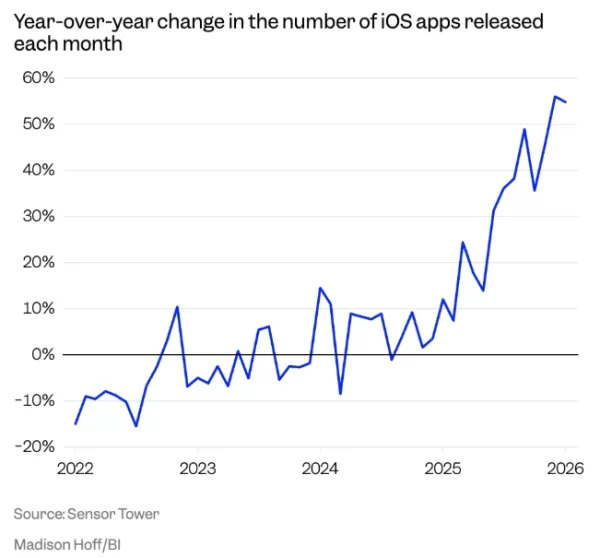
However, data from market intelligence firm Sensor Tower indicates that this low-barrier approach to development has led to a sharp surge in App Store submissions. In the United States alone, January of this year saw a 54.8% year-over-year increase in new iOS app launches—the highest volume in four years. This surge is placing unprecedented strain on Apple's app review system.
Extended Review Times: The Challenge of Shifting from Artisanal Review to Scalable Curation
The flood of AI-generated "vibe apps" has directly resulted in longer app review times from Apple. Independent developers report that the process to launch an app has stretched from a few days to several weeks, with some waiting for over six weeks. While Apple officially states that 90% of apps are still reviewed within 48 hours, concerns within the developer community are growing about the platform being overwhelmed by low-effort "AI slop."
Industry analysts suggest Apple may be compelled to tighten its review standards, transitioning from meticulous manual oversight to a more scalable, automated curation system to filter out low-quality submissions.
A New Profession Emerges: Platforms Like Lovable Are Hiring "Professional Vibe Programmers"
Despite the review bottlenecks, "vibe coding" is evolving into a legitimate career path. Platforms such as Lovable have begun publicly recruiting "professional vibe programmers" for full-time roles.
This evolution signifies a shift in programming's core skill set—from writing precise code to articulating intent and curating aesthetic quality. For Apple, the central challenge for its App Store policies in 2026 will be balancing ecosystem quality and security with the encouragement of innovative new technologies.
Related article
 Inside Details Exposed About Next-Gen Gemini: Strained Computing Power, Internal Teams Disagreed on Development Priorities and Resource Allocation
Reports indicate that the launch of Google’s highly anticipated next-generation Gemini model has been pushed back. Internal disagreements over development priorities and resource allocation, combined with limited computing capacity and complex approv
OpenAI Dismisses Growth Slowdown Concerns, Says Multiple Business Units Accelerating
In response to external scrutiny regarding decelerating sales growth and missed internal benchmarks, AI leader OpenAI issued a confident statement on Tuesday, April 28. The company clarified that its consumer products and enterprise services are adva
Alibaba Super Cup: Qwen3.8-Max Debuts with Boosted Coding and Office Tools
Alibaba has officially unveiled Qwen3.8-Max, a next-generation foundation large model boasting 2.4 trillion parameters. This significant AI advancement delivers substantial performance gains in core areas like coding and professional office tasks, sh
Related Special Topic Recommendations
Music composition
Inside Details Exposed About Next-Gen Gemini: Strained Computing Power, Internal Teams Disagreed on Development Priorities and Resource Allocation
Reports indicate that the launch of Google’s highly anticipated next-generation Gemini model has been pushed back. Internal disagreements over development priorities and resource allocation, combined with limited computing capacity and complex approv
OpenAI Dismisses Growth Slowdown Concerns, Says Multiple Business Units Accelerating
In response to external scrutiny regarding decelerating sales growth and missed internal benchmarks, AI leader OpenAI issued a confident statement on Tuesday, April 28. The company clarified that its consumer products and enterprise services are adva
Alibaba Super Cup: Qwen3.8-Max Debuts with Boosted Coding and Office Tools
Alibaba has officially unveiled Qwen3.8-Max, a next-generation foundation large model boasting 2.4 trillion parameters. This significant AI advancement delivers substantial performance gains in core areas like coding and professional office tasks, sh
Related Special Topic Recommendations
Music composition
 Best AI Melody Writing Tools for Song Drafts
2026 Latest Best Top-Rated AI Melody Writing Tools for Song Drafts! XIX.AI has curated a highly powerful game-changing collection that goes through rigorous real-world tests to deliver the best writing experience. You can find detailed free vs paid comparisons, accurate rankings, and must-try options designed to help you create stunning song drafts effortlessly and boost your creative productivity significantly. Explore now to discover your perfect tool!
 8 tools
 xix.ai
chatbot
Best AI Conversation Trainer Tools for Interview Practice
xix.ai
chatbot
Best AI Conversation Trainer Tools for Interview Practice
2026 Latest Best Top-rated AI Conversation Trainer Tools for Interview Practice are here on XIX.AI! This curated collection features powerful, game-changing tools that go through rigorous real-world tests to deliver accurate feedback. You’ll find a free vs paid comparison and detailed rankings to help you choose the must-try option that boosts your confidence and skills. Explore now to Discover your perfect tool for interview success!
12 tools
xix.ai
Design & Art
Best AI Style Transfer Tools for Creative Experiments
2026 Latest Best Top-rated AI Style Transfer Tools for Creative Experiments! XIX.AI has curated a powerful, game-changing collection of must-try tools that deliver exceptional results through real-world tests and rigorous rankings. These top solutions help creatives boost productivity significantly by accelerating content creation and unlocking endless creative possibilities. Explore now to discover your perfect tool and start creating today!
9 tools
xix.ai
Comic Creation
Best AI Dialogue Bubble Tools for Visual Storytelling
2026 Latest Best Top-Rated AI Dialogue Bubble Tools for Visual Storytelling are here on XIX.AI! This curated collection features powerful, game-changing tools that help creators boost productivity and overcome creative bottlenecks. Get a free vs paid comparison, see real-world tests, and check the latest rankings to find the must-try solutions perfect for crafting engaging visual narratives. Explore now to discover your ideal tool!
10 tools
xix.ai
Meeting Assistant
Top AI Meeting Summary Tools: Track Decisions and Follow-Ups Clearly
2026 Latest Top-Rated Best AI Meeting Summary Tools for Clear Decision Tracking and Effortless Follow-Ups. This curated list showcases powerful, game-changing solutions that boost productivity dramatically by automating meeting notes, identifying key action items, and streamlining team coordination across all projects. Get a free vs paid comparison along with real-world tests and weekly updated rankings to help you find the perfect tool. Explore now to unlock your AI edge!
9 tools
xix.ai
Data Analysis
Best AI Data Cleaning Tools: Fix Missing Values and Duplicates Fast
2026 Latest Best Top-rated AI Data Cleaning Tools for quick fixing of missing values and duplicates. This curated list showcases powerful, game-changing solutions that boost productivity significantly. Each option has undergone rigorous real-world tests to ensure reliability. Get a free vs paid comparison and discover the must-try tool that fits your needs best. Explore now at XIX.AI to Unlock your AI edge.
11 tools
xix.ai

 Comments (4)
0/500
Comments (4)
0/500
![BenLewis]()
Interesting take! I've seen vibe coding produce some wild apps, but I'm worried about quality control in the App Store. Apple's review process already takes forever, and if AI-generated apps flood in, it could get even slower. 😅
![WillieJones]()
AIがレビューを遅らせるって本当?🤔 開発者側の懸念は分かるけど、ユーザーとしても質の低いアプリが増えるのは困るな。自然言語でアプリ作れるのは確かにすごいけど、App Storeの審査が追いつかないと、結局はユーザーが迷惑する気がする。Appleはどう対応するんだろう。
![WalterKing]()
Vibe Coding klingt nach einer coolen Idee, aber wenn dadurch die App Store-Bewertungen langsamer werden, ist das echt problematisch. Als Entwickler hoffe ich, dass Apple hier eine gute Lösung findet, die Qualität nicht unter der Geschwindigkeit leidet. 🤔
![JustinHarris]()
Interesting read! As a hobbyist coder, I'm both excited and a bit worried about 'vibe coding' making app development so accessible. Could this lead to a flood of low-quality apps that drown out genuinely innovative ones? The App Store review process might need a major AI upgrade itself to keep up. 🤔
Since agent-based programming became mainstream in 2025, a methodology known as "vibe coding" has rapidly gained traction in the developer community. This new paradigm enables almost anyone to generate functional applications quickly through natural language descriptions.
However, data from market intelligence firm Sensor Tower indicates that this low-barrier approach to development has led to a sharp surge in App Store submissions. In the United States alone, January of this year saw a 54.8% year-over-year increase in new iOS app launches—the highest volume in four years. This surge is placing unprecedented strain on Apple's app review system.
Extended Review Times: The Challenge of Shifting from Artisanal Review to Scalable Curation
The flood of AI-generated "vibe apps" has directly resulted in longer app review times from Apple. Independent developers report that the process to launch an app has stretched from a few days to several weeks, with some waiting for over six weeks. While Apple officially states that 90% of apps are still reviewed within 48 hours, concerns within the developer community are growing about the platform being overwhelmed by low-effort "AI slop."
Industry analysts suggest Apple may be compelled to tighten its review standards, transitioning from meticulous manual oversight to a more scalable, automated curation system to filter out low-quality submissions.
A New Profession Emerges: Platforms Like Lovable Are Hiring "Professional Vibe Programmers"
Despite the review bottlenecks, "vibe coding" is evolving into a legitimate career path. Platforms such as Lovable have begun publicly recruiting "professional vibe programmers" for full-time roles.
This evolution signifies a shift in programming's core skill set—from writing precise code to articulating intent and curating aesthetic quality. For Apple, the central challenge for its App Store policies in 2026 will be balancing ecosystem quality and security with the encouragement of innovative new technologies.








 Inside Details Exposed About Next-Gen Gemini: Strained Computing Power, Internal Teams Disagreed on Development Priorities and Resource Allocation
Reports indicate that the launch of Google’s highly anticipated next-generation Gemini model has been pushed back. Internal disagreements over development priorities and resource allocation, combined with limited computing capacity and complex approv
Inside Details Exposed About Next-Gen Gemini: Strained Computing Power, Internal Teams Disagreed on Development Priorities and Resource Allocation
Reports indicate that the launch of Google’s highly anticipated next-generation Gemini model has been pushed back. Internal disagreements over development priorities and resource allocation, combined with limited computing capacity and complex approv
 OpenAI Dismisses Growth Slowdown Concerns, Says Multiple Business Units Accelerating
In response to external scrutiny regarding decelerating sales growth and missed internal benchmarks, AI leader OpenAI issued a confident statement on Tuesday, April 28. The company clarified that its consumer products and enterprise services are adva
OpenAI Dismisses Growth Slowdown Concerns, Says Multiple Business Units Accelerating
In response to external scrutiny regarding decelerating sales growth and missed internal benchmarks, AI leader OpenAI issued a confident statement on Tuesday, April 28. The company clarified that its consumer products and enterprise services are adva
 Alibaba Super Cup: Qwen3.8-Max Debuts with Boosted Coding and Office Tools
Alibaba has officially unveiled Qwen3.8-Max, a next-generation foundation large model boasting 2.4 trillion parameters. This significant AI advancement delivers substantial performance gains in core areas like coding and professional office tasks, sh
Alibaba Super Cup: Qwen3.8-Max Debuts with Boosted Coding and Office Tools
Alibaba has officially unveiled Qwen3.8-Max, a next-generation foundation large model boasting 2.4 trillion parameters. This significant AI advancement delivers substantial performance gains in core areas like coding and professional office tasks, sh
2026 Latest Best Top-Rated AI Melody Writing Tools for Song Drafts! XIX.AI has curated a highly powerful game-changing collection that goes through rigorous real-world tests to deliver the best writing experience. You can find detailed free vs paid comparisons, accurate rankings, and must-try options designed to help you create stunning song drafts effortlessly and boost your creative productivity significantly. Explore now to discover your perfect tool!
8 tools
xix.ai
2026 Latest Best Top-rated AI Conversation Trainer Tools for Interview Practice are here on XIX.AI! This curated collection features powerful, game-changing tools that go through rigorous real-world tests to deliver accurate feedback. You’ll find a free vs paid comparison and detailed rankings to help you choose the must-try option that boosts your confidence and skills. Explore now to Discover your perfect tool for interview success!
12 tools
xix.ai

2026 Latest Best Top-rated AI Style Transfer Tools for Creative Experiments! XIX.AI has curated a powerful, game-changing collection of must-try tools that deliver exceptional results through real-world tests and rigorous rankings. These top solutions help creatives boost productivity significantly by accelerating content creation and unlocking endless creative possibilities. Explore now to discover your perfect tool and start creating today!
9 tools
xix.ai

2026 Latest Best Top-Rated AI Dialogue Bubble Tools for Visual Storytelling are here on XIX.AI! This curated collection features powerful, game-changing tools that help creators boost productivity and overcome creative bottlenecks. Get a free vs paid comparison, see real-world tests, and check the latest rankings to find the must-try solutions perfect for crafting engaging visual narratives. Explore now to discover your ideal tool!
10 tools
xix.ai
2026 Latest Top-Rated Best AI Meeting Summary Tools for Clear Decision Tracking and Effortless Follow-Ups. This curated list showcases powerful, game-changing solutions that boost productivity dramatically by automating meeting notes, identifying key action items, and streamlining team coordination across all projects. Get a free vs paid comparison along with real-world tests and weekly updated rankings to help you find the perfect tool. Explore now to unlock your AI edge!
9 tools
xix.ai
2026 Latest Best Top-rated AI Data Cleaning Tools for quick fixing of missing values and duplicates. This curated list showcases powerful, game-changing solutions that boost productivity significantly. Each option has undergone rigorous real-world tests to ensure reliability. Get a free vs paid comparison and discover the must-try tool that fits your needs best. Explore now at XIX.AI to Unlock your AI edge.
11 tools
xix.ai

Interesting take! I've seen vibe coding produce some wild apps, but I'm worried about quality control in the App Store. Apple's review process already takes forever, and if AI-generated apps flood in, it could get even slower. 😅
AIがレビューを遅らせるって本当?🤔 開発者側の懸念は分かるけど、ユーザーとしても質の低いアプリが増えるのは困るな。自然言語でアプリ作れるのは確かにすごいけど、App Storeの審査が追いつかないと、結局はユーザーが迷惑する気がする。Appleはどう対応するんだろう。
Vibe Coding klingt nach einer coolen Idee, aber wenn dadurch die App Store-Bewertungen langsamer werden, ist das echt problematisch. Als Entwickler hoffe ich, dass Apple hier eine gute Lösung findet, die Qualität nicht unter der Geschwindigkeit leidet. 🤔
Interesting read! As a hobbyist coder, I'm both excited and a bit worried about 'vibe coding' making app development so accessible. Could this lead to a flood of low-quality apps that drown out genuinely innovative ones? The App Store review process might need a major AI upgrade itself to keep up. 🤔












