


 Home
HomeAnthropic Set to Launch Claude Opus 4.7 and New AI Design Tools This Week
AIbase Report | April 16, 2026
Anthropic's update cadence has accelerated dramatically in recent months, making it challenging to track—since January, nearly every two weeks has brought a major release, including new models, Claude Code, Cowork, Excel plugins, and more. The news cycle is intensifying once again: according to an exclusive report from The Information, Claude Opus 4.7 and a novel AI-powered design tool could launch this week. On the day this news emerged, stock prices for Adobe, Figma, and Wix each fell by over 2%.
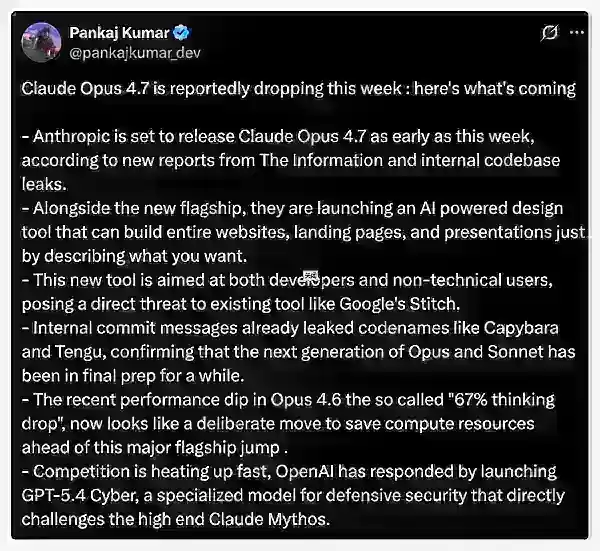


Opus 4.7 appeared in a leak on Google Vertex AI
What to Expect This Time
First, the model. Opus 4.7 represents an incremental upgrade from Claude Opus 4.6, which launched in February. Version 4.6 introduced enhanced coding proficiency, improved agent task execution, and a 1 million token context window. Recent appearances of internal API references for Opus 4.7 suggest its release is imminent.
Community developers have already discovered configuration switches for Opus 4.7 in API settings and spotted it listed among the models on Google Vertex AI. Source code for Claude Code was also inadvertently leaked, revealing mentions of Opus 4.7 and Sonnet 4.8, as well as the newly introduced Routines feature—most of which have since been officially confirmed.
The item that truly captured attention was the design tool. Anthropic is preparing to launch an AI-driven design application that enables users to generate websites, presentations, and landing pages through natural language prompts. This tool caters to both developers and non-technical users, positioning it as a direct competitor to startups like Gamma and Google's Stitch. In essence, Anthropic is no longer content with merely selling models—it aims to productize the concept of "describing a need and receiving a functional product."
Why Did Adobe and Figma Shares Decline?
The context here is broader. The S&P 500 software and services index has dropped nearly 26% this year, with investors concerned that AI tools may erode demand for traditional software products. When Anthropic previously launched the Claude Cowork assistant and a suite of automation plugins, software stocks similarly experienced significant sell-offs.
Simply put, the market's worry isn't about one tool replacing another. The concern is that if the "prompt-as-design" paradigm gains traction, a substantial portion of the traditional software toolchain could be disrupted. Anthropic already partners with Figma—translating AI-generated code into editable design files—and Claude is integrated into Microsoft Word and PowerPoint. This dynamic of "both collaboration and direct competition" creates more uncertainty than the launch of a straightforward rival.
Opus 4.7 Isn't Anthropic's Ultimate Offering
A notable detail in the report is that Opus 4.7 is not Anthropic's most advanced model. That distinction belongs to Claude Mythos, which is currently being used by a select group of partners for security vulnerability research.
Mythos follows a completely different development path—Anthropic builds its frontier models by fine-tuning the Opus series. Opus 4.7 serves as the foundational model that will eventually be "infused with cybersecurity capabilities" and hardened into Mythos. When the UK AI Safety Institute evaluated the Mythos Preview, they found it could autonomously execute complex network attack sequences beyond the reach of other models. Consequently, Anthropic has kept Mythos confined within its Project Glasswing initiative, with a broader unveiling expected in San Francisco this May.
This "dual-track" strategy reflects Anthropic's current posture: the commercial line (Opus) iterates rapidly and competes aggressively, while the frontier line (Mythos) remains under strict control, focused on safety and not rushed to market.
Valuation Context: From $80 Billion to $800 Billion
Investors have valued Anthropic as high as $800 billion, more than double its $380 billion valuation from a funding round in February. On the secondary market platform Caplight, Anthropic's current trading valuation stands at $688 billion, a 75% increase over three months. For comparison, OpenAI's latest valuation was $85.2 billion.
The soaring valuation is driven by revenue growth. Anthropic reports its annualized revenue has climbed from $9 billion at the end of 2025 to $30 billion, with over 1,000 enterprise customers each spending more than $1 million annually. This customer count has doubled in less than two months.
However, rising costs are becoming evident. As computational expenses surge, Anthropic is shifting from fixed enterprise pricing to usage-based billing, which could double or triple costs for heavy users. This change coincides with increased reasoning costs from tools like Claude Code and Claude Cowork, alongside tightening availability of compute resources.
For developers, this serves as a signal to plan ahead—if your product relies heavily on Claude Code or APIs, its cost structure may need reassessment.
An Unprecedentedly Busy Week Ahead
Industry observers are calling this week one of the busiest in AI history. Beyond Anthropic's expected releases, OpenAI is also anticipated to announce updates, and Meta's LlamaCon is scheduled around the same time. This intense release schedule can easily overwhelm users, but it also means the window for evaluating and selecting tools is shorter than ever.
A Quick Assessment
From Claude Code Routines to Opus 4.7 and the design tool, Anthropic's moves over the past six months reveal a clear strategy: it is building not just point solutions, but a complete stack from models to tools to distribution. The design tool is a pivotal step in this stack, as it marks the first major push to bring non-technical users into its ecosystem—previously, Claude Code, Cowork, and Excel plugins primarily targeted developers and knowledge workers.
Several key areas to monitor going forward:
Pricing. The previous API pricing for the Opus series was $5/$25 per million tokens. Whether 4.7 stays within this range will directly impact its value proposition against GPT and Gemini.The design tool's distribution. Whether it becomes a standalone product, integrates into claude.ai, or offers an API via the Claude Platform will have vastly different implications for the ecosystem.The boundaries of the Figma partnership. Navigating a relationship that mixes collaboration with competition requires careful observation of how product responsibilities and features are delineated.Officially, a precise release date has not been announced. The information above is primarily sourced from The Information's exclusive report, leaks within Claude Code's source, API traces on platforms like Vertex AI, and community discussion. Given Anthropic's recent tempo, clarity is likely just days away.
Related article
 Stripe to Acquire OpenRouter as AI Model Routing Gains Momentum
Stripe has agreed to acquire OpenRouter, an AI model-routing platform that gives developers access to hundreds of models through a single interface. The deal adds model selection and routing to Stripe’s existing work around AI usage and token-based b
Former OpenAI Researcher Barrett Zoph Returns to Google to Support Gemini Development
Barret Zoph, who previously abruptly left and joined OpenAI due to a disagreement with Thinking Machines Lab CEO Miriam Mularati, has once again changed employers. Alphabet's Google announced that Zoph will return as Vice President of Research, bring
How Recursive Intelligence Raised $335M at $4B Valuation in 4 Months
The co-founders of startup Ricursive Intelligence seemed destined to be co-founders.Anna Goldie, CEO, and Azalia Mirhoseini, CTO, are so well-known in the AI community that they were among those AI engineers who “got those weird emails from Zuckerber
Related Special Topic Recommendations
Design & Art
Stripe to Acquire OpenRouter as AI Model Routing Gains Momentum
Stripe has agreed to acquire OpenRouter, an AI model-routing platform that gives developers access to hundreds of models through a single interface. The deal adds model selection and routing to Stripe’s existing work around AI usage and token-based b
Former OpenAI Researcher Barrett Zoph Returns to Google to Support Gemini Development
Barret Zoph, who previously abruptly left and joined OpenAI due to a disagreement with Thinking Machines Lab CEO Miriam Mularati, has once again changed employers. Alphabet's Google announced that Zoph will return as Vice President of Research, bring
How Recursive Intelligence Raised $335M at $4B Valuation in 4 Months
The co-founders of startup Ricursive Intelligence seemed destined to be co-founders.Anna Goldie, CEO, and Azalia Mirhoseini, CTO, are so well-known in the AI community that they were among those AI engineers who “got those weird emails from Zuckerber
Related Special Topic Recommendations
Design & Art
 Top AI Illustration Tools: Create Editorial Scenes and Cover Art Faster
2026 Latest Top-rated AI Illustration Tools: Our curated list features the best powerfully designed tools for creating stunning editorial scenes and eye-catching cover art quickly. Each option has gone through rigorous real-world tests, offering a free vs paid comparison to help you find the perfect match for your workflow. Try these must-try solutions today to unlock your AI edge and boost your creative productivity. Explore now at XIX.AI.
 10 tools
 xix.ai
Education and Learning
Top AI Tutors for Exam Prep: Practice Math, Science, and English
xix.ai
Education and Learning
Top AI Tutors for Exam Prep: Practice Math, Science, and English
2026 Latest Top-Rated Best AI Tutors for Exam Prep are here on XIX.AI! Our curated list features powerful game-changing tools that offer free vs paid comparison, real-world tests, and weekly updated rankings. They help boost your writing efficiency, simplify complex topic learning, and unlock your academic potential. Explore now to Discover your perfect exam prep tool and Start creating today to Unlock your AI edge!
10 tools
xix.ai
Finance
AI Budget Planning Tools for Personal Money Management
2026 Latest Best Top-Rated AI Budget Planning Tools for Personal Money Management are here on XIX.AI! This curated collection features powerful, game-changing solutions that help you conduct real-world tests, understand spending habits, and create personalized plans to boost productivity. Enjoy a free vs paid comparison along with detailed rankings. Must-try tools designed to simplify money management and unlock your AI edge. Explore now!
11 tools
xix.ai
Health & Wellness
AI Sleep Tracking Assistants: Improve Recovery with Better Bedtime Habits
2026 Latest Best Top-Rated AI Sleep Tracking Assistants curated for ultimate recovery. This fully updated weekly guide features powerful tools that deliver real-world tests, free vs paid comparison, and detailed rankings to help you find the must-try solution that boosts sleep quality and supports better bedtime habits. Explore now at XIX.AI to Unlock your AI edge.
10 tools
xix.ai
Data Analysis
AI SQL Copilots for Product and Revenue Analytics
2026 Latest Best Top-Rated AI SQL Copilots for Product and Revenue Analytics! XIX.AI has curated a powerful, game-changing collection of must-try tools that undergo real-world tests through weekly updated rankings. These tools help users boost productivity significantly by accelerating data analysis, streamlining complex queries, and generating accurate insights to drive smarter business decisions. Explore now to Discover your perfect tool for unlocking your AI edge!
14 tools
xix.ai
Education and Learning
Best AI Homework Helpers That Teach: Learn Concepts, Not Just Answers
2026 Latest Best Top-Rated AI Homework Helpers That Teach Core Concepts Not Just Answers Powerful Tools for Students Must-Try Curated List Weekly Updated Free vs Paid Comparison Real-World Tests Accurate Rankings to Help You Unlock Your Full Learning Potential Explore now to Discover your perfect tool for smarter studying.
10 tools
xix.ai

 Comments (0)
0/500
Comments (0)
0/500
AIbase Report | April 16, 2026
Anthropic's update cadence has accelerated dramatically in recent months, making it challenging to track—since January, nearly every two weeks has brought a major release, including new models, Claude Code, Cowork, Excel plugins, and more. The news cycle is intensifying once again: according to an exclusive report from The Information, Claude Opus 4.7 and a novel AI-powered design tool could launch this week. On the day this news emerged, stock prices for Adobe, Figma, and Wix each fell by over 2%.
Opus 4.7 appeared in a leak on Google Vertex AI
What to Expect This Time
First, the model. Opus 4.7 represents an incremental upgrade from Claude Opus 4.6, which launched in February. Version 4.6 introduced enhanced coding proficiency, improved agent task execution, and a 1 million token context window. Recent appearances of internal API references for Opus 4.7 suggest its release is imminent.
Community developers have already discovered configuration switches for Opus 4.7 in API settings and spotted it listed among the models on Google Vertex AI. Source code for Claude Code was also inadvertently leaked, revealing mentions of Opus 4.7 and Sonnet 4.8, as well as the newly introduced Routines feature—most of which have since been officially confirmed.
The item that truly captured attention was the design tool. Anthropic is preparing to launch an AI-driven design application that enables users to generate websites, presentations, and landing pages through natural language prompts. This tool caters to both developers and non-technical users, positioning it as a direct competitor to startups like Gamma and Google's Stitch. In essence, Anthropic is no longer content with merely selling models—it aims to productize the concept of "describing a need and receiving a functional product."
Why Did Adobe and Figma Shares Decline?
The context here is broader. The S&P 500 software and services index has dropped nearly 26% this year, with investors concerned that AI tools may erode demand for traditional software products. When Anthropic previously launched the Claude Cowork assistant and a suite of automation plugins, software stocks similarly experienced significant sell-offs.
Simply put, the market's worry isn't about one tool replacing another. The concern is that if the "prompt-as-design" paradigm gains traction, a substantial portion of the traditional software toolchain could be disrupted. Anthropic already partners with Figma—translating AI-generated code into editable design files—and Claude is integrated into Microsoft Word and PowerPoint. This dynamic of "both collaboration and direct competition" creates more uncertainty than the launch of a straightforward rival.
Opus 4.7 Isn't Anthropic's Ultimate Offering
A notable detail in the report is that Opus 4.7 is not Anthropic's most advanced model. That distinction belongs to Claude Mythos, which is currently being used by a select group of partners for security vulnerability research.
Mythos follows a completely different development path—Anthropic builds its frontier models by fine-tuning the Opus series. Opus 4.7 serves as the foundational model that will eventually be "infused with cybersecurity capabilities" and hardened into Mythos. When the UK AI Safety Institute evaluated the Mythos Preview, they found it could autonomously execute complex network attack sequences beyond the reach of other models. Consequently, Anthropic has kept Mythos confined within its Project Glasswing initiative, with a broader unveiling expected in San Francisco this May.
This "dual-track" strategy reflects Anthropic's current posture: the commercial line (Opus) iterates rapidly and competes aggressively, while the frontier line (Mythos) remains under strict control, focused on safety and not rushed to market.
Valuation Context: From $80 Billion to $800 Billion
Investors have valued Anthropic as high as $800 billion, more than double its $380 billion valuation from a funding round in February. On the secondary market platform Caplight, Anthropic's current trading valuation stands at $688 billion, a 75% increase over three months. For comparison, OpenAI's latest valuation was $85.2 billion.
The soaring valuation is driven by revenue growth. Anthropic reports its annualized revenue has climbed from $9 billion at the end of 2025 to $30 billion, with over 1,000 enterprise customers each spending more than $1 million annually. This customer count has doubled in less than two months.
However, rising costs are becoming evident. As computational expenses surge, Anthropic is shifting from fixed enterprise pricing to usage-based billing, which could double or triple costs for heavy users. This change coincides with increased reasoning costs from tools like Claude Code and Claude Cowork, alongside tightening availability of compute resources.
For developers, this serves as a signal to plan ahead—if your product relies heavily on Claude Code or APIs, its cost structure may need reassessment.
An Unprecedentedly Busy Week Ahead
Industry observers are calling this week one of the busiest in AI history. Beyond Anthropic's expected releases, OpenAI is also anticipated to announce updates, and Meta's LlamaCon is scheduled around the same time. This intense release schedule can easily overwhelm users, but it also means the window for evaluating and selecting tools is shorter than ever.
A Quick Assessment
From Claude Code Routines to Opus 4.7 and the design tool, Anthropic's moves over the past six months reveal a clear strategy: it is building not just point solutions, but a complete stack from models to tools to distribution. The design tool is a pivotal step in this stack, as it marks the first major push to bring non-technical users into its ecosystem—previously, Claude Code, Cowork, and Excel plugins primarily targeted developers and knowledge workers.
Several key areas to monitor going forward:
Pricing. The previous API pricing for the Opus series was $5/$25 per million tokens. Whether 4.7 stays within this range will directly impact its value proposition against GPT and Gemini.The design tool's distribution. Whether it becomes a standalone product, integrates into claude.ai, or offers an API via the Claude Platform will have vastly different implications for the ecosystem.The boundaries of the Figma partnership. Navigating a relationship that mixes collaboration with competition requires careful observation of how product responsibilities and features are delineated.Officially, a precise release date has not been announced. The information above is primarily sourced from The Information's exclusive report, leaks within Claude Code's source, API traces on platforms like Vertex AI, and community discussion. Given Anthropic's recent tempo, clarity is likely just days away.








 Stripe to Acquire OpenRouter as AI Model Routing Gains Momentum
Stripe has agreed to acquire OpenRouter, an AI model-routing platform that gives developers access to hundreds of models through a single interface. The deal adds model selection and routing to Stripe’s existing work around AI usage and token-based b
Stripe to Acquire OpenRouter as AI Model Routing Gains Momentum
Stripe has agreed to acquire OpenRouter, an AI model-routing platform that gives developers access to hundreds of models through a single interface. The deal adds model selection and routing to Stripe’s existing work around AI usage and token-based b
 Former OpenAI Researcher Barrett Zoph Returns to Google to Support Gemini Development
Barret Zoph, who previously abruptly left and joined OpenAI due to a disagreement with Thinking Machines Lab CEO Miriam Mularati, has once again changed employers. Alphabet's Google announced that Zoph will return as Vice President of Research, bring
Former OpenAI Researcher Barrett Zoph Returns to Google to Support Gemini Development
Barret Zoph, who previously abruptly left and joined OpenAI due to a disagreement with Thinking Machines Lab CEO Miriam Mularati, has once again changed employers. Alphabet's Google announced that Zoph will return as Vice President of Research, bring
 How Recursive Intelligence Raised $335M at $4B Valuation in 4 Months
The co-founders of startup Ricursive Intelligence seemed destined to be co-founders.Anna Goldie, CEO, and Azalia Mirhoseini, CTO, are so well-known in the AI community that they were among those AI engineers who “got those weird emails from Zuckerber
How Recursive Intelligence Raised $335M at $4B Valuation in 4 Months
The co-founders of startup Ricursive Intelligence seemed destined to be co-founders.Anna Goldie, CEO, and Azalia Mirhoseini, CTO, are so well-known in the AI community that they were among those AI engineers who “got those weird emails from Zuckerber

2026 Latest Top-rated AI Illustration Tools: Our curated list features the best powerfully designed tools for creating stunning editorial scenes and eye-catching cover art quickly. Each option has gone through rigorous real-world tests, offering a free vs paid comparison to help you find the perfect match for your workflow. Try these must-try solutions today to unlock your AI edge and boost your creative productivity. Explore now at XIX.AI.
10 tools
xix.ai

2026 Latest Top-Rated Best AI Tutors for Exam Prep are here on XIX.AI! Our curated list features powerful game-changing tools that offer free vs paid comparison, real-world tests, and weekly updated rankings. They help boost your writing efficiency, simplify complex topic learning, and unlock your academic potential. Explore now to Discover your perfect exam prep tool and Start creating today to Unlock your AI edge!
10 tools
xix.ai

2026 Latest Best Top-Rated AI Budget Planning Tools for Personal Money Management are here on XIX.AI! This curated collection features powerful, game-changing solutions that help you conduct real-world tests, understand spending habits, and create personalized plans to boost productivity. Enjoy a free vs paid comparison along with detailed rankings. Must-try tools designed to simplify money management and unlock your AI edge. Explore now!
11 tools
xix.ai

2026 Latest Best Top-Rated AI Sleep Tracking Assistants curated for ultimate recovery. This fully updated weekly guide features powerful tools that deliver real-world tests, free vs paid comparison, and detailed rankings to help you find the must-try solution that boosts sleep quality and supports better bedtime habits. Explore now at XIX.AI to Unlock your AI edge.
10 tools
xix.ai

2026 Latest Best Top-Rated AI SQL Copilots for Product and Revenue Analytics! XIX.AI has curated a powerful, game-changing collection of must-try tools that undergo real-world tests through weekly updated rankings. These tools help users boost productivity significantly by accelerating data analysis, streamlining complex queries, and generating accurate insights to drive smarter business decisions. Explore now to Discover your perfect tool for unlocking your AI edge!
14 tools
xix.ai

2026 Latest Best Top-Rated AI Homework Helpers That Teach Core Concepts Not Just Answers Powerful Tools for Students Must-Try Curated List Weekly Updated Free vs Paid Comparison Real-World Tests Accurate Rankings to Help You Unlock Your Full Learning Potential Explore now to Discover your perfect tool for smarter studying.
10 tools
xix.ai












