


 Home
HomeAmazon Launches Its Own Jev Clone as Decision Models Flood the Web

Amazon Web Services has launched an open-source decision model inspired by TypeSafe’s Jev, as AI developers increasingly prioritize intelligence optimized for computer automation over frontier large language models.
Released the same week OpenAI announced a similar offering, Amazon’s Strands Decider 2B provides a high-speed, low-cost method for sorting pre-decided options while delivering confidence scores for its choices. The model is fully open-sourced, immediately available, and compact enough to run locally.
Amazon distinguished engineer Marc Brooker initiated the project after observing Jev and attempting to build a similar model. The homebrew project proved successful—briefly topping the Jevbench rankings for its size—prompting Amazon engineers to refine it and release it through Strands Labs, a division focused on developing tools and protocols for deploying AI agents.
Brooker explains that the demand for such a tool arose from discussions with AWS customers, whose agentic workflows often do not require the capability or expense of a fully-featured LLM at all times.
“What originally piqued my interest in this class of models was that they make a perfect decider for a workflow step— ‘what is the next thing for me to do here, based on where I am?’” Brooker told TechCrunch. He noted that this offers customers “a workflow step that can be structured in a way that is more reliable, thanks to the confidence scores, thanks to the closed domain of answers, [and is] lower latency, potentially lower cost.”
Like other decision models, Strands Decider is built on the “torso” of an LLM, specifically Qwen3.5-2B, but instead of generating text, it outputs calibrated choices. TypeSafe named their model Jev after economist William Stanley Jevons, invoking his theory that the falling cost of something—such as computer intelligence—can actually increase its demand.
The proliferation of dozens of similar models by researchers since TypeSafe’s debut highlights widespread interest, yet raises questions about their practical value. Brooker suggests the key challenge lies in optimizing the model’s rapid decision-making without compromising its intelligence.
“There is a very careful balance to be found where you want to push its performance on accuracy and calibration on these kinds of tasks, without degrading its performance on understanding different languages, on having the kind of knowledge it has, which is what makes it general purpose and interesting and useful,” he told TechCrunch.
Nevertheless, he does not necessarily expect frontier labs to dominate this niche, especially since the cost to build something meaningful in smaller markets is often just hundreds or thousands of dollars.
Meanwhile, TypeSafe executives are focusing on refining their approach and improving future models.
“I get that people think it’s a gold rush, but they might be underestimating the difficulty of making the models actually smart,” CEO and founder Diogo Almeida told TechCrunch, adding that he does not yet see real competition for his company emerging.
“The current batch seems more like ML people wanting to implement a cool architecture than a team deeply dedicated to making intelligence useful.”
Related article
 Under $400: Hugging Face launches Microduck, an open-source mini bipedal robot
Pollen Robotics, an open-source robotics startup backed by Hugging Face, has released the source code for Microduck, a compact bipedal robot. Measuring just 25cm and weighing 800g, this charming machine duck combines reinforcement learning, Sim2Real
Google Gemini Deeply Integrated with Google Photos for Personalized AI Image Generation
Google has recently rolled out a significant update to its AI assistant, Gemini, by deeply integrating it with Google Photos. This enhancement allows Gemini to directly access visual data from your photo library, enabling the creation of more persona
Reddit Masterpiece Makes Claude Interact with You Through Handwriting in Real Time, Providing an Immersive Learning Experience That Is Simply Outstanding
A Reddit developer has launched a new interactive handwriting app that lets users converse with Claude AI in real time. By mimicking the magical, two-way exchange of Tom Riddle’s diary from Harry Potter, the tool transforms digital note-taking into a
Related Special Topic Recommendations
Health & Wellness
Under $400: Hugging Face launches Microduck, an open-source mini bipedal robot
Pollen Robotics, an open-source robotics startup backed by Hugging Face, has released the source code for Microduck, a compact bipedal robot. Measuring just 25cm and weighing 800g, this charming machine duck combines reinforcement learning, Sim2Real
Google Gemini Deeply Integrated with Google Photos for Personalized AI Image Generation
Google has recently rolled out a significant update to its AI assistant, Gemini, by deeply integrating it with Google Photos. This enhancement allows Gemini to directly access visual data from your photo library, enabling the creation of more persona
Reddit Masterpiece Makes Claude Interact with You Through Handwriting in Real Time, Providing an Immersive Learning Experience That Is Simply Outstanding
A Reddit developer has launched a new interactive handwriting app that lets users converse with Claude AI in real time. By mimicking the magical, two-way exchange of Tom Riddle’s diary from Harry Potter, the tool transforms digital note-taking into a
Related Special Topic Recommendations
Health & Wellness
 AI Sleep Tracking Assistants: Improve Recovery with Better Bedtime Habits
2026 Latest Best Top-Rated AI Sleep Tracking Assistants curated for ultimate recovery. This fully updated weekly guide features powerful tools that deliver real-world tests, free vs paid comparison, and detailed rankings to help you find the must-try solution that boosts sleep quality and supports better bedtime habits. Explore now at XIX.AI to Unlock your AI edge.
 10 tools
 xix.ai
Data Analysis
AI SQL Copilots for Product and Revenue Analytics
xix.ai
Data Analysis
AI SQL Copilots for Product and Revenue Analytics
2026 Latest Best Top-Rated AI SQL Copilots for Product and Revenue Analytics! XIX.AI has curated a powerful, game-changing collection of must-try tools that undergo real-world tests through weekly updated rankings. These tools help users boost productivity significantly by accelerating data analysis, streamlining complex queries, and generating accurate insights to drive smarter business decisions. Explore now to Discover your perfect tool for unlocking your AI edge!
14 tools
xix.ai
Education and Learning
Best AI Homework Helpers That Teach: Learn Concepts, Not Just Answers
2026 Latest Best Top-Rated AI Homework Helpers That Teach Core Concepts Not Just Answers Powerful Tools for Students Must-Try Curated List Weekly Updated Free vs Paid Comparison Real-World Tests Accurate Rankings to Help You Unlock Your Full Learning Potential Explore now to Discover your perfect tool for smarter studying.
10 tools
xix.ai
Marketing
ChatGPT Ad Copy Tools for Meta Campaigns, Landing Pages, and Creative Testing
2026 Latest Best ChatGPT Ad Copy Tools Reviewed! This curated top-rated list offers powerful game-changing solutions to help you craft high-converting copy for Meta campaigns, landing pages, and creative testing. Get a free vs paid comparison along with real-world tests and detailed rankings to find the must-try tool that boosts your productivity significantly. Explore now at XIX.AI to unlock your AI edge!
11 tools
xix.ai
Business
Best AI Pricing Strategy Tools for Market Testing
2026 Latest Best Top-rated AI Pricing Strategy Tools for Market Testing! XIX.AI has curated a powerful game-changing collection of must-try tools, featuring weekly updated rankings and free vs paid comparison. These top-rated solutions help businesses run real-world tests, boost productivity, and discover the perfect pricing model to stand out in competitive markets. Explore now to Unlock your AI edge!
9 tools
xix.ai
Academic Research
AI PDF Citation Extractors for Journal Articles, Methods Sections, and References
2026 Latest Best Top-rated AI PDF Citation Extractors for Journal Articles, Methods Sections, and References are here on XIX.AI. This curated list features powerful game-changing tools that go through real-world tests to deliver accurate results every time. You can find a free vs paid comparison along with detailed rankings to help you choose the must-try option that boosts your research efficiency significantly. Explore now to discover your perfect tool for faster academic work!
9 tools
xix.ai

 Comments (0)
0/500
Comments (0)
0/500
Amazon Web Services has launched an open-source decision model inspired by TypeSafe’s Jev, as AI developers increasingly prioritize intelligence optimized for computer automation over frontier large language models.
Released the same week OpenAI announced a similar offering, Amazon’s Strands Decider 2B provides a high-speed, low-cost method for sorting pre-decided options while delivering confidence scores for its choices. The model is fully open-sourced, immediately available, and compact enough to run locally.
Amazon distinguished engineer Marc Brooker initiated the project after observing Jev and attempting to build a similar model. The homebrew project proved successful—briefly topping the Jevbench rankings for its size—prompting Amazon engineers to refine it and release it through Strands Labs, a division focused on developing tools and protocols for deploying AI agents.
Brooker explains that the demand for such a tool arose from discussions with AWS customers, whose agentic workflows often do not require the capability or expense of a fully-featured LLM at all times.
“What originally piqued my interest in this class of models was that they make a perfect decider for a workflow step— ‘what is the next thing for me to do here, based on where I am?’” Brooker told TechCrunch. He noted that this offers customers “a workflow step that can be structured in a way that is more reliable, thanks to the confidence scores, thanks to the closed domain of answers, [and is] lower latency, potentially lower cost.”
Like other decision models, Strands Decider is built on the “torso” of an LLM, specifically Qwen3.5-2B, but instead of generating text, it outputs calibrated choices. TypeSafe named their model Jev after economist William Stanley Jevons, invoking his theory that the falling cost of something—such as computer intelligence—can actually increase its demand.
The proliferation of dozens of similar models by researchers since TypeSafe’s debut highlights widespread interest, yet raises questions about their practical value. Brooker suggests the key challenge lies in optimizing the model’s rapid decision-making without compromising its intelligence.
“There is a very careful balance to be found where you want to push its performance on accuracy and calibration on these kinds of tasks, without degrading its performance on understanding different languages, on having the kind of knowledge it has, which is what makes it general purpose and interesting and useful,” he told TechCrunch.
Nevertheless, he does not necessarily expect frontier labs to dominate this niche, especially since the cost to build something meaningful in smaller markets is often just hundreds or thousands of dollars.
Meanwhile, TypeSafe executives are focusing on refining their approach and improving future models.
“I get that people think it’s a gold rush, but they might be underestimating the difficulty of making the models actually smart,” CEO and founder Diogo Almeida told TechCrunch, adding that he does not yet see real competition for his company emerging.
“The current batch seems more like ML people wanting to implement a cool architecture than a team deeply dedicated to making intelligence useful.”








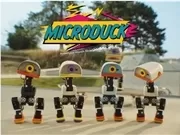 Under $400: Hugging Face launches Microduck, an open-source mini bipedal robot
Pollen Robotics, an open-source robotics startup backed by Hugging Face, has released the source code for Microduck, a compact bipedal robot. Measuring just 25cm and weighing 800g, this charming machine duck combines reinforcement learning, Sim2Real
Under $400: Hugging Face launches Microduck, an open-source mini bipedal robot
Pollen Robotics, an open-source robotics startup backed by Hugging Face, has released the source code for Microduck, a compact bipedal robot. Measuring just 25cm and weighing 800g, this charming machine duck combines reinforcement learning, Sim2Real
 Google Gemini Deeply Integrated with Google Photos for Personalized AI Image Generation
Google has recently rolled out a significant update to its AI assistant, Gemini, by deeply integrating it with Google Photos. This enhancement allows Gemini to directly access visual data from your photo library, enabling the creation of more persona
Google Gemini Deeply Integrated with Google Photos for Personalized AI Image Generation
Google has recently rolled out a significant update to its AI assistant, Gemini, by deeply integrating it with Google Photos. This enhancement allows Gemini to directly access visual data from your photo library, enabling the creation of more persona
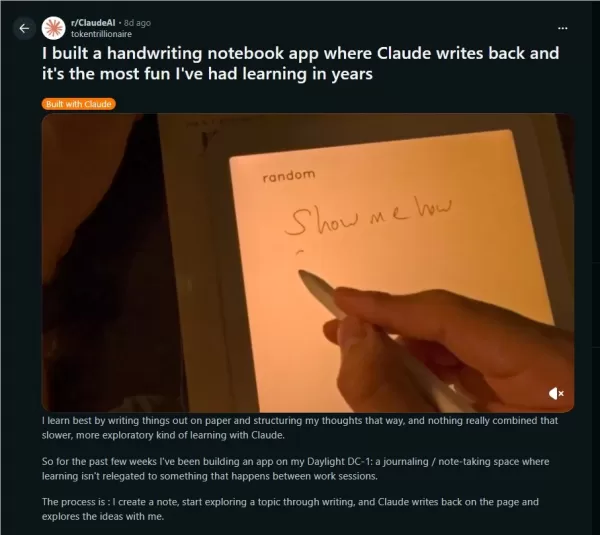 Reddit Masterpiece Makes Claude Interact with You Through Handwriting in Real Time, Providing an Immersive Learning Experience That Is Simply Outstanding
A Reddit developer has launched a new interactive handwriting app that lets users converse with Claude AI in real time. By mimicking the magical, two-way exchange of Tom Riddle’s diary from Harry Potter, the tool transforms digital note-taking into a
Reddit Masterpiece Makes Claude Interact with You Through Handwriting in Real Time, Providing an Immersive Learning Experience That Is Simply Outstanding
A Reddit developer has launched a new interactive handwriting app that lets users converse with Claude AI in real time. By mimicking the magical, two-way exchange of Tom Riddle’s diary from Harry Potter, the tool transforms digital note-taking into a

2026 Latest Best Top-Rated AI Sleep Tracking Assistants curated for ultimate recovery. This fully updated weekly guide features powerful tools that deliver real-world tests, free vs paid comparison, and detailed rankings to help you find the must-try solution that boosts sleep quality and supports better bedtime habits. Explore now at XIX.AI to Unlock your AI edge.
10 tools
xix.ai

2026 Latest Best Top-Rated AI SQL Copilots for Product and Revenue Analytics! XIX.AI has curated a powerful, game-changing collection of must-try tools that undergo real-world tests through weekly updated rankings. These tools help users boost productivity significantly by accelerating data analysis, streamlining complex queries, and generating accurate insights to drive smarter business decisions. Explore now to Discover your perfect tool for unlocking your AI edge!
14 tools
xix.ai

2026 Latest Best Top-Rated AI Homework Helpers That Teach Core Concepts Not Just Answers Powerful Tools for Students Must-Try Curated List Weekly Updated Free vs Paid Comparison Real-World Tests Accurate Rankings to Help You Unlock Your Full Learning Potential Explore now to Discover your perfect tool for smarter studying.
10 tools
xix.ai
2026 Latest Best ChatGPT Ad Copy Tools Reviewed! This curated top-rated list offers powerful game-changing solutions to help you craft high-converting copy for Meta campaigns, landing pages, and creative testing. Get a free vs paid comparison along with real-world tests and detailed rankings to find the must-try tool that boosts your productivity significantly. Explore now at XIX.AI to unlock your AI edge!
11 tools
xix.ai

2026 Latest Best Top-rated AI Pricing Strategy Tools for Market Testing! XIX.AI has curated a powerful game-changing collection of must-try tools, featuring weekly updated rankings and free vs paid comparison. These top-rated solutions help businesses run real-world tests, boost productivity, and discover the perfect pricing model to stand out in competitive markets. Explore now to Unlock your AI edge!
9 tools
xix.ai

2026 Latest Best Top-rated AI PDF Citation Extractors for Journal Articles, Methods Sections, and References are here on XIX.AI. This curated list features powerful game-changing tools that go through real-world tests to deliver accurate results every time. You can find a free vs paid comparison along with detailed rankings to help you choose the must-try option that boosts your research efficiency significantly. Explore now to discover your perfect tool for faster academic work!
9 tools
xix.ai












