


 Home
Alphabet Q2 Revenue Surges 24% as Gemini Hits 9.5 Billion Monthly Users
Quarterly reports now serve as concrete proof that AI is transitioning from a capital-intensive narrative to a profitable reality. On July 23, Alphabet CEO Sundar Pichai shared the company's second-quarter financial results on X, highlighting a confident opening statement: "This quarter was amazing, and our AI investments are redefining the possibilities in every part of our business." This assurance is backed by compelling financial data.
The most notable trend is the acceleration of overall performance. Alphabet's revenue surged by 24% year-over-year in Q2, while Google Cloud's growth rate skyrocketed to 82%, emerging as the primary driver for the entire corporation. Spanning search, YouTube, and the Gemini app, Pichai characterized this growth trajectory as "completely positive." This momentum is supported by substantial AI infrastructure investments, which have faced criticism in recent years for being overly heavy.
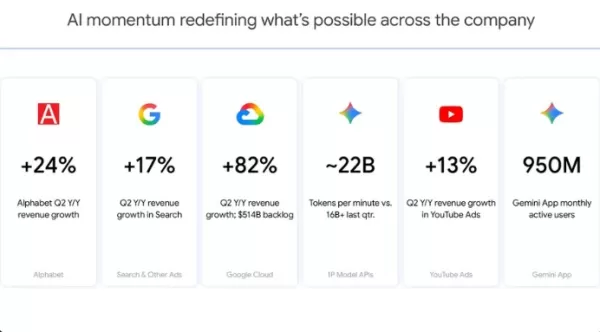
User-side signals are equally impressive. The Gemini app has reached 950 million monthly active users, nearing the one billion threshold. This indicates that a large model-driven conversational product has rapidly evolved into a global consumer entry point in a remarkably short timeframe. Furthermore, model usage has surged significantly: Google's model API now processes 22 billion tokens per minute, up from over 16 billion in the previous quarter. In just one quarter, the Flash series models increased this figure by nearly 40%. Pichai described Flash as the primary workhorse, confirming that low-cost, high-throughput models are becoming the standard in real-world production environments.
In the enterprise sector, Gemini Enterprise has been adopted by 90% of Fortune 100 companies, with strong demand for security solutions persisting. As top-tier companies integrate Gemini into their workflows, the value of AI for enterprises has moved beyond pilot project demonstrations and is now clearly reflected in procurement and deployment.
Related article
 DingTalk Rebuilds Architecture With AliAI’s MuleRun, Launching Full-Agent Era
DingTalk’s new CEO and head of the Wukong Business Unit, Chen Yusen, revealed a major organizational restructuring in an internal memo issued this afternoon. By creating the Core Platform Business Department and fully merging the AI Agent team, DingT
How to fix Core Web Vitals for better SEO ranking
How Carrefour Is Using Generative AI to Transform RetailIntroductionHélène Labaum: From Law to E-Commerce LeadershipCarrefour: A Global Retail GiantDigital Transformation at CarrefourCarrefour’s Generative AI StrategyReal-World Applications of Genera
Fortinet’s Virtue AI Deal Bolsters Agentic AI Security
Ken Xie, Founder and CEO of Fortinet | Credit: FortinetFortinet acquires Virtue AI to strengthen runtime protection and automated validation for AI systems as enterprises scale deployment of agents and modelsFortinet has acquired Virtue AI, a company
Related Special Topic Recommendations
Design & Art
 Top AI Illustration Tools: Create Editorial Scenes and Cover Art Faster
2026 Latest Top-rated AI Illustration Tools: Our curated list features the best powerfully designed tools for creating stunning editorial scenes and eye-catching cover art quickly. Each option has gone through rigorous real-world tests, offering a free vs paid comparison to help you find the perfect match for your workflow. Try these must-try solutions today to unlock your AI edge and boost your creative productivity. Explore now at XIX.AI.
 10 tools
 xix.ai
Education and Learning
Top AI Tutors for Exam Prep: Practice Math, Science, and English
2026 Latest Top-Rated Best AI Tutors for Exam Prep are here on XIX.AI! Our curated list features powerful game-changing tools that offer free vs paid comparison, real-world tests, and weekly updated rankings. They help boost your writing efficiency, simplify complex topic learning, and unlock your academic potential. Explore now to Discover your perfect exam prep tool and Start creating today to Unlock your AI edge!
10 tools
xix.ai
Finance
AI Budget Planning Tools for Personal Money Management
2026 Latest Best Top-Rated AI Budget Planning Tools for Personal Money Management are here on XIX.AI! This curated collection features powerful, game-changing solutions that help you conduct real-world tests, understand spending habits, and create personalized plans to boost productivity. Enjoy a free vs paid comparison along with detailed rankings. Must-try tools designed to simplify money management and unlock your AI edge. Explore now!
11 tools
xix.ai
Health & Wellness
AI Sleep Tracking Assistants: Improve Recovery with Better Bedtime Habits
2026 Latest Best Top-Rated AI Sleep Tracking Assistants curated for ultimate recovery. This fully updated weekly guide features powerful tools that deliver real-world tests, free vs paid comparison, and detailed rankings to help you find the must-try solution that boosts sleep quality and supports better bedtime habits. Explore now at XIX.AI to Unlock your AI edge.
10 tools
xix.ai
Data Analysis
AI SQL Copilots for Product and Revenue Analytics
2026 Latest Best Top-Rated AI SQL Copilots for Product and Revenue Analytics! XIX.AI has curated a powerful, game-changing collection of must-try tools that undergo real-world tests through weekly updated rankings. These tools help users boost productivity significantly by accelerating data analysis, streamlining complex queries, and generating accurate insights to drive smarter business decisions. Explore now to Discover your perfect tool for unlocking your AI edge!
14 tools
xix.ai
Education and Learning
Best AI Homework Helpers That Teach: Learn Concepts, Not Just Answers
2026 Latest Best Top-Rated AI Homework Helpers That Teach Core Concepts Not Just Answers Powerful Tools for Students Must-Try Curated List Weekly Updated Free vs Paid Comparison Real-World Tests Accurate Rankings to Help You Unlock Your Full Learning Potential Explore now to Discover your perfect tool for smarter studying.
10 tools
xix.ai

 Comments (0)
0/500
Quarterly reports now serve as concrete proof that AI is transitioning from a capital-intensive narrative to a profitable reality. On July 23, Alphabet CEO Sundar Pichai shared the company's second-quarter financial results on X, highlighting a confident opening statement: "This quarter was amazing, and our AI investments are redefining the possibilities in every part of our business." This assurance is backed by compelling financial data.
The most notable trend is the acceleration of overall performance. Alphabet's revenue surged by 24% year-over-year in Q2, while Google Cloud's growth rate skyrocketed to 82%, emerging as the primary driver for the entire corporation. Spanning search, YouTube, and the Gemini app, Pichai characterized this growth trajectory as "completely positive." This momentum is supported by substantial AI infrastructure investments, which have faced criticism in recent years for being overly heavy.
User-side signals are equally impressive. The Gemini app has reached 950 million monthly active users, nearing the one billion threshold. This indicates that a large model-driven conversational product has rapidly evolved into a global consumer entry point in a remarkably short timeframe. Furthermore, model usage has surged significantly: Google's model API now processes 22 billion tokens per minute, up from over 16 billion in the previous quarter. In just one quarter, the Flash series models increased this figure by nearly 40%. Pichai described Flash as the primary workhorse, confirming that low-cost, high-throughput models are becoming the standard in real-world production environments.
In the enterprise sector, Gemini Enterprise has been adopted by 90% of Fortune 100 companies, with strong demand for security solutions persisting. As top-tier companies integrate Gemini into their workflows, the value of AI for enterprises has moved beyond pilot project demonstrations and is now clearly reflected in procurement and deployment.








 DingTalk Rebuilds Architecture With AliAI’s MuleRun, Launching Full-Agent Era
DingTalk’s new CEO and head of the Wukong Business Unit, Chen Yusen, revealed a major organizational restructuring in an internal memo issued this afternoon. By creating the Core Platform Business Department and fully merging the AI Agent team, DingT
 How to fix Core Web Vitals for better SEO ranking
How Carrefour Is Using Generative AI to Transform RetailIntroductionHélène Labaum: From Law to E-Commerce LeadershipCarrefour: A Global Retail GiantDigital Transformation at CarrefourCarrefour’s Generative AI StrategyReal-World Applications of Genera
 Fortinet’s Virtue AI Deal Bolsters Agentic AI Security
Ken Xie, Founder and CEO of Fortinet | Credit: FortinetFortinet acquires Virtue AI to strengthen runtime protection and automated validation for AI systems as enterprises scale deployment of agents and modelsFortinet has acquired Virtue AI, a company

2026 Latest Top-rated AI Illustration Tools: Our curated list features the best powerfully designed tools for creating stunning editorial scenes and eye-catching cover art quickly. Each option has gone through rigorous real-world tests, offering a free vs paid comparison to help you find the perfect match for your workflow. Try these must-try solutions today to unlock your AI edge and boost your creative productivity. Explore now at XIX.AI.
10 tools
xix.ai

2026 Latest Top-Rated Best AI Tutors for Exam Prep are here on XIX.AI! Our curated list features powerful game-changing tools that offer free vs paid comparison, real-world tests, and weekly updated rankings. They help boost your writing efficiency, simplify complex topic learning, and unlock your academic potential. Explore now to Discover your perfect exam prep tool and Start creating today to Unlock your AI edge!
10 tools
xix.ai

2026 Latest Best Top-Rated AI Budget Planning Tools for Personal Money Management are here on XIX.AI! This curated collection features powerful, game-changing solutions that help you conduct real-world tests, understand spending habits, and create personalized plans to boost productivity. Enjoy a free vs paid comparison along with detailed rankings. Must-try tools designed to simplify money management and unlock your AI edge. Explore now!
11 tools
xix.ai

2026 Latest Best Top-Rated AI Sleep Tracking Assistants curated for ultimate recovery. This fully updated weekly guide features powerful tools that deliver real-world tests, free vs paid comparison, and detailed rankings to help you find the must-try solution that boosts sleep quality and supports better bedtime habits. Explore now at XIX.AI to Unlock your AI edge.
10 tools
xix.ai

2026 Latest Best Top-Rated AI SQL Copilots for Product and Revenue Analytics! XIX.AI has curated a powerful, game-changing collection of must-try tools that undergo real-world tests through weekly updated rankings. These tools help users boost productivity significantly by accelerating data analysis, streamlining complex queries, and generating accurate insights to drive smarter business decisions. Explore now to Discover your perfect tool for unlocking your AI edge!
14 tools
xix.ai

2026 Latest Best Top-Rated AI Homework Helpers That Teach Core Concepts Not Just Answers Powerful Tools for Students Must-Try Curated List Weekly Updated Free vs Paid Comparison Real-World Tests Accurate Rankings to Help You Unlock Your Full Learning Potential Explore now to Discover your perfect tool for smarter studying.
10 tools
xix.ai












