


 Home
HomeVirtual Event Assistant Powered by AI Requires No Startup Costs
AI-Powered Virtual Event Planning: The Zero-Investment Business Opportunity
The entrepreneurial landscape in 2025 makes starting a business more accessible than ever. AI technology now enables ambitious founders to launch innovative ventures with minimal upfront costs. One particularly promising opportunity is developing an AI Virtual Event Planning Assistant - a smart solution that revolutionizes how organizations manage digital gatherings. This comprehensive guide explores how to capitalize on this growing market, from validating your concept to implementing a sustainable business model - all without substantial initial capital.
Key Advantages
The virtual event industry continues rapid expansion with growing demand for efficient solutions.
AI-powered assistants dramatically reduce manual workload while improving event outcomes.
Freemium model enables wide adoption while creating clear pathways for monetization.
Digital-first marketing approach maximizes reach with minimal expenditure.
Cloud-based infrastructure allows effortless scaling as demand grows.
Requires no major upfront investment to establish proof of concept.
Understanding AI Virtual Event Planning Assistants
The Next Generation of Event Management
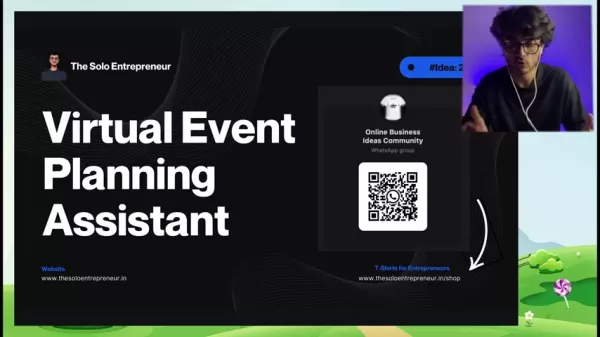
An AI Virtual Event Planning Assistant represents a fundamental shift in how organizations coordinate digital gatherings. This intelligent software solution harnesses artificial intelligence to automate the entire event lifecycle - from initial scheduling through post-event analysis. Unlike traditional methods that require extensive manual coordination, these platforms handle complex logistics while delivering data-driven insights.
The assistant becomes particularly valuable by automating repetitive tasks like scheduling, registration processing, and attendee communication. More advanced implementations leverage machine learning to personalize attendee experiences and predict event success metrics. This technological approach provides significant advantages over human planners in terms of cost, scalability, and analytical capabilities.
Market Potential and Growth Projections
The event management software sector demonstrates remarkable momentum, with valuations expected to surpass $34 billion by 2029. This growth stems from organizations increasingly adopting virtual and hybrid event formats across multiple industries. Small and mid-sized businesses especially benefit from these AI solutions that offer enterprise-grade event management at accessible price points.
Building Your Minimum Viable Product
Core Functionality Requirements
When developing an initial product version, focus on these essential features:
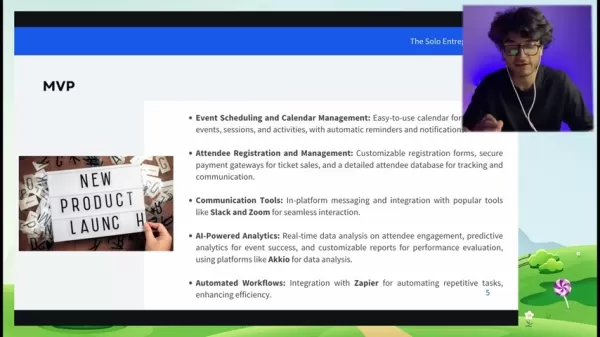
- Smart scheduling system with automated calendar management
- User-friendly registration portal with payment processing
- Integrated communication tools for seamless coordination
- AI-driven analytics dashboard for performance tracking
- Automated workflow capabilities to reduce manual tasks
Development Approach
No-Code Platform Implementation
Bubble.io provides an excellent foundation for building your MVP without coding expertise:
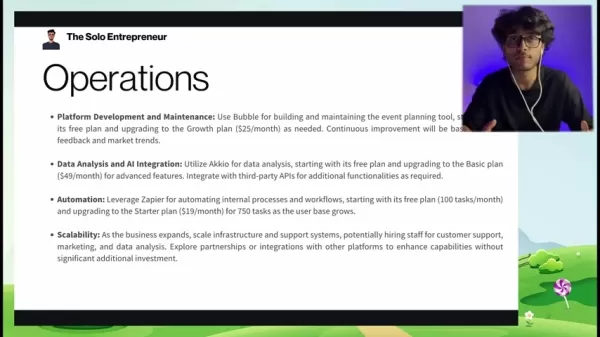
- Begin with the free tier to validate core concepts
- Gradually expand to paid plans as user adoption grows
- Continuously gather user feedback for iterative improvements
- Implement a freemium model to demonstrate value before conversion
Business Model and Financial Considerations
Revenue Strategy
Effective monetization relies on tiered pricing:
- Free tier: Basic functionality to build user base
- Professional tier: Advanced features starting at $20/month
- Enterprise tier: Custom solutions for large organizations
Estimated annual operational costs remain under $1,500 including platform subscriptions and marketing allocations at 20% of revenue.
Industry Applications
Versatile Use Cases
This solution serves diverse sectors:
- Corporate training and product launches
- Higher education and professional development
- Marketing campaigns and sales enablement
- Community engagement and non-profit fundraising
Frequently Asked Questions
What's the typical implementation timeline?
Most founders can develop an initial prototype within 4-6 weeks using no-code platforms.
How does AI improve upon traditional event planning?
By automating administrative tasks and providing predictive insights that reduce costs while improving attendee experience.
What technical skills are required?
No coding experience is necessary when using platforms like Bubble, though basic UX/UI knowledge helps.
How does the freemium model drive conversions?
By demonstrating tangible value through limited free usage while reserving premium features for paying customers.
Critical Success Factors
Competitive Advantages
- Zero initial capital requirements
- Scalable cloud-based infrastructure
- Continuous improvement through user feedback
- Data-driven optimization capabilities
Potential Challenges
- Differentiation from established competitors
- Marketing effectiveness on limited budgets
- Technology integration complexities
- Rapid industry evolution requiring adaptation
Related article
 Former OpenAI Researcher Barrett Zoph Returns to Google to Support Gemini Development
Barret Zoph, who previously abruptly left and joined OpenAI due to a disagreement with Thinking Machines Lab CEO Miriam Mularati, has once again changed employers. Alphabet's Google announced that Zoph will return as Vice President of Research, bring
How Recursive Intelligence Raised $335M at $4B Valuation in 4 Months
The co-founders of startup Ricursive Intelligence seemed destined to be co-founders.Anna Goldie, CEO, and Azalia Mirhoseini, CTO, are so well-known in the AI community that they were among those AI engineers who “got those weird emails from Zuckerber
AI race won’t wait, nor will this TechCrunch Disrupt 25% discount
Every founder building in AI right now is asking the same question: Are we moving fast enough, and effectively enough? TechCrunch Disrupt 2026 puts you in the same room as the people wrestling with that existential question at the highest levels. Fro
Related Special Topic Recommendations
Design & Art
Former OpenAI Researcher Barrett Zoph Returns to Google to Support Gemini Development
Barret Zoph, who previously abruptly left and joined OpenAI due to a disagreement with Thinking Machines Lab CEO Miriam Mularati, has once again changed employers. Alphabet's Google announced that Zoph will return as Vice President of Research, bring
How Recursive Intelligence Raised $335M at $4B Valuation in 4 Months
The co-founders of startup Ricursive Intelligence seemed destined to be co-founders.Anna Goldie, CEO, and Azalia Mirhoseini, CTO, are so well-known in the AI community that they were among those AI engineers who “got those weird emails from Zuckerber
AI race won’t wait, nor will this TechCrunch Disrupt 25% discount
Every founder building in AI right now is asking the same question: Are we moving fast enough, and effectively enough? TechCrunch Disrupt 2026 puts you in the same room as the people wrestling with that existential question at the highest levels. Fro
Related Special Topic Recommendations
Design & Art
 Top AI Illustration Tools: Create Editorial Scenes and Cover Art Faster
2026 Latest Top-rated AI Illustration Tools: Our curated list features the best powerfully designed tools for creating stunning editorial scenes and eye-catching cover art quickly. Each option has gone through rigorous real-world tests, offering a free vs paid comparison to help you find the perfect match for your workflow. Try these must-try solutions today to unlock your AI edge and boost your creative productivity. Explore now at XIX.AI.
 10 tools
 xix.ai
Education and Learning
Top AI Tutors for Exam Prep: Practice Math, Science, and English
xix.ai
Education and Learning
Top AI Tutors for Exam Prep: Practice Math, Science, and English
2026 Latest Top-Rated Best AI Tutors for Exam Prep are here on XIX.AI! Our curated list features powerful game-changing tools that offer free vs paid comparison, real-world tests, and weekly updated rankings. They help boost your writing efficiency, simplify complex topic learning, and unlock your academic potential. Explore now to Discover your perfect exam prep tool and Start creating today to Unlock your AI edge!
10 tools
xix.ai
Finance
AI Budget Planning Tools for Personal Money Management
2026 Latest Best Top-Rated AI Budget Planning Tools for Personal Money Management are here on XIX.AI! This curated collection features powerful, game-changing solutions that help you conduct real-world tests, understand spending habits, and create personalized plans to boost productivity. Enjoy a free vs paid comparison along with detailed rankings. Must-try tools designed to simplify money management and unlock your AI edge. Explore now!
11 tools
xix.ai
Health & Wellness
AI Sleep Tracking Assistants: Improve Recovery with Better Bedtime Habits
2026 Latest Best Top-Rated AI Sleep Tracking Assistants curated for ultimate recovery. This fully updated weekly guide features powerful tools that deliver real-world tests, free vs paid comparison, and detailed rankings to help you find the must-try solution that boosts sleep quality and supports better bedtime habits. Explore now at XIX.AI to Unlock your AI edge.
10 tools
xix.ai
Data Analysis
AI SQL Copilots for Product and Revenue Analytics
2026 Latest Best Top-Rated AI SQL Copilots for Product and Revenue Analytics! XIX.AI has curated a powerful, game-changing collection of must-try tools that undergo real-world tests through weekly updated rankings. These tools help users boost productivity significantly by accelerating data analysis, streamlining complex queries, and generating accurate insights to drive smarter business decisions. Explore now to Discover your perfect tool for unlocking your AI edge!
14 tools
xix.ai
Education and Learning
Best AI Homework Helpers That Teach: Learn Concepts, Not Just Answers
2026 Latest Best Top-Rated AI Homework Helpers That Teach Core Concepts Not Just Answers Powerful Tools for Students Must-Try Curated List Weekly Updated Free vs Paid Comparison Real-World Tests Accurate Rankings to Help You Unlock Your Full Learning Potential Explore now to Discover your perfect tool for smarter studying.
10 tools
xix.ai

 Comments (2)
0/500
Comments (2)
0/500
![NicholasHernández]()
Honestly, the idea of a zero-investment AI event assistant sounds too good to be true. But if it works, it could really democratize event planning for small creators. Just hope the AI doesn't hallucinate the catering order 😅
![NicholasThomas]()
Kinda tempted to try this myself, everyone talks about AI startups needing funding, but zero-cost entry is the real game changer. Just need to find the right niche and let the AI do the grunt work! 🤯
AI-Powered Virtual Event Planning: The Zero-Investment Business Opportunity
The entrepreneurial landscape in 2025 makes starting a business more accessible than ever. AI technology now enables ambitious founders to launch innovative ventures with minimal upfront costs. One particularly promising opportunity is developing an AI Virtual Event Planning Assistant - a smart solution that revolutionizes how organizations manage digital gatherings. This comprehensive guide explores how to capitalize on this growing market, from validating your concept to implementing a sustainable business model - all without substantial initial capital.
Key Advantages
The virtual event industry continues rapid expansion with growing demand for efficient solutions.
AI-powered assistants dramatically reduce manual workload while improving event outcomes.
Freemium model enables wide adoption while creating clear pathways for monetization.
Digital-first marketing approach maximizes reach with minimal expenditure.
Cloud-based infrastructure allows effortless scaling as demand grows.
Requires no major upfront investment to establish proof of concept.
Understanding AI Virtual Event Planning Assistants
The Next Generation of Event Management
An AI Virtual Event Planning Assistant represents a fundamental shift in how organizations coordinate digital gatherings. This intelligent software solution harnesses artificial intelligence to automate the entire event lifecycle - from initial scheduling through post-event analysis. Unlike traditional methods that require extensive manual coordination, these platforms handle complex logistics while delivering data-driven insights.
The assistant becomes particularly valuable by automating repetitive tasks like scheduling, registration processing, and attendee communication. More advanced implementations leverage machine learning to personalize attendee experiences and predict event success metrics. This technological approach provides significant advantages over human planners in terms of cost, scalability, and analytical capabilities.
Market Potential and Growth Projections
The event management software sector demonstrates remarkable momentum, with valuations expected to surpass $34 billion by 2029. This growth stems from organizations increasingly adopting virtual and hybrid event formats across multiple industries. Small and mid-sized businesses especially benefit from these AI solutions that offer enterprise-grade event management at accessible price points.
Building Your Minimum Viable Product
Core Functionality Requirements
When developing an initial product version, focus on these essential features:
- Smart scheduling system with automated calendar management
- User-friendly registration portal with payment processing
- Integrated communication tools for seamless coordination
- AI-driven analytics dashboard for performance tracking
- Automated workflow capabilities to reduce manual tasks
Development Approach
No-Code Platform Implementation
Bubble.io provides an excellent foundation for building your MVP without coding expertise:
- Begin with the free tier to validate core concepts
- Gradually expand to paid plans as user adoption grows
- Continuously gather user feedback for iterative improvements
- Implement a freemium model to demonstrate value before conversion
Business Model and Financial Considerations
Revenue Strategy
Effective monetization relies on tiered pricing:
- Free tier: Basic functionality to build user base
- Professional tier: Advanced features starting at $20/month
- Enterprise tier: Custom solutions for large organizations
Estimated annual operational costs remain under $1,500 including platform subscriptions and marketing allocations at 20% of revenue.
Industry Applications
Versatile Use Cases
This solution serves diverse sectors:
- Corporate training and product launches
- Higher education and professional development
- Marketing campaigns and sales enablement
- Community engagement and non-profit fundraising
Frequently Asked Questions
What's the typical implementation timeline?
Most founders can develop an initial prototype within 4-6 weeks using no-code platforms.
How does AI improve upon traditional event planning?
By automating administrative tasks and providing predictive insights that reduce costs while improving attendee experience.
What technical skills are required?
No coding experience is necessary when using platforms like Bubble, though basic UX/UI knowledge helps.
How does the freemium model drive conversions?
By demonstrating tangible value through limited free usage while reserving premium features for paying customers.
Critical Success Factors
Competitive Advantages
- Zero initial capital requirements
- Scalable cloud-based infrastructure
- Continuous improvement through user feedback
- Data-driven optimization capabilities
Potential Challenges
- Differentiation from established competitors
- Marketing effectiveness on limited budgets
- Technology integration complexities
- Rapid industry evolution requiring adaptation








 Former OpenAI Researcher Barrett Zoph Returns to Google to Support Gemini Development
Barret Zoph, who previously abruptly left and joined OpenAI due to a disagreement with Thinking Machines Lab CEO Miriam Mularati, has once again changed employers. Alphabet's Google announced that Zoph will return as Vice President of Research, bring
Former OpenAI Researcher Barrett Zoph Returns to Google to Support Gemini Development
Barret Zoph, who previously abruptly left and joined OpenAI due to a disagreement with Thinking Machines Lab CEO Miriam Mularati, has once again changed employers. Alphabet's Google announced that Zoph will return as Vice President of Research, bring
 How Recursive Intelligence Raised $335M at $4B Valuation in 4 Months
The co-founders of startup Ricursive Intelligence seemed destined to be co-founders.Anna Goldie, CEO, and Azalia Mirhoseini, CTO, are so well-known in the AI community that they were among those AI engineers who “got those weird emails from Zuckerber
How Recursive Intelligence Raised $335M at $4B Valuation in 4 Months
The co-founders of startup Ricursive Intelligence seemed destined to be co-founders.Anna Goldie, CEO, and Azalia Mirhoseini, CTO, are so well-known in the AI community that they were among those AI engineers who “got those weird emails from Zuckerber
 AI race won’t wait, nor will this TechCrunch Disrupt 25% discount
Every founder building in AI right now is asking the same question: Are we moving fast enough, and effectively enough? TechCrunch Disrupt 2026 puts you in the same room as the people wrestling with that existential question at the highest levels. Fro
AI race won’t wait, nor will this TechCrunch Disrupt 25% discount
Every founder building in AI right now is asking the same question: Are we moving fast enough, and effectively enough? TechCrunch Disrupt 2026 puts you in the same room as the people wrestling with that existential question at the highest levels. Fro
2026 Latest Top-rated AI Illustration Tools: Our curated list features the best powerfully designed tools for creating stunning editorial scenes and eye-catching cover art quickly. Each option has gone through rigorous real-world tests, offering a free vs paid comparison to help you find the perfect match for your workflow. Try these must-try solutions today to unlock your AI edge and boost your creative productivity. Explore now at XIX.AI.
10 tools
xix.ai

2026 Latest Top-Rated Best AI Tutors for Exam Prep are here on XIX.AI! Our curated list features powerful game-changing tools that offer free vs paid comparison, real-world tests, and weekly updated rankings. They help boost your writing efficiency, simplify complex topic learning, and unlock your academic potential. Explore now to Discover your perfect exam prep tool and Start creating today to Unlock your AI edge!
10 tools
xix.ai

2026 Latest Best Top-Rated AI Budget Planning Tools for Personal Money Management are here on XIX.AI! This curated collection features powerful, game-changing solutions that help you conduct real-world tests, understand spending habits, and create personalized plans to boost productivity. Enjoy a free vs paid comparison along with detailed rankings. Must-try tools designed to simplify money management and unlock your AI edge. Explore now!
11 tools
xix.ai

2026 Latest Best Top-Rated AI Sleep Tracking Assistants curated for ultimate recovery. This fully updated weekly guide features powerful tools that deliver real-world tests, free vs paid comparison, and detailed rankings to help you find the must-try solution that boosts sleep quality and supports better bedtime habits. Explore now at XIX.AI to Unlock your AI edge.
10 tools
xix.ai

2026 Latest Best Top-Rated AI SQL Copilots for Product and Revenue Analytics! XIX.AI has curated a powerful, game-changing collection of must-try tools that undergo real-world tests through weekly updated rankings. These tools help users boost productivity significantly by accelerating data analysis, streamlining complex queries, and generating accurate insights to drive smarter business decisions. Explore now to Discover your perfect tool for unlocking your AI edge!
14 tools
xix.ai

2026 Latest Best Top-Rated AI Homework Helpers That Teach Core Concepts Not Just Answers Powerful Tools for Students Must-Try Curated List Weekly Updated Free vs Paid Comparison Real-World Tests Accurate Rankings to Help You Unlock Your Full Learning Potential Explore now to Discover your perfect tool for smarter studying.
10 tools
xix.ai

Honestly, the idea of a zero-investment AI event assistant sounds too good to be true. But if it works, it could really democratize event planning for small creators. Just hope the AI doesn't hallucinate the catering order 😅
Kinda tempted to try this myself, everyone talks about AI startups needing funding, but zero-cost entry is the real game changer. Just need to find the right niche and let the AI do the grunt work! 🤯












