


 Home
HomeHow to analyze employee survey open comments with AI in 2026?
Employee surveys provide invaluable insights into team morale and highlight areas for organizational growth. Yet, the most revealing feedback often comes from the open-ended comments where employees share their thoughts, feelings, and suggestions in their own words. Manually reviewing these comments is often overwhelming and time-intensive. This is where Artificial Intelligence (AI) steps in, revolutionizing how businesses interpret and leverage this rich qualitative data.
Key Points
AI significantly improves the analysis of employee survey comments by efficiently extracting meaningful insights.
The process starts with gathering open-ended feedback directly from employees.
Text preprocessing cleans and standardizes comment data to ensure consistent analysis.
Thematic categorization organizes comments into key topics based on recurring phrases.
Sentiment analysis assesses the emotional tone of comments, classifying them as positive, negative, or neutral.
Trend detection spots patterns and emerging organizational issues.
AI minimizes bias, ensuring all feedback is evaluated fairly.
Visualizations and summaries are generated to clearly present findings to HR leaders.
Understanding AI's Role in Employee Survey Analysis
The Power of Open Comments in Employee Surveys
Employee surveys are fundamental to modern HR practices, designed to capture the collective voice of an organization's most vital asset—its people. These surveys typically include both multiple-choice and open-ended questions, but the latter offers the richest, most detailed data. Open comments let employees express themselves freely, sharing personal experiences, suggestions for improvement, and genuine feelings about their work environment. This unstructured feedback provides a deep look into the employee experience, uncovering both challenges and successes that quantitative data might overlook.
However, the volume of these comments can be staggering. Manually reviewing hundreds or even thousands of responses is not only labor-intensive but also susceptible to human bias, which can lead to skewed interpretations and missed opportunities for meaningful change.
This is where AI offers a scalable, objective solution to fully unlock the potential of employee feedback. By automating the analysis, AI algorithms can quickly pinpoint key themes, assess overall sentiment, and identify emerging trends, turning raw data into practical insights. Strategically using AI in employee survey analysis helps organizations listen more effectively, respond more quickly, and ultimately foster a more engaged and supportive workplace.This involves several crucial steps, from data preprocessing to sentiment evaluation, each designed to maximize the value of employee input.
How Does AI Analyze Open Comments in Employee Surveys?
AI analyzes open comments in employee surveys using a combination of natural language processing (NLP), machine learning (ML), and sentiment analysis techniques.
The objective is to convert unstructured text into structured, actionable insights that guide HR strategies and enhance the overall employee experience.
- Data Collection: The process begins by collecting the open-ended comments employees provide in response to survey questions. These comments are filled with personal experiences, emotions, and suggestions.
- Text Preprocessing: The first technical step is text preprocessing, a crucial phase where AI cleans and standardizes the data. This includes removing irrelevant characters, correcting spelling errors, and standardizing terminology. This ensures that subsequent analysis is consistent and dependable.
- Thematic Categorization: AI algorithms group comments into themes based on common words and phrases. This helps identify the most discussed topics, such as work environment or career development.
- Sentiment Analysis: AI evaluates the emotional tone of each comment, classifying them as positive, negative, or neutral. This step quantifies how employees feel about specific subjects, revealing areas of satisfaction or concern.
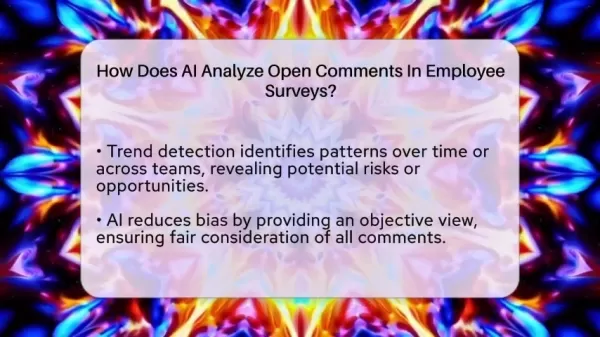
- Trend Detection: By examining comments over time or across different teams, AI can detect emerging patterns, helping organizations spot potential risks or opportunities early.
- Bias Reduction: AI provides an objective perspective, reducing human biases that may occur during manual reviews. This ensures all feedback is considered equitably.
- Summaries and Visualizations: AI creates summaries and visualizations to present feedback in a clear, understandable format for HR leaders.
This comprehensive method allows AI to process large volumes of text, identify meaningful patterns, and deliver actionable insights that would be difficult to extract manually.
Deeper Dive into AI Techniques
Text Preprocessing: Cleaning and Standardizing Data
Text preprocessing is the cornerstone of AI-driven comment analysis, ensuring data is clean, consistent, and ready for further examination. This stage includes several key steps:
- Removal of Irrelevant Characters: AI algorithms eliminate non-essential elements like HTML tags, special symbols, and excessive punctuation that could disrupt accurate analysis.
- Spelling Correction: AI tools automatically detect and correct spelling mistakes, typos, and grammatical errors, ensuring the intended meaning of each comment is accurately captured.
- Standardization of Terms: AI standardizes different expressions of the same idea by mapping synonyms and related terms to a single, consistent representation. For instance, "happy," "satisfied," and "content" might all be mapped to a common "positive" sentiment.
This thorough preprocessing ensures AI algorithms can focus on the core content of each comment, extracting meaningful insights without being sidetracked by inconsistencies.
By investing in robust text preprocessing, organizations can greatly enhance the accuracy and reliability of their employee survey analysis.
Thematic Categorization: Uncovering Key Topics
After comments are preprocessed, AI algorithms begin categorizing them into meaningful themes. This process, known as thematic categorization, involves identifying common words, phrases, and concepts within the text and grouping related comments together. Several techniques are used for this purpose:
- Keyword Extraction: AI algorithms identify the most frequent and relevant keywords in the comments, offering a snapshot of the dominant topics discussed.
- Topic Modeling: Machine learning techniques like Latent Dirichlet Allocation (LDA) uncover underlying themes in the data, grouping comments based on shared vocabulary and conceptual relationships.
- Custom Category Creation: Organizations can define their own categories based on specific interests, allowing AI to focus on relevant topics like "work-life balance," "leadership," or "career development."
By grouping comments into themes, AI helps HR leaders quickly identify the most critical issues and understand the overall sentiment around each topic. This enables them to prioritize efforts and address the areas that matter most to employees.
Sentiment Analysis: Gauging Employee Emotions
Sentiment analysis is a powerful AI technique that helps organizations understand the emotional tone of employee feedback. By examining the words, phrases, and context within each comment, AI algorithms classify sentiment as positive, negative, or neutral. This offers valuable insight into employee morale, satisfaction, and overall engagement.
Several factors contribute to accurate sentiment analysis:
- Lexicon-Based Approach: AI tools use sentiment lexicons—databases of words and phrases linked to specific emotions. By matching comment words to these lexicons, AI can determine overall sentiment.
- Machine Learning Models: Trained on large datasets of text with labeled sentiment, machine learning models learn to identify subtle cues and contextual nuances that indicate emotional tone.
- Negation Handling: AI algorithms are designed to recognize and handle negation, ensuring statements like "I am not satisfied" are correctly classified as negative sentiment.
By quantifying employee emotions, sentiment analysis provides crucial insights into the impact of organizational policies, leadership styles, and workplace initiatives.
This empowers HR leaders to make data-driven decisions that promote a more positive and supportive work environment.
Implementing AI in Your Employee Survey Process
Step-by-Step Guide to Integrating AI
Integrating AI into your employee survey analysis process requires careful planning and execution. Follow this step-by-step guide to get started:
- Define Your Objectives: Clearly outline what you aim to achieve with AI-driven analysis. Are you seeking to identify key drivers of employee engagement, uncover pain points in the employee experience, or track the impact of specific initiatives?
- Choose the Right AI Tool: Research and select an AI-powered survey platform or analytics tool that aligns with your goals and budget. Consider factors like ease of use, data integration capabilities, and the specific AI techniques offered (e.g., sentiment analysis, topic modeling).
- Prepare Your Data: Clean and prepare your existing survey data for AI analysis. This may involve removing irrelevant information, correcting errors, and standardizing formats.
- Train the AI Model (If Necessary): Some AI tools require training on your specific data to improve accuracy. Follow the tool's instructions to train the model on a representative sample of your comments.
- Analyze the Results: Once the AI analysis is complete, review the findings, focusing on key themes, sentiment trends, and emerging patterns.
- Take Action: Use insights from the AI analysis to develop and implement targeted interventions that address employee concerns, improve the employee experience, and drive positive change.
- Monitor and Evaluate: Continuously monitor the impact of your interventions and assess the effectiveness of your AI-driven analysis process. Adjust as needed to optimize results.
By following these steps, organizations can effectively use AI to turn employee survey data into actionable insights and create a more engaged and supportive workplace.
Pricing Considerations for AI-Powered Survey Tools
Understanding Cost Structures
Pricing for AI-powered survey tools varies based on factors like organization size, features offered, and level of support. Here’s a breakdown of common pricing models:
- Subscription-Based: Many AI-powered survey platforms offer monthly or annual subscription plans. These typically include access to all core features, with pricing tiers based on the number of employees surveyed or the volume of comments analyzed.
- Usage-Based: Some tools charge based on actual usage, such as the number of surveys conducted or comments processed. This model can be cost-effective for organizations with infrequent survey needs.
- Custom Pricing: For large enterprises with complex requirements, vendors may offer custom pricing plans tailored to specific needs. These often include advanced features, dedicated support, and customized reporting.
When evaluating pricing, consider not only the initial costs but also the long-term value and potential ROI of using AI to boost employee engagement, reduce turnover, and enhance organizational performance.
Advantages and Disadvantages of AI in Survey Analytics
Pros
Improved efficiency and speed of analysis
Enhanced objectivity and reduced bias
Ability to identify key themes and patterns
Greater accuracy in sentiment analysis
Improved data visualization and reporting
Cons
Potential for algorithm bias if not properly trained
Dependence on data quality
Lack of human judgment and context in interpretation
Cost of implementation and maintenance
Potential privacy concerns
Essential Core Features of AI Survey Analytics
Must-Have AI Capabilities
When evaluating AI-powered survey tools, look for these core features:
- Natural Language Processing (NLP):NLP is essential for understanding the meaning and context of employee comments. Seek tools that accurately process and analyze text, even with variations in language and grammar.
- Sentiment Analysis:Accurate sentiment analysis is crucial for assessing employee morale and identifying areas of concern. Tools should detect positive, negative, and neutral sentiment, as well as nuanced emotions like frustration or excitement.
- Topic Modeling:Topic modeling helps uncover key themes and topics in employee comments. Look for tools that automatically identify and categorize comments based on shared vocabulary and conceptual relationships.
- Trend Detection:The ability to track trends over time is essential for spotting emerging issues and measuring the impact of interventions. Tools should provide visualizations and reports highlighting significant changes in sentiment or topic frequency.
- Data Visualization:Clear and intuitive data visualizations are critical for communicating insights to HR leaders and managers. Seek tools that offer a variety of charts, graphs, and dashboards to present data effectively.
- Bias Detection and Mitigation:Tools should include features to detect and mitigate potential biases in the data, ensuring all comments are evaluated fairly.
- Integration with Existing Systems:Seamless integration with your current HR systems is essential for streamlining the survey process and maximizing data value.
These core features will help you gain a deeper understanding of your employees’ experiences and make data-driven decisions to improve your workplace.
Real-World Use Cases of AI in Employee Surveys
How Different Industries are Leveraging AI
AI is transforming employee survey analysis across various sectors. Here are a few examples:
- Healthcare: Hospitals and healthcare systems use AI to analyze employee feedback on workload, stress levels, and work-life balance. This helps them identify and address burnout, improve employee well-being, and enhance patient care.
- Retail: Retail companies leverage AI to understand employee sentiment on customer service processes, store management, and compensation. This allows them to optimize operations, boost employee satisfaction, and improve the customer experience.
- Technology: Tech firms use AI to analyze employee feedback on innovation, collaboration, and career development. This helps them foster a creative culture, enhance team performance, and attract and retain top talent.
- Manufacturing: Manufacturing companies use AI to analyze employee feedback on safety protocols, equipment maintenance, and production processes. This helps them improve workplace safety, reduce downtime, and increase productivity.
In each case, AI enables organizations to listen more effectively to their employees, identify improvement areas, and take targeted actions that drive positive results.
Frequently Asked Questions (FAQ)
How accurate is AI sentiment analysis for employee comments?
AI sentiment analysis has become increasingly accurate, but its reliability depends on the quality of the algorithms and the data they are trained on. Modern sentiment analysis tools often achieve accuracy rates above 80%, but it's important to choose a tool specifically trained on workplace-related text. Also, consider potential cultural or linguistic nuances that could affect sentiment interpretation.
Can AI completely replace human analysis of employee comments?
While AI can automate many aspects of employee comment analysis, it cannot fully replace human judgment. AI excels at identifying patterns, quantifying sentiment, and flagging potential issues, but human analysts are still needed to interpret findings, understand context, and develop appropriate interventions. The best approach combines AI-driven analysis with human expertise for the most comprehensive and actionable insights.
How can I ensure that AI-driven analysis is fair and unbiased?
To ensure fairness and minimize bias in AI-driven analysis, choose tools that include bias detection and mitigation features. These features help identify and correct potential biases in the data or algorithms. Additionally, involve human analysts in the process to review findings and ensure they are not skewed by unintended biases.
Related Questions
What are the ethical considerations of using AI to analyze employee feedback?
Using AI to analyze employee feedback raises several ethical considerations. It's important to be transparent with employees about how their feedback will be used and to obtain their consent before collecting and analyzing their comments. Also, ensure data is protected and used responsibly, and avoid using AI in ways that could discriminate against or unfairly disadvantage certain employee groups. Uphold principles of transparency, consent, data protection, and fairness.
How can I measure the ROI of investing in AI-powered survey tools?
Measuring the ROI of AI-powered survey tools involves tracking key metrics related to employee engagement, turnover, and organizational performance. For example, track changes in employee satisfaction scores, retention rates, or productivity levels after implementing AI-driven interventions. Compare these metrics to a baseline period before using AI to determine the technology's impact. Also, consider cost savings from automating the analysis process and freeing HR staff for more strategic work.
What are the best practices for designing employee surveys that are optimized for AI analysis?
To design employee surveys optimized for AI analysis, follow these best practices: Use clear and concise language: Avoid jargon, slang, or ambiguous wording that could confuse AI algorithms. Include a mix of question types: Combine multiple-choice questions with open-ended prompts to capture both quantitative and qualitative data. Provide sufficient context: Ensure employees have enough information to answer questions thoughtfully and accurately. Limit the number of questions: Keep the survey concise to avoid survey fatigue and ensure high completion rates. Pilot test the survey: Before deploying it organization-wide, test it with a small group of employees to identify any issues or areas for improvement. By following these best practices, you can create surveys that yield valuable insights effectively analyzed by AI.
Related article
 Apple Smart Glasses Could Debut at WWDC27, Highlighting Privacy Protection
Bloomberg’s Mark Gurman reports that Apple’s smart glasses, codenamed N50, are slated for a WWDC27 debut in June 2027, with a retail launch expected in autumn 2027. Originally targeted for late this year and early 2027, the device’s release has been
Inside Details Exposed About Next-Gen Gemini: Strained Computing Power, Internal Teams Disagreed on Development Priorities and Resource Allocation
Reports indicate that the launch of Google’s highly anticipated next-generation Gemini model has been pushed back. Internal disagreements over development priorities and resource allocation, combined with limited computing capacity and complex approv
OpenAI Dismisses Growth Slowdown Concerns, Says Multiple Business Units Accelerating
In response to external scrutiny regarding decelerating sales growth and missed internal benchmarks, AI leader OpenAI issued a confident statement on Tuesday, April 28. The company clarified that its consumer products and enterprise services are adva
Related Special Topic Recommendations
Music composition
Apple Smart Glasses Could Debut at WWDC27, Highlighting Privacy Protection
Bloomberg’s Mark Gurman reports that Apple’s smart glasses, codenamed N50, are slated for a WWDC27 debut in June 2027, with a retail launch expected in autumn 2027. Originally targeted for late this year and early 2027, the device’s release has been
Inside Details Exposed About Next-Gen Gemini: Strained Computing Power, Internal Teams Disagreed on Development Priorities and Resource Allocation
Reports indicate that the launch of Google’s highly anticipated next-generation Gemini model has been pushed back. Internal disagreements over development priorities and resource allocation, combined with limited computing capacity and complex approv
OpenAI Dismisses Growth Slowdown Concerns, Says Multiple Business Units Accelerating
In response to external scrutiny regarding decelerating sales growth and missed internal benchmarks, AI leader OpenAI issued a confident statement on Tuesday, April 28. The company clarified that its consumer products and enterprise services are adva
Related Special Topic Recommendations
Music composition
 Best AI Melody Writing Tools for Song Drafts
2026 Latest Best Top-Rated AI Melody Writing Tools for Song Drafts! XIX.AI has curated a highly powerful game-changing collection that goes through rigorous real-world tests to deliver the best writing experience. You can find detailed free vs paid comparisons, accurate rankings, and must-try options designed to help you create stunning song drafts effortlessly and boost your creative productivity significantly. Explore now to discover your perfect tool!
 8 tools
 xix.ai
chatbot
Best AI Conversation Trainer Tools for Interview Practice
xix.ai
chatbot
Best AI Conversation Trainer Tools for Interview Practice
2026 Latest Best Top-rated AI Conversation Trainer Tools for Interview Practice are here on XIX.AI! This curated collection features powerful, game-changing tools that go through rigorous real-world tests to deliver accurate feedback. You’ll find a free vs paid comparison and detailed rankings to help you choose the must-try option that boosts your confidence and skills. Explore now to Discover your perfect tool for interview success!
12 tools
xix.ai
Design & Art
Best AI Style Transfer Tools for Creative Experiments
2026 Latest Best Top-rated AI Style Transfer Tools for Creative Experiments! XIX.AI has curated a powerful, game-changing collection of must-try tools that deliver exceptional results through real-world tests and rigorous rankings. These top solutions help creatives boost productivity significantly by accelerating content creation and unlocking endless creative possibilities. Explore now to discover your perfect tool and start creating today!
9 tools
xix.ai
Comic Creation
Best AI Dialogue Bubble Tools for Visual Storytelling
2026 Latest Best Top-Rated AI Dialogue Bubble Tools for Visual Storytelling are here on XIX.AI! This curated collection features powerful, game-changing tools that help creators boost productivity and overcome creative bottlenecks. Get a free vs paid comparison, see real-world tests, and check the latest rankings to find the must-try solutions perfect for crafting engaging visual narratives. Explore now to discover your ideal tool!
10 tools
xix.ai
Meeting Assistant
Top AI Meeting Summary Tools: Track Decisions and Follow-Ups Clearly
2026 Latest Top-Rated Best AI Meeting Summary Tools for Clear Decision Tracking and Effortless Follow-Ups. This curated list showcases powerful, game-changing solutions that boost productivity dramatically by automating meeting notes, identifying key action items, and streamlining team coordination across all projects. Get a free vs paid comparison along with real-world tests and weekly updated rankings to help you find the perfect tool. Explore now to unlock your AI edge!
9 tools
xix.ai
Data Analysis
Best AI Data Cleaning Tools: Fix Missing Values and Duplicates Fast
2026 Latest Best Top-rated AI Data Cleaning Tools for quick fixing of missing values and duplicates. This curated list showcases powerful, game-changing solutions that boost productivity significantly. Each option has undergone rigorous real-world tests to ensure reliability. Get a free vs paid comparison and discover the must-try tool that fits your needs best. Explore now at XIX.AI to Unlock your AI edge.
11 tools
xix.ai

 Comments (1)
0/500
Comments (1)
0/500
![DouglasRodriguez]()
Interesting read! I've always wondered how AI could handle the nuance in open-ended feedback—like sarcasm or cultural references. Do you think it'll ever truly 'get' the emotional undertones, or will it just flag keywords? 🤔
Employee surveys provide invaluable insights into team morale and highlight areas for organizational growth. Yet, the most revealing feedback often comes from the open-ended comments where employees share their thoughts, feelings, and suggestions in their own words. Manually reviewing these comments is often overwhelming and time-intensive. This is where Artificial Intelligence (AI) steps in, revolutionizing how businesses interpret and leverage this rich qualitative data.
Key Points
AI significantly improves the analysis of employee survey comments by efficiently extracting meaningful insights.
The process starts with gathering open-ended feedback directly from employees.
Text preprocessing cleans and standardizes comment data to ensure consistent analysis.
Thematic categorization organizes comments into key topics based on recurring phrases.
Sentiment analysis assesses the emotional tone of comments, classifying them as positive, negative, or neutral.
Trend detection spots patterns and emerging organizational issues.
AI minimizes bias, ensuring all feedback is evaluated fairly.
Visualizations and summaries are generated to clearly present findings to HR leaders.
Understanding AI's Role in Employee Survey Analysis
The Power of Open Comments in Employee Surveys
Employee surveys are fundamental to modern HR practices, designed to capture the collective voice of an organization's most vital asset—its people. These surveys typically include both multiple-choice and open-ended questions, but the latter offers the richest, most detailed data. Open comments let employees express themselves freely, sharing personal experiences, suggestions for improvement, and genuine feelings about their work environment. This unstructured feedback provides a deep look into the employee experience, uncovering both challenges and successes that quantitative data might overlook.
However, the volume of these comments can be staggering. Manually reviewing hundreds or even thousands of responses is not only labor-intensive but also susceptible to human bias, which can lead to skewed interpretations and missed opportunities for meaningful change.
This is where AI offers a scalable, objective solution to fully unlock the potential of employee feedback. By automating the analysis, AI algorithms can quickly pinpoint key themes, assess overall sentiment, and identify emerging trends, turning raw data into practical insights. Strategically using AI in employee survey analysis helps organizations listen more effectively, respond more quickly, and ultimately foster a more engaged and supportive workplace.This involves several crucial steps, from data preprocessing to sentiment evaluation, each designed to maximize the value of employee input.
How Does AI Analyze Open Comments in Employee Surveys?
AI analyzes open comments in employee surveys using a combination of natural language processing (NLP), machine learning (ML), and sentiment analysis techniques.
The objective is to convert unstructured text into structured, actionable insights that guide HR strategies and enhance the overall employee experience.
- Data Collection: The process begins by collecting the open-ended comments employees provide in response to survey questions. These comments are filled with personal experiences, emotions, and suggestions.
- Text Preprocessing: The first technical step is text preprocessing, a crucial phase where AI cleans and standardizes the data. This includes removing irrelevant characters, correcting spelling errors, and standardizing terminology. This ensures that subsequent analysis is consistent and dependable.
- Thematic Categorization: AI algorithms group comments into themes based on common words and phrases. This helps identify the most discussed topics, such as work environment or career development.
- Sentiment Analysis: AI evaluates the emotional tone of each comment, classifying them as positive, negative, or neutral. This step quantifies how employees feel about specific subjects, revealing areas of satisfaction or concern.
- Trend Detection: By examining comments over time or across different teams, AI can detect emerging patterns, helping organizations spot potential risks or opportunities early.
- Bias Reduction: AI provides an objective perspective, reducing human biases that may occur during manual reviews. This ensures all feedback is considered equitably.
- Summaries and Visualizations: AI creates summaries and visualizations to present feedback in a clear, understandable format for HR leaders.
This comprehensive method allows AI to process large volumes of text, identify meaningful patterns, and deliver actionable insights that would be difficult to extract manually.
Deeper Dive into AI Techniques
Text Preprocessing: Cleaning and Standardizing Data
Text preprocessing is the cornerstone of AI-driven comment analysis, ensuring data is clean, consistent, and ready for further examination. This stage includes several key steps:
- Removal of Irrelevant Characters: AI algorithms eliminate non-essential elements like HTML tags, special symbols, and excessive punctuation that could disrupt accurate analysis.
- Spelling Correction: AI tools automatically detect and correct spelling mistakes, typos, and grammatical errors, ensuring the intended meaning of each comment is accurately captured.
- Standardization of Terms: AI standardizes different expressions of the same idea by mapping synonyms and related terms to a single, consistent representation. For instance, "happy," "satisfied," and "content" might all be mapped to a common "positive" sentiment.
This thorough preprocessing ensures AI algorithms can focus on the core content of each comment, extracting meaningful insights without being sidetracked by inconsistencies.
By investing in robust text preprocessing, organizations can greatly enhance the accuracy and reliability of their employee survey analysis.
Thematic Categorization: Uncovering Key Topics
After comments are preprocessed, AI algorithms begin categorizing them into meaningful themes. This process, known as thematic categorization, involves identifying common words, phrases, and concepts within the text and grouping related comments together. Several techniques are used for this purpose:
- Keyword Extraction: AI algorithms identify the most frequent and relevant keywords in the comments, offering a snapshot of the dominant topics discussed.
- Topic Modeling: Machine learning techniques like Latent Dirichlet Allocation (LDA) uncover underlying themes in the data, grouping comments based on shared vocabulary and conceptual relationships.
- Custom Category Creation: Organizations can define their own categories based on specific interests, allowing AI to focus on relevant topics like "work-life balance," "leadership," or "career development."
By grouping comments into themes, AI helps HR leaders quickly identify the most critical issues and understand the overall sentiment around each topic. This enables them to prioritize efforts and address the areas that matter most to employees.
Sentiment Analysis: Gauging Employee Emotions
Sentiment analysis is a powerful AI technique that helps organizations understand the emotional tone of employee feedback. By examining the words, phrases, and context within each comment, AI algorithms classify sentiment as positive, negative, or neutral. This offers valuable insight into employee morale, satisfaction, and overall engagement.
Several factors contribute to accurate sentiment analysis:
- Lexicon-Based Approach: AI tools use sentiment lexicons—databases of words and phrases linked to specific emotions. By matching comment words to these lexicons, AI can determine overall sentiment.
- Machine Learning Models: Trained on large datasets of text with labeled sentiment, machine learning models learn to identify subtle cues and contextual nuances that indicate emotional tone.
- Negation Handling: AI algorithms are designed to recognize and handle negation, ensuring statements like "I am not satisfied" are correctly classified as negative sentiment.
By quantifying employee emotions, sentiment analysis provides crucial insights into the impact of organizational policies, leadership styles, and workplace initiatives.
This empowers HR leaders to make data-driven decisions that promote a more positive and supportive work environment.
Implementing AI in Your Employee Survey Process
Step-by-Step Guide to Integrating AI
Integrating AI into your employee survey analysis process requires careful planning and execution. Follow this step-by-step guide to get started:
- Define Your Objectives: Clearly outline what you aim to achieve with AI-driven analysis. Are you seeking to identify key drivers of employee engagement, uncover pain points in the employee experience, or track the impact of specific initiatives?
- Choose the Right AI Tool: Research and select an AI-powered survey platform or analytics tool that aligns with your goals and budget. Consider factors like ease of use, data integration capabilities, and the specific AI techniques offered (e.g., sentiment analysis, topic modeling).
- Prepare Your Data: Clean and prepare your existing survey data for AI analysis. This may involve removing irrelevant information, correcting errors, and standardizing formats.
- Train the AI Model (If Necessary): Some AI tools require training on your specific data to improve accuracy. Follow the tool's instructions to train the model on a representative sample of your comments.
- Analyze the Results: Once the AI analysis is complete, review the findings, focusing on key themes, sentiment trends, and emerging patterns.
- Take Action: Use insights from the AI analysis to develop and implement targeted interventions that address employee concerns, improve the employee experience, and drive positive change.
- Monitor and Evaluate: Continuously monitor the impact of your interventions and assess the effectiveness of your AI-driven analysis process. Adjust as needed to optimize results.
By following these steps, organizations can effectively use AI to turn employee survey data into actionable insights and create a more engaged and supportive workplace.
Pricing Considerations for AI-Powered Survey Tools
Understanding Cost Structures
Pricing for AI-powered survey tools varies based on factors like organization size, features offered, and level of support. Here’s a breakdown of common pricing models:
- Subscription-Based: Many AI-powered survey platforms offer monthly or annual subscription plans. These typically include access to all core features, with pricing tiers based on the number of employees surveyed or the volume of comments analyzed.
- Usage-Based: Some tools charge based on actual usage, such as the number of surveys conducted or comments processed. This model can be cost-effective for organizations with infrequent survey needs.
- Custom Pricing: For large enterprises with complex requirements, vendors may offer custom pricing plans tailored to specific needs. These often include advanced features, dedicated support, and customized reporting.
When evaluating pricing, consider not only the initial costs but also the long-term value and potential ROI of using AI to boost employee engagement, reduce turnover, and enhance organizational performance.
Advantages and Disadvantages of AI in Survey Analytics
Pros
Improved efficiency and speed of analysis
Enhanced objectivity and reduced bias
Ability to identify key themes and patterns
Greater accuracy in sentiment analysis
Improved data visualization and reporting
Cons
Potential for algorithm bias if not properly trained
Dependence on data quality
Lack of human judgment and context in interpretation
Cost of implementation and maintenance
Potential privacy concerns
Essential Core Features of AI Survey Analytics
Must-Have AI Capabilities
When evaluating AI-powered survey tools, look for these core features:
- Natural Language Processing (NLP):NLP is essential for understanding the meaning and context of employee comments. Seek tools that accurately process and analyze text, even with variations in language and grammar.
- Sentiment Analysis:Accurate sentiment analysis is crucial for assessing employee morale and identifying areas of concern. Tools should detect positive, negative, and neutral sentiment, as well as nuanced emotions like frustration or excitement.
- Topic Modeling:Topic modeling helps uncover key themes and topics in employee comments. Look for tools that automatically identify and categorize comments based on shared vocabulary and conceptual relationships.
- Trend Detection:The ability to track trends over time is essential for spotting emerging issues and measuring the impact of interventions. Tools should provide visualizations and reports highlighting significant changes in sentiment or topic frequency.
- Data Visualization:Clear and intuitive data visualizations are critical for communicating insights to HR leaders and managers. Seek tools that offer a variety of charts, graphs, and dashboards to present data effectively.
- Bias Detection and Mitigation:Tools should include features to detect and mitigate potential biases in the data, ensuring all comments are evaluated fairly.
- Integration with Existing Systems:Seamless integration with your current HR systems is essential for streamlining the survey process and maximizing data value.
These core features will help you gain a deeper understanding of your employees’ experiences and make data-driven decisions to improve your workplace.
Real-World Use Cases of AI in Employee Surveys
How Different Industries are Leveraging AI
AI is transforming employee survey analysis across various sectors. Here are a few examples:
- Healthcare: Hospitals and healthcare systems use AI to analyze employee feedback on workload, stress levels, and work-life balance. This helps them identify and address burnout, improve employee well-being, and enhance patient care.
- Retail: Retail companies leverage AI to understand employee sentiment on customer service processes, store management, and compensation. This allows them to optimize operations, boost employee satisfaction, and improve the customer experience.
- Technology: Tech firms use AI to analyze employee feedback on innovation, collaboration, and career development. This helps them foster a creative culture, enhance team performance, and attract and retain top talent.
- Manufacturing: Manufacturing companies use AI to analyze employee feedback on safety protocols, equipment maintenance, and production processes. This helps them improve workplace safety, reduce downtime, and increase productivity.
In each case, AI enables organizations to listen more effectively to their employees, identify improvement areas, and take targeted actions that drive positive results.
Frequently Asked Questions (FAQ)
How accurate is AI sentiment analysis for employee comments?
AI sentiment analysis has become increasingly accurate, but its reliability depends on the quality of the algorithms and the data they are trained on. Modern sentiment analysis tools often achieve accuracy rates above 80%, but it's important to choose a tool specifically trained on workplace-related text. Also, consider potential cultural or linguistic nuances that could affect sentiment interpretation.
Can AI completely replace human analysis of employee comments?
While AI can automate many aspects of employee comment analysis, it cannot fully replace human judgment. AI excels at identifying patterns, quantifying sentiment, and flagging potential issues, but human analysts are still needed to interpret findings, understand context, and develop appropriate interventions. The best approach combines AI-driven analysis with human expertise for the most comprehensive and actionable insights.
How can I ensure that AI-driven analysis is fair and unbiased?
To ensure fairness and minimize bias in AI-driven analysis, choose tools that include bias detection and mitigation features. These features help identify and correct potential biases in the data or algorithms. Additionally, involve human analysts in the process to review findings and ensure they are not skewed by unintended biases.
Related Questions
What are the ethical considerations of using AI to analyze employee feedback?
Using AI to analyze employee feedback raises several ethical considerations. It's important to be transparent with employees about how their feedback will be used and to obtain their consent before collecting and analyzing their comments. Also, ensure data is protected and used responsibly, and avoid using AI in ways that could discriminate against or unfairly disadvantage certain employee groups. Uphold principles of transparency, consent, data protection, and fairness.
How can I measure the ROI of investing in AI-powered survey tools?
Measuring the ROI of AI-powered survey tools involves tracking key metrics related to employee engagement, turnover, and organizational performance. For example, track changes in employee satisfaction scores, retention rates, or productivity levels after implementing AI-driven interventions. Compare these metrics to a baseline period before using AI to determine the technology's impact. Also, consider cost savings from automating the analysis process and freeing HR staff for more strategic work.
What are the best practices for designing employee surveys that are optimized for AI analysis?
To design employee surveys optimized for AI analysis, follow these best practices: Use clear and concise language: Avoid jargon, slang, or ambiguous wording that could confuse AI algorithms. Include a mix of question types: Combine multiple-choice questions with open-ended prompts to capture both quantitative and qualitative data. Provide sufficient context: Ensure employees have enough information to answer questions thoughtfully and accurately. Limit the number of questions: Keep the survey concise to avoid survey fatigue and ensure high completion rates. Pilot test the survey: Before deploying it organization-wide, test it with a small group of employees to identify any issues or areas for improvement. By following these best practices, you can create surveys that yield valuable insights effectively analyzed by AI.








 Apple Smart Glasses Could Debut at WWDC27, Highlighting Privacy Protection
Bloomberg’s Mark Gurman reports that Apple’s smart glasses, codenamed N50, are slated for a WWDC27 debut in June 2027, with a retail launch expected in autumn 2027. Originally targeted for late this year and early 2027, the device’s release has been
Apple Smart Glasses Could Debut at WWDC27, Highlighting Privacy Protection
Bloomberg’s Mark Gurman reports that Apple’s smart glasses, codenamed N50, are slated for a WWDC27 debut in June 2027, with a retail launch expected in autumn 2027. Originally targeted for late this year and early 2027, the device’s release has been
 Inside Details Exposed About Next-Gen Gemini: Strained Computing Power, Internal Teams Disagreed on Development Priorities and Resource Allocation
Reports indicate that the launch of Google’s highly anticipated next-generation Gemini model has been pushed back. Internal disagreements over development priorities and resource allocation, combined with limited computing capacity and complex approv
Inside Details Exposed About Next-Gen Gemini: Strained Computing Power, Internal Teams Disagreed on Development Priorities and Resource Allocation
Reports indicate that the launch of Google’s highly anticipated next-generation Gemini model has been pushed back. Internal disagreements over development priorities and resource allocation, combined with limited computing capacity and complex approv
 OpenAI Dismisses Growth Slowdown Concerns, Says Multiple Business Units Accelerating
In response to external scrutiny regarding decelerating sales growth and missed internal benchmarks, AI leader OpenAI issued a confident statement on Tuesday, April 28. The company clarified that its consumer products and enterprise services are adva
OpenAI Dismisses Growth Slowdown Concerns, Says Multiple Business Units Accelerating
In response to external scrutiny regarding decelerating sales growth and missed internal benchmarks, AI leader OpenAI issued a confident statement on Tuesday, April 28. The company clarified that its consumer products and enterprise services are adva

2026 Latest Best Top-Rated AI Melody Writing Tools for Song Drafts! XIX.AI has curated a highly powerful game-changing collection that goes through rigorous real-world tests to deliver the best writing experience. You can find detailed free vs paid comparisons, accurate rankings, and must-try options designed to help you create stunning song drafts effortlessly and boost your creative productivity significantly. Explore now to discover your perfect tool!
8 tools
xix.ai
2026 Latest Best Top-rated AI Conversation Trainer Tools for Interview Practice are here on XIX.AI! This curated collection features powerful, game-changing tools that go through rigorous real-world tests to deliver accurate feedback. You’ll find a free vs paid comparison and detailed rankings to help you choose the must-try option that boosts your confidence and skills. Explore now to Discover your perfect tool for interview success!
12 tools
xix.ai

2026 Latest Best Top-rated AI Style Transfer Tools for Creative Experiments! XIX.AI has curated a powerful, game-changing collection of must-try tools that deliver exceptional results through real-world tests and rigorous rankings. These top solutions help creatives boost productivity significantly by accelerating content creation and unlocking endless creative possibilities. Explore now to discover your perfect tool and start creating today!
9 tools
xix.ai

2026 Latest Best Top-Rated AI Dialogue Bubble Tools for Visual Storytelling are here on XIX.AI! This curated collection features powerful, game-changing tools that help creators boost productivity and overcome creative bottlenecks. Get a free vs paid comparison, see real-world tests, and check the latest rankings to find the must-try solutions perfect for crafting engaging visual narratives. Explore now to discover your ideal tool!
10 tools
xix.ai
2026 Latest Top-Rated Best AI Meeting Summary Tools for Clear Decision Tracking and Effortless Follow-Ups. This curated list showcases powerful, game-changing solutions that boost productivity dramatically by automating meeting notes, identifying key action items, and streamlining team coordination across all projects. Get a free vs paid comparison along with real-world tests and weekly updated rankings to help you find the perfect tool. Explore now to unlock your AI edge!
9 tools
xix.ai

2026 Latest Best Top-rated AI Data Cleaning Tools for quick fixing of missing values and duplicates. This curated list showcases powerful, game-changing solutions that boost productivity significantly. Each option has undergone rigorous real-world tests to ensure reliability. Get a free vs paid comparison and discover the must-try tool that fits your needs best. Explore now at XIX.AI to Unlock your AI edge.
11 tools
xix.ai

Interesting read! I've always wondered how AI could handle the nuance in open-ended feedback—like sarcasm or cultural references. Do you think it'll ever truly 'get' the emotional undertones, or will it just flag keywords? 🤔












