


 Home
HomeAutomation Transforms Legal Services as AI Chatbots Reshape Justice
In today's fast-evolving digital environment, the legal industry is increasingly adopting Artificial Intelligence (AI) to boost efficiency and broaden access to services. AI chatbots are leading this change, delivering innovative ways to handle complex legal data and offer immediate user assistance. These AI-driven virtual assistants are more than a futuristic idea; they are practical tools reshaping how people engage with the legal system. By offering real-time support and improving accessibility, they are transforming the way individuals connect with the justice system.
Key Points
AI chatbots deliver user-friendly interfaces for obtaining legal information.
They help users navigate and grasp complex legal terms and procedures.
AI chatbots supply instant answers to questions, improving the user experience.
By integrating NLP and legal datasets, they provide precise and relevant replies.
Chatbots increase accessibility for those unfamiliar with legal language.
They also maintain security compliance and data protection in line with regulations.
These AI legal tools can identify user needs and connect them with services to support justice.
The Role of AI Chatbots in Modern Legal Services
What is Justice Assist? An AI-Powered Legal Chatbot
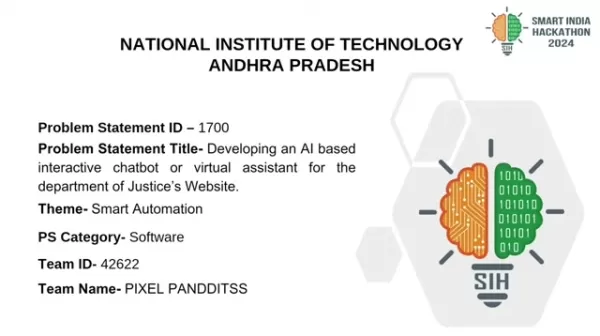
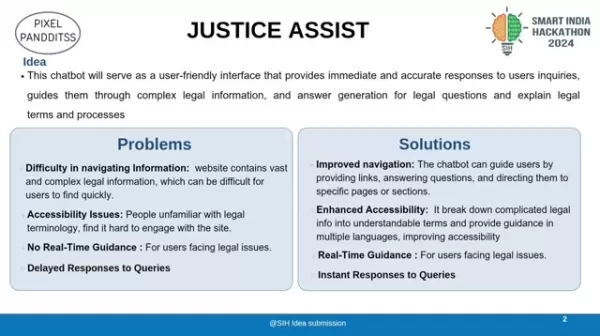
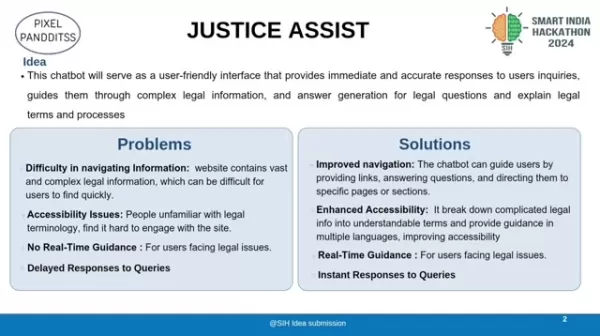
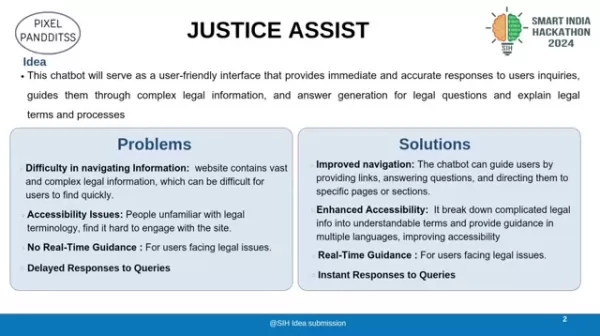
Justice Assist is an AI-based interactive chatbot created to act as a user-friendly interface for the Department of Justice's website
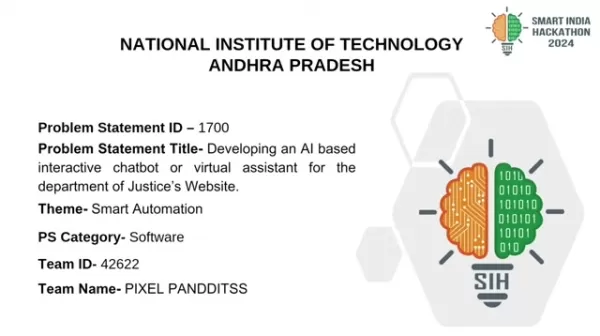
. It delivers prompt and accurate answers to user questions, helping them navigate intricate legal information and processes. The main objective is to improve accessibility and simplify the search for legal answers. This solution uses AI to address legal questions, clarifying legal terms and procedures in simple terms. It removes accessibility barriers to make the website more welcoming and easier to use.
Our chatbot is designed as a user-friendly interface that gives quick and correct answers to user questions, helping them work through complex legal information, generate answers to legal questions, and explain legal terms and processes.
The application of AI in legal support is progressing quickly, with chatbots such as Justice Assist paving the way in providing effective, dependable, and accessible legal help. By tackling common issues like the challenge of navigating extensive legal information and accessibility barriers for those new to legal terminology, AI chatbots are changing how people interact with the justice system. Furthermore, the goal is to resolve delays in answering questions and assist individuals dealing with legal matters and complex legal terms.
Keywords: AI Chatbot, legal services, justice, legal terminology, accessibility, legal information, user-friendly interface.
Addressing Key Problems in Legal Information Access
A major challenge when using legal websites is the enormous amount and complexity of the information available. Many users struggle to find specific answers or comprehend intricate legal language. This issue impacts the speed and ease with which people can obtain the legal advice they require.
Common Problems
- Difficulty in Navigating Information:
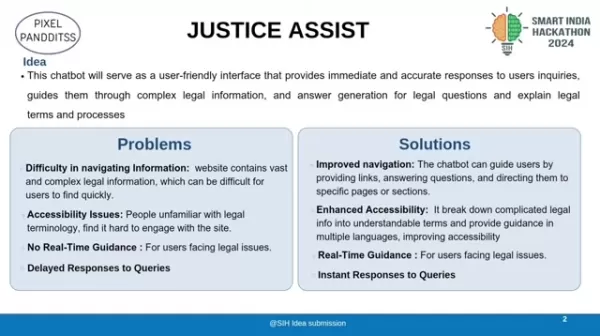
Legal websites often hold large volumes of complex legal information, making it tough for users to quickly locate what they need. The level of legal knowledge required to explore these sites can be a major obstacle. The extensive and complicated website includes legal content that users find difficult to interpret.
- Accessibility Issues: Many individuals are not familiar with legal terms, which hinders their ability to use legal websites effectively. This language barrier can discourage people from seeking the help they need. Users find it challenging to interact with the site due to legal terminology.
- No Real-Time Guidance: Without real-time assistance, users may find it hard to understand the information they locate or how it relates to their specific circumstances. This absence of guidance can result in confusion and delays in taking required steps.
- Delayed Responses to Queries: Conventional methods of seeking legal information often involve waiting for answers, which can be problematic in urgent situations. Users want to receive immediate replies to their questions.
By concentrating on these key issues, AI chatbots provide practical and efficient solutions that enhance the overall experience for users seeking legal help. This is achieved by improving accessibility, offering guidance, and simplifying navigation. Justice Assist guarantees that users can explore the site effectively and with assurance.
Solutions Offered by AI Chatbots Like Justice Assist
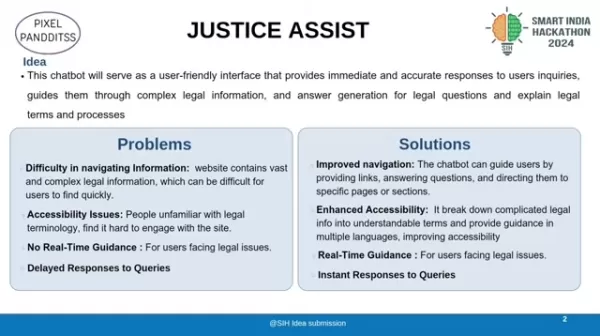
AI chatbots like Justice Assist are built to directly address the problems mentioned above, offering user-friendly solutions that increase accessibility and efficiency in accessing legal information.
Key Solutions
- Improved Navigation: The chatbot assists users by offering direct links, answering inquiries, and directing them to specific pages or sections of the website. This feature streamlines the search process and conserves users' time.
- Enhanced Accessibility: Complex legal information is explained in understandable language, and guidance is available in multiple languages. This method makes legal information available to a broader audience, including those unfamiliar with legal jargon.
- Real-Time Guidance: Users dealing with legal matters get immediate support and guidance, helping them comprehend their rights and options in real time. This capability is vital in time-sensitive scenarios where fast access to information is important.
- Instant Responses to Queries: AI chatbots give immediate replies to user questions, removing the need to wait for help. This function ensures users can rapidly access the information they need, enabling them to make informed choices.
By providing these solutions, Justice Assist improves the user experience. The chatbot offers navigation help for legal terminology, guidance, and real-time answers. Legal AI is changing how justice services are accessed.
The Five-Step Technical Approach to Legal Chatbot Development
Step-by-Step Implementation
To guarantee the creation of a strong and efficient legal chatbot, a structured technical method is necessary
. Here is a detailed five-step process to direct the development of such an AI system:
Step 1: NLP and Legal Dataset Integration
The initial step includes integrating Natural Language Processing (NLP) models with pertinent legal datasets. This ensures the chatbot can comprehend and reply accurately to legal questions. Advanced NLP models are customized for legal terminology, and the assistant is pre-trained on legal-specific data to guarantee precise and relevant responses.
Step 2: Conversational User Interface (UI)
Creating an intuitive chatbot interface is essential for accessibility. The interface should include Speech-to-Text and Text-to-Speech features to accommodate diverse user requirements. It should also enable multi-turn conversation support for thorough interactions.
Step 3: Legal Information Retrieval
An AI-powered system is set up to retrieve case laws, legal guidelines, and documents from a centralized database. This ensures accuracy and current information, offering reliable legal support to users.
Step 4: Security and Privacy Compliance
Ensuring secure user authentication and data protection is critical. This requires implementing multi-factor authentication and adhering to data protection rules such as GDPR and other national regulations. This step protects user information and maintains confidence.
Step 5: Scalability and Continuous Improvement
The final step is hosting the system on a scalable cloud infrastructure. Incorporating a machine-learning feedback loop allows for ongoing enhancement and regular updates on legal policies. Scalability ensures the chatbot can manage a high number of queries, and regular updates keep the system aligned with legal changes.
How to Effectively Utilize Justice Assist: A User Guide
Step-by-Step Instructions for Users
Justice Assist is designed to be user-friendly. This ensures that anyone, regardless of their experience with technology or legal terms, can effectively use the chatbot to find the information they require. Here is a step-by-step guide to help you begin:
Accessing the Chatbot:
- Go to the Department of Justice website.
- Find the Justice Assist chatbot icon, usually located in the corner of the screen.
- Click the icon to open the chat window.
Starting a Conversation:
- Type your legal question or inquiry into the chat window.
- Alternatively, use the speech-to-text feature to speak your question if typing is challenging.
Navigating Responses:
- Read the chatbot’s reply carefully.
- Follow any provided links to access specific pages or sections of the website for more detailed information.
- If the response is not clear, rephrase your question or ask for more explanation.
Utilizing Multi-Turn Conversations:
- Engage in multi-turn conversations to deepen your understanding.
- Ask follow-up questions to investigate different aspects of your legal issue.
- Use the chatbot to clarify legal terms or processes you find confusing.
Ensuring Security:
- Be aware of the security and privacy measures in place.
- Ensure secure user authentication and data protection by following GDPR and other national regulations.
- Protect sensitive information, such as case statuses, by using secure communications and user authentication.
By following these steps, users can effectively use Justice Assist to navigate legal information, understand their rights, and make informed decisions. It is designed to be a comprehensive resource for legal information and inquiries.
Cost Feasibility of AI Chatbot Implementation in Legal Services
Worthwhile Investment for Justice Departments
Implementing AI chatbots like Justice Assist is a valuable investment.
Although there are initial expenses related to development, integration, and maintenance, the long-term advantages greatly exceed these costs. The chatbot provides cost savings by decreasing the need for human support.
Key Factors in Cost Feasibility
Factor Description Benefits Reduced Human Support AI chatbots can manage a large number of queries, reducing dependence on human staff for basic questions. Significant cost savings in salaries, training, and administrative overhead. Improved Efficiency Chatbots provide instant replies and guide users to relevant information, cutting down the time spent on each inquiry. Increased throughput, allowing legal departments to assist more users with the same resources. Enhanced Accessibility By making legal information more accessible, chatbots reduce the need for users to seek costly legal consultations for simple questions. Cost savings for both the justice department and the public. Continuous Improvement Machine learning feedback loops enable ongoing improvement, ensuring the chatbot becomes more effective over time and needs less manual upkeep. Reduced long-term maintenance costs and improved response accuracy. Scalable Cloud Infrastructure Hosting the chatbot on a scalable cloud infrastructure allows efficient resource allocation, ensuring the system can manage growing demand without major cost rises. Cost-effective solution for handling varying user traffic and ensuring constant availability.
Keywords: Cost feasibility, AI chatbot, worthwhile investment, legal services, cost savings, machine learning, cloud infrastructure.
Weighing the Benefits and Drawbacks of AI Legal Chatbots
Pros
Better user experience
Higher efficiency through quick and automated responses
Greater accessibility with 24/7 availability
Accuracy by supplying current information
Cost savings by reducing the need for human support
Cons
Risk of incorrect or incomplete information
Limited capacity to manage complex or nuanced legal matters
Worries about data privacy and security
Reliance on technology and possibility of system breakdowns
Absence of human empathy and understanding
Core Features of Justice Assist: Transforming Legal Interactions
Key Capabilities and Technical Specifications
Justice Assist is equipped with a set of core features designed to improve user experience, increase efficiency, and ensure accessibility.
The AI system provides various features, from multiple languages and speech technology to data security. These core features help transform and enhance justice services.
Key Capabilities:
NLP and Legal Dataset Integration:
- Advanced NLP models customized for legal terminology.
- Pre-training on legal-specific data for accurate replies.
Conversational User Interface (UI):
- Intuitive chatbot interface with speech-to-text and text-to-speech features.
- Multi-turn conversation support for thorough interactions.
Legal Information Retrieval:
- AI-powered system to retrieve case laws, legal guidelines, and documents.
- Centralized database ensuring accuracy and up-to-date information.
Security and Privacy Compliance:
- Secure user authentication (e.g., multi-factor authentication).
- Data protection following GDPR and national regulations.
Scalability and Continuous Improvement:
- System hosted on scalable cloud infrastructure.
- Machine learning feedback loop for ongoing enhancement and regular updates.
Keywords: Core features, AI chatbot, NLP, user interface, legal information retrieval, security, scalability.
Practical Use Cases: How Justice Assist Can Be Applied
Real-World Applications of a Legal AI Chatbot
Justice Assist and similar AI chatbots can be used in various real-world situations to enhance legal services.
Whether you are a member of the public trying to understand legal guidelines or someone in a law office requiring legal information retrieval, Justice Assist can help.
Use Cases
Public Legal Information:
- Giving citizens easy access to information about their rights, legal procedures, and applicable laws.
- Answering common legal questions and guiding users through complex legal processes.
- Providing support in multiple languages to serve diverse populations.
Legal Aid and Support:
- Helping individuals navigate legal aid applications and eligibility criteria.
- Connecting users with relevant legal resources and support services.
- Offering guidance on pro bono legal services and other forms of assistance.
Court and Tribunal Assistance:
- Supplying information about court procedures, filing requirements, and deadlines.
- Assisting litigants in preparing documents and understanding court processes.
- Answering frequently asked questions about court operations and rules.
Law Enforcement Support:
- Providing law enforcement officers quick access to legal guidelines and case laws.
- Offering support in interpreting laws and regulations in the field.
- Assisting in the preparation of legal documents and filings.
Legal Education and Training:
- Giving law students and legal professionals access to a comprehensive legal knowledge base.
- Providing interactive training modules and quizzes to improve understanding of legal concepts.
- Assisting in legal research and analysis.
Keywords: Use cases, AI chatbot, legal services, public legal information, legal aid, court assistance, law enforcement, legal education.
Frequently Asked Questions (FAQ)
What is the primary function of Justice Assist?
Justice Assist is an AI-powered chatbot built to deliver prompt and accurate replies to legal inquiries. It helps users navigate complex legal information, making it more accessible and understandable. It aims to improve user experience and increase efficiency in accessing legal services.
How does Justice Assist ensure data security and privacy?
Data security and privacy are top priorities. Justice Assist implements secure user authentication, such as multi-factor authentication, and complies with data protection regulations like GDPR and national rules. This method safeguards sensitive information and maintains user trust.
Can Justice Assist assist individuals with disabilities?
Yes, Justice Assist includes accessibility features designed to help users with disabilities. The chatbot interface incorporates speech-to-text and text-to-speech functionalities, making it easier for individuals with visual or motor impairments to access and use the system.
How does the AI system retrieve legal information?
The AI system retrieves legal information from a centralized database containing case laws, legal guidelines, and relevant documents. This database ensures accuracy and current information, providing reliable legal support to users.
What NLP models are used in Justice Assist?
Justice Assist uses advanced Natural Language Processing (NLP) models customized for legal terminology. Examples of these models include transformer models like BERT and GPT. These models are pre-trained on legal-specific data to ensure accurate and relevant responses.
Related Questions
How can AI chatbots improve legal services?
AI chatbots can greatly enhance legal services by offering 24/7 support, shortening wait times, improving accessibility for people with disabilities, and freeing legal professionals to concentrate on complex tasks. They can answer basic legal questions, guide users through legal processes, and connect them with relevant resources. Furthermore, AI-powered chatbots provide personalized support by analyzing user inquiries and delivering tailored information. They can also offer multilingual support, making legal information available to diverse populations. By automating routine tasks and giving instant assistance, AI chatbots can boost the overall efficiency and accessibility of legal services. AI Chatbots can significantly improve how individuals interact with the justice system.
What are the challenges in implementing AI chatbots in the legal sector?
There are several challenges in implementing AI chatbots in the legal sector. One primary challenge is ensuring the accuracy and reliability of the chatbot’s responses, as legal information can be complex and nuanced. Another challenge is protecting user data and maintaining privacy, especially given the sensitive nature of legal information. Additionally, there may be concerns about bias in AI algorithms and the need to ensure fairness and equity in the provision of legal services. Furthermore, user acceptance and trust can be a hurdle, as some individuals may be reluctant to rely on AI for legal guidance. It is important to address these challenges by implementing robust testing and validation processes, ensuring data security and privacy, and promoting transparency and user education. Overcoming these challenges can lead to wider adoption of Justice Assist.
Related article
 Anthropic Expands Claude AI Coding Tools to Japan in Push for Overseas Growth
Anthropic, a prominent U.S. artificial intelligence firm, is intensifying its global outreach. On Wednesday, the company hosted a major developer gathering, "Code with Claude," in Tokyo, drawing close to 500 software engineers. This initiative seeks
India’s Software Giant Cuts Hiring, Promises No Layoffs as AI Agents Scale Up
As artificial intelligence reshapes traditional labor-intensive business models, Tata Consultancy Services (TCS), a premier Indian software outsourcing firm, has unveiled its strategic response. During Tuesday’s annual general meeting, the chairman o
China Locks AI Models During Gaokam to Block Instant Homework Help
With the 2026 Gaokao fast approaching, rumors regarding the suspension of AI tools during the exam period have ignited intense online debate. In response to public concern, major AI platforms and educational apps have clarified their stance: rather t
Related Special Topic Recommendations
Design & Art
Anthropic Expands Claude AI Coding Tools to Japan in Push for Overseas Growth
Anthropic, a prominent U.S. artificial intelligence firm, is intensifying its global outreach. On Wednesday, the company hosted a major developer gathering, "Code with Claude," in Tokyo, drawing close to 500 software engineers. This initiative seeks
India’s Software Giant Cuts Hiring, Promises No Layoffs as AI Agents Scale Up
As artificial intelligence reshapes traditional labor-intensive business models, Tata Consultancy Services (TCS), a premier Indian software outsourcing firm, has unveiled its strategic response. During Tuesday’s annual general meeting, the chairman o
China Locks AI Models During Gaokam to Block Instant Homework Help
With the 2026 Gaokao fast approaching, rumors regarding the suspension of AI tools during the exam period have ignited intense online debate. In response to public concern, major AI platforms and educational apps have clarified their stance: rather t
Related Special Topic Recommendations
Design & Art
 Best AI Style Transfer Tools for Creative Experiments
2026 Latest Best Top-rated AI Style Transfer Tools for Creative Experiments! XIX.AI has curated a powerful, game-changing collection of must-try tools that deliver exceptional results through real-world tests and rigorous rankings. These top solutions help creatives boost productivity significantly by accelerating content creation and unlocking endless creative possibilities. Explore now to discover your perfect tool and start creating today!
 9 tools
 xix.ai
Comic Creation
Best AI Dialogue Bubble Tools for Visual Storytelling
xix.ai
Comic Creation
Best AI Dialogue Bubble Tools for Visual Storytelling
2026 Latest Best Top-Rated AI Dialogue Bubble Tools for Visual Storytelling are here on XIX.AI! This curated collection features powerful, game-changing tools that help creators boost productivity and overcome creative bottlenecks. Get a free vs paid comparison, see real-world tests, and check the latest rankings to find the must-try solutions perfect for crafting engaging visual narratives. Explore now to discover your ideal tool!
10 tools
xix.ai
Meeting Assistant
Top AI Meeting Summary Tools: Track Decisions and Follow-Ups Clearly
2026 Latest Top-Rated Best AI Meeting Summary Tools for Clear Decision Tracking and Effortless Follow-Ups. This curated list showcases powerful, game-changing solutions that boost productivity dramatically by automating meeting notes, identifying key action items, and streamlining team coordination across all projects. Get a free vs paid comparison along with real-world tests and weekly updated rankings to help you find the perfect tool. Explore now to unlock your AI edge!
9 tools
xix.ai
Data Analysis
Best AI Data Cleaning Tools: Fix Missing Values and Duplicates Fast
2026 Latest Best Top-rated AI Data Cleaning Tools for quick fixing of missing values and duplicates. This curated list showcases powerful, game-changing solutions that boost productivity significantly. Each option has undergone rigorous real-world tests to ensure reliability. Get a free vs paid comparison and discover the must-try tool that fits your needs best. Explore now at XIX.AI to Unlock your AI edge.
11 tools
xix.ai
Design & Art
Best AI Creative Ideation Tools for Artists: Break Through Visual Blocks
2026 Latest Best Top-Rated AI Creative Ideation Tools for Artists are curated by XIX.AI to help creators break through visual blocks and boost creativity instantly. These powerful game-changing tools offer real-world tests, detailed free vs paid comparison, and weekly updated rankings. Discover your perfect tool to accelerate content creation and unlock your AI edge today. Explore now!
14 tools
xix.ai
Music composition
AI Beat Makers for TikTok Background Tracks, Reels Audio, and Creator Promo Music
2026 Latest Best AI Beat Makers for TikTok Background Tracks, Reels Audio, and Creator Promo Music! XIX.AI has curated a top-rated list of powerful game-changing tools that go through real-world tests to deliver flawless music for every content need. You’ll find detailed free vs paid comparison data, weekly updated rankings, and must-try options to help you boost creativity and productivity. Explore now to discover your perfect tool!
11 tools
xix.ai

 Comments (0)
0/500
Comments (0)
0/500
In today's fast-evolving digital environment, the legal industry is increasingly adopting Artificial Intelligence (AI) to boost efficiency and broaden access to services. AI chatbots are leading this change, delivering innovative ways to handle complex legal data and offer immediate user assistance. These AI-driven virtual assistants are more than a futuristic idea; they are practical tools reshaping how people engage with the legal system. By offering real-time support and improving accessibility, they are transforming the way individuals connect with the justice system.
Key Points
AI chatbots deliver user-friendly interfaces for obtaining legal information.
They help users navigate and grasp complex legal terms and procedures.
AI chatbots supply instant answers to questions, improving the user experience.
By integrating NLP and legal datasets, they provide precise and relevant replies.
Chatbots increase accessibility for those unfamiliar with legal language.
They also maintain security compliance and data protection in line with regulations.
These AI legal tools can identify user needs and connect them with services to support justice.
The Role of AI Chatbots in Modern Legal Services
What is Justice Assist? An AI-Powered Legal Chatbot
Justice Assist is an AI-based interactive chatbot created to act as a user-friendly interface for the Department of Justice's website
. It delivers prompt and accurate answers to user questions, helping them navigate intricate legal information and processes. The main objective is to improve accessibility and simplify the search for legal answers. This solution uses AI to address legal questions, clarifying legal terms and procedures in simple terms. It removes accessibility barriers to make the website more welcoming and easier to use.
Our chatbot is designed as a user-friendly interface that gives quick and correct answers to user questions, helping them work through complex legal information, generate answers to legal questions, and explain legal terms and processes.
The application of AI in legal support is progressing quickly, with chatbots such as Justice Assist paving the way in providing effective, dependable, and accessible legal help. By tackling common issues like the challenge of navigating extensive legal information and accessibility barriers for those new to legal terminology, AI chatbots are changing how people interact with the justice system. Furthermore, the goal is to resolve delays in answering questions and assist individuals dealing with legal matters and complex legal terms.
Keywords: AI Chatbot, legal services, justice, legal terminology, accessibility, legal information, user-friendly interface.
Addressing Key Problems in Legal Information Access
A major challenge when using legal websites is the enormous amount and complexity of the information available. Many users struggle to find specific answers or comprehend intricate legal language. This issue impacts the speed and ease with which people can obtain the legal advice they require.
Common Problems
- Difficulty in Navigating Information:
Legal websites often hold large volumes of complex legal information, making it tough for users to quickly locate what they need. The level of legal knowledge required to explore these sites can be a major obstacle. The extensive and complicated website includes legal content that users find difficult to interpret.
- Accessibility Issues: Many individuals are not familiar with legal terms, which hinders their ability to use legal websites effectively. This language barrier can discourage people from seeking the help they need. Users find it challenging to interact with the site due to legal terminology.
- No Real-Time Guidance: Without real-time assistance, users may find it hard to understand the information they locate or how it relates to their specific circumstances. This absence of guidance can result in confusion and delays in taking required steps.
- Delayed Responses to Queries: Conventional methods of seeking legal information often involve waiting for answers, which can be problematic in urgent situations. Users want to receive immediate replies to their questions.
By concentrating on these key issues, AI chatbots provide practical and efficient solutions that enhance the overall experience for users seeking legal help. This is achieved by improving accessibility, offering guidance, and simplifying navigation. Justice Assist guarantees that users can explore the site effectively and with assurance.
Solutions Offered by AI Chatbots Like Justice Assist
AI chatbots like Justice Assist are built to directly address the problems mentioned above, offering user-friendly solutions that increase accessibility and efficiency in accessing legal information.
Key Solutions
- Improved Navigation: The chatbot assists users by offering direct links, answering inquiries, and directing them to specific pages or sections of the website. This feature streamlines the search process and conserves users' time.
- Enhanced Accessibility: Complex legal information is explained in understandable language, and guidance is available in multiple languages. This method makes legal information available to a broader audience, including those unfamiliar with legal jargon.
- Real-Time Guidance: Users dealing with legal matters get immediate support and guidance, helping them comprehend their rights and options in real time. This capability is vital in time-sensitive scenarios where fast access to information is important.
- Instant Responses to Queries: AI chatbots give immediate replies to user questions, removing the need to wait for help. This function ensures users can rapidly access the information they need, enabling them to make informed choices.
By providing these solutions, Justice Assist improves the user experience. The chatbot offers navigation help for legal terminology, guidance, and real-time answers. Legal AI is changing how justice services are accessed.
The Five-Step Technical Approach to Legal Chatbot Development
Step-by-Step Implementation
To guarantee the creation of a strong and efficient legal chatbot, a structured technical method is necessary
. Here is a detailed five-step process to direct the development of such an AI system:
Step 1: NLP and Legal Dataset Integration
The initial step includes integrating Natural Language Processing (NLP) models with pertinent legal datasets. This ensures the chatbot can comprehend and reply accurately to legal questions. Advanced NLP models are customized for legal terminology, and the assistant is pre-trained on legal-specific data to guarantee precise and relevant responses.
Step 2: Conversational User Interface (UI)
Creating an intuitive chatbot interface is essential for accessibility. The interface should include Speech-to-Text and Text-to-Speech features to accommodate diverse user requirements. It should also enable multi-turn conversation support for thorough interactions.
Step 3: Legal Information Retrieval
An AI-powered system is set up to retrieve case laws, legal guidelines, and documents from a centralized database. This ensures accuracy and current information, offering reliable legal support to users.
Step 4: Security and Privacy Compliance
Ensuring secure user authentication and data protection is critical. This requires implementing multi-factor authentication and adhering to data protection rules such as GDPR and other national regulations. This step protects user information and maintains confidence.
Step 5: Scalability and Continuous Improvement
The final step is hosting the system on a scalable cloud infrastructure. Incorporating a machine-learning feedback loop allows for ongoing enhancement and regular updates on legal policies. Scalability ensures the chatbot can manage a high number of queries, and regular updates keep the system aligned with legal changes.
How to Effectively Utilize Justice Assist: A User Guide
Step-by-Step Instructions for Users
Justice Assist is designed to be user-friendly. This ensures that anyone, regardless of their experience with technology or legal terms, can effectively use the chatbot to find the information they require. Here is a step-by-step guide to help you begin:
Accessing the Chatbot:
- Go to the Department of Justice website.
- Find the Justice Assist chatbot icon, usually located in the corner of the screen.
- Click the icon to open the chat window.
Starting a Conversation:
- Type your legal question or inquiry into the chat window.
- Alternatively, use the speech-to-text feature to speak your question if typing is challenging.
Navigating Responses:
- Read the chatbot’s reply carefully.
- Follow any provided links to access specific pages or sections of the website for more detailed information.
- If the response is not clear, rephrase your question or ask for more explanation.
Utilizing Multi-Turn Conversations:
- Engage in multi-turn conversations to deepen your understanding.
- Ask follow-up questions to investigate different aspects of your legal issue.
- Use the chatbot to clarify legal terms or processes you find confusing.
Ensuring Security:
- Be aware of the security and privacy measures in place.
- Ensure secure user authentication and data protection by following GDPR and other national regulations.
- Protect sensitive information, such as case statuses, by using secure communications and user authentication.
By following these steps, users can effectively use Justice Assist to navigate legal information, understand their rights, and make informed decisions. It is designed to be a comprehensive resource for legal information and inquiries.
Cost Feasibility of AI Chatbot Implementation in Legal Services
Worthwhile Investment for Justice Departments
Implementing AI chatbots like Justice Assist is a valuable investment.
Although there are initial expenses related to development, integration, and maintenance, the long-term advantages greatly exceed these costs. The chatbot provides cost savings by decreasing the need for human support.
Key Factors in Cost Feasibility
| Factor | Description | Benefits |
|---|---|---|
| Reduced Human Support | AI chatbots can manage a large number of queries, reducing dependence on human staff for basic questions. | Significant cost savings in salaries, training, and administrative overhead. |
| Improved Efficiency | Chatbots provide instant replies and guide users to relevant information, cutting down the time spent on each inquiry. | Increased throughput, allowing legal departments to assist more users with the same resources. |
| Enhanced Accessibility | By making legal information more accessible, chatbots reduce the need for users to seek costly legal consultations for simple questions. | Cost savings for both the justice department and the public. |
| Continuous Improvement | Machine learning feedback loops enable ongoing improvement, ensuring the chatbot becomes more effective over time and needs less manual upkeep. | Reduced long-term maintenance costs and improved response accuracy. |
| Scalable Cloud Infrastructure | Hosting the chatbot on a scalable cloud infrastructure allows efficient resource allocation, ensuring the system can manage growing demand without major cost rises. | Cost-effective solution for handling varying user traffic and ensuring constant availability. |
Keywords: Cost feasibility, AI chatbot, worthwhile investment, legal services, cost savings, machine learning, cloud infrastructure.
Weighing the Benefits and Drawbacks of AI Legal Chatbots
Pros
Better user experience
Higher efficiency through quick and automated responses
Greater accessibility with 24/7 availability
Accuracy by supplying current information
Cost savings by reducing the need for human support
Cons
Risk of incorrect or incomplete information
Limited capacity to manage complex or nuanced legal matters
Worries about data privacy and security
Reliance on technology and possibility of system breakdowns
Absence of human empathy and understanding
Core Features of Justice Assist: Transforming Legal Interactions
Key Capabilities and Technical Specifications
Justice Assist is equipped with a set of core features designed to improve user experience, increase efficiency, and ensure accessibility.
The AI system provides various features, from multiple languages and speech technology to data security. These core features help transform and enhance justice services.
Key Capabilities:
NLP and Legal Dataset Integration:
- Advanced NLP models customized for legal terminology.
- Pre-training on legal-specific data for accurate replies.
Conversational User Interface (UI):
- Intuitive chatbot interface with speech-to-text and text-to-speech features.
- Multi-turn conversation support for thorough interactions.
Legal Information Retrieval:
- AI-powered system to retrieve case laws, legal guidelines, and documents.
- Centralized database ensuring accuracy and up-to-date information.
Security and Privacy Compliance:
- Secure user authentication (e.g., multi-factor authentication).
- Data protection following GDPR and national regulations.
Scalability and Continuous Improvement:
- System hosted on scalable cloud infrastructure.
- Machine learning feedback loop for ongoing enhancement and regular updates.
Keywords: Core features, AI chatbot, NLP, user interface, legal information retrieval, security, scalability.
Practical Use Cases: How Justice Assist Can Be Applied
Real-World Applications of a Legal AI Chatbot
Justice Assist and similar AI chatbots can be used in various real-world situations to enhance legal services.
Whether you are a member of the public trying to understand legal guidelines or someone in a law office requiring legal information retrieval, Justice Assist can help.
Use Cases
Public Legal Information:
- Giving citizens easy access to information about their rights, legal procedures, and applicable laws.
- Answering common legal questions and guiding users through complex legal processes.
- Providing support in multiple languages to serve diverse populations.
Legal Aid and Support:
- Helping individuals navigate legal aid applications and eligibility criteria.
- Connecting users with relevant legal resources and support services.
- Offering guidance on pro bono legal services and other forms of assistance.
Court and Tribunal Assistance:
- Supplying information about court procedures, filing requirements, and deadlines.
- Assisting litigants in preparing documents and understanding court processes.
- Answering frequently asked questions about court operations and rules.
Law Enforcement Support:
- Providing law enforcement officers quick access to legal guidelines and case laws.
- Offering support in interpreting laws and regulations in the field.
- Assisting in the preparation of legal documents and filings.
Legal Education and Training:
- Giving law students and legal professionals access to a comprehensive legal knowledge base.
- Providing interactive training modules and quizzes to improve understanding of legal concepts.
- Assisting in legal research and analysis.
Keywords: Use cases, AI chatbot, legal services, public legal information, legal aid, court assistance, law enforcement, legal education.
Frequently Asked Questions (FAQ)
What is the primary function of Justice Assist?
Justice Assist is an AI-powered chatbot built to deliver prompt and accurate replies to legal inquiries. It helps users navigate complex legal information, making it more accessible and understandable. It aims to improve user experience and increase efficiency in accessing legal services.
How does Justice Assist ensure data security and privacy?
Data security and privacy are top priorities. Justice Assist implements secure user authentication, such as multi-factor authentication, and complies with data protection regulations like GDPR and national rules. This method safeguards sensitive information and maintains user trust.
Can Justice Assist assist individuals with disabilities?
Yes, Justice Assist includes accessibility features designed to help users with disabilities. The chatbot interface incorporates speech-to-text and text-to-speech functionalities, making it easier for individuals with visual or motor impairments to access and use the system.
How does the AI system retrieve legal information?
The AI system retrieves legal information from a centralized database containing case laws, legal guidelines, and relevant documents. This database ensures accuracy and current information, providing reliable legal support to users.
What NLP models are used in Justice Assist?
Justice Assist uses advanced Natural Language Processing (NLP) models customized for legal terminology. Examples of these models include transformer models like BERT and GPT. These models are pre-trained on legal-specific data to ensure accurate and relevant responses.
Related Questions
How can AI chatbots improve legal services?
AI chatbots can greatly enhance legal services by offering 24/7 support, shortening wait times, improving accessibility for people with disabilities, and freeing legal professionals to concentrate on complex tasks. They can answer basic legal questions, guide users through legal processes, and connect them with relevant resources. Furthermore, AI-powered chatbots provide personalized support by analyzing user inquiries and delivering tailored information. They can also offer multilingual support, making legal information available to diverse populations. By automating routine tasks and giving instant assistance, AI chatbots can boost the overall efficiency and accessibility of legal services. AI Chatbots can significantly improve how individuals interact with the justice system.
What are the challenges in implementing AI chatbots in the legal sector?
There are several challenges in implementing AI chatbots in the legal sector. One primary challenge is ensuring the accuracy and reliability of the chatbot’s responses, as legal information can be complex and nuanced. Another challenge is protecting user data and maintaining privacy, especially given the sensitive nature of legal information. Additionally, there may be concerns about bias in AI algorithms and the need to ensure fairness and equity in the provision of legal services. Furthermore, user acceptance and trust can be a hurdle, as some individuals may be reluctant to rely on AI for legal guidance. It is important to address these challenges by implementing robust testing and validation processes, ensuring data security and privacy, and promoting transparency and user education. Overcoming these challenges can lead to wider adoption of Justice Assist.








 Anthropic Expands Claude AI Coding Tools to Japan in Push for Overseas Growth
Anthropic, a prominent U.S. artificial intelligence firm, is intensifying its global outreach. On Wednesday, the company hosted a major developer gathering, "Code with Claude," in Tokyo, drawing close to 500 software engineers. This initiative seeks
Anthropic Expands Claude AI Coding Tools to Japan in Push for Overseas Growth
Anthropic, a prominent U.S. artificial intelligence firm, is intensifying its global outreach. On Wednesday, the company hosted a major developer gathering, "Code with Claude," in Tokyo, drawing close to 500 software engineers. This initiative seeks
 India’s Software Giant Cuts Hiring, Promises No Layoffs as AI Agents Scale Up
As artificial intelligence reshapes traditional labor-intensive business models, Tata Consultancy Services (TCS), a premier Indian software outsourcing firm, has unveiled its strategic response. During Tuesday’s annual general meeting, the chairman o
India’s Software Giant Cuts Hiring, Promises No Layoffs as AI Agents Scale Up
As artificial intelligence reshapes traditional labor-intensive business models, Tata Consultancy Services (TCS), a premier Indian software outsourcing firm, has unveiled its strategic response. During Tuesday’s annual general meeting, the chairman o
 China Locks AI Models During Gaokam to Block Instant Homework Help
With the 2026 Gaokao fast approaching, rumors regarding the suspension of AI tools during the exam period have ignited intense online debate. In response to public concern, major AI platforms and educational apps have clarified their stance: rather t
China Locks AI Models During Gaokam to Block Instant Homework Help
With the 2026 Gaokao fast approaching, rumors regarding the suspension of AI tools during the exam period have ignited intense online debate. In response to public concern, major AI platforms and educational apps have clarified their stance: rather t

2026 Latest Best Top-rated AI Style Transfer Tools for Creative Experiments! XIX.AI has curated a powerful, game-changing collection of must-try tools that deliver exceptional results through real-world tests and rigorous rankings. These top solutions help creatives boost productivity significantly by accelerating content creation and unlocking endless creative possibilities. Explore now to discover your perfect tool and start creating today!
9 tools
xix.ai

2026 Latest Best Top-Rated AI Dialogue Bubble Tools for Visual Storytelling are here on XIX.AI! This curated collection features powerful, game-changing tools that help creators boost productivity and overcome creative bottlenecks. Get a free vs paid comparison, see real-world tests, and check the latest rankings to find the must-try solutions perfect for crafting engaging visual narratives. Explore now to discover your ideal tool!
10 tools
xix.ai

2026 Latest Top-Rated Best AI Meeting Summary Tools for Clear Decision Tracking and Effortless Follow-Ups. This curated list showcases powerful, game-changing solutions that boost productivity dramatically by automating meeting notes, identifying key action items, and streamlining team coordination across all projects. Get a free vs paid comparison along with real-world tests and weekly updated rankings to help you find the perfect tool. Explore now to unlock your AI edge!
9 tools
xix.ai

2026 Latest Best Top-rated AI Data Cleaning Tools for quick fixing of missing values and duplicates. This curated list showcases powerful, game-changing solutions that boost productivity significantly. Each option has undergone rigorous real-world tests to ensure reliability. Get a free vs paid comparison and discover the must-try tool that fits your needs best. Explore now at XIX.AI to Unlock your AI edge.
11 tools
xix.ai

2026 Latest Best Top-Rated AI Creative Ideation Tools for Artists are curated by XIX.AI to help creators break through visual blocks and boost creativity instantly. These powerful game-changing tools offer real-world tests, detailed free vs paid comparison, and weekly updated rankings. Discover your perfect tool to accelerate content creation and unlock your AI edge today. Explore now!
14 tools
xix.ai

2026 Latest Best AI Beat Makers for TikTok Background Tracks, Reels Audio, and Creator Promo Music! XIX.AI has curated a top-rated list of powerful game-changing tools that go through real-world tests to deliver flawless music for every content need. You’ll find detailed free vs paid comparison data, weekly updated rankings, and must-try options to help you boost creativity and productivity. Explore now to discover your perfect tool!
11 tools
xix.ai












