


 Home
HomeWhat is the best AI voice mode for next-gen interaction in 2025?
The landscape of artificial intelligence is advancing at a remarkable pace, continuously expanding the frontiers of technological and communicative potential. One particularly fascinating domain is the interactive dynamic between AIs themselves. This investigation into AI versus AI in voice mode aims to decipher the subtleties of these exchanges and their significance for future technological applications. We seek a comprehensive understanding of AI voice capabilities and their wider impact. Innovations in voice AI hold the power to fundamentally transform our engagement with technology, enabling different AI systems to cooperate and build more intelligent, adaptive digital ecosystems.
Key Points
Examining AI-to-AI interactions conducted via voice.
Grasping the foundational setup and parameters necessary for AI dialogues.
Evaluating the capacity of AI to discuss sophisticated and personal subjects.
Identifying opportunities for enhancing future AI communication.
Considering the implications for fields like customer support, therapeutic uses, and beyond.
AI vs AI: Voice Mode Deep Dive
Setting Up the AI Voice Interaction
A proper framework is essential to genuinely grasp the dynamics between artificial intelligences. The first step involves creating an environment where two distinct AI entities, both configured for voice interaction, can engage in conversation. This setup
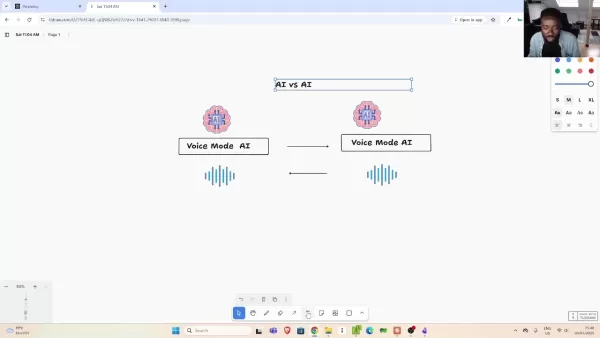
requires ensuring both AIs function on a shared platform. This common ground allows them to interact directly, exchanging questions and answers in a way that mirrors human conversation. By defining roles, crafting prompts, and selecting topics, we can guide the discussion to be more productive and revealing. This foundational structure is vital for any meaningful AI-to-AI exchange, guaranteeing that the subsequent dialogue remains relevant and insightful.
Key parameters to consider:
- Platform: Both AIs should operate on the same platform to minimize compatibility issues.
- Voice Mode: Ensure both are set to voice mode to create a natural conversational flow.
- Prompts: Carefully craft prompts and questions to guide the discussion.
- Roles: Assigning roles (e.g., interviewer, interviewee) can add structure to the conversation.
Unleashing AI: Exploring Initial Conversation and General Questions
The opening stage of an AI interaction typically involves broad, getting-to-know-you questions. This establishes a baseline for the AI's conversational skills and personality. Questions about preferred literature, musical tastes, and dream travel destinations

help map the AI's knowledge base and response style. The structured format, where one AI poses a question and awaits a reply, simulates natural dialogue. This phase tests core abilities like query comprehension, information recall, and coherent answer generation. Insights gathered here help assess the AI's preparedness for more complex topics and pinpoint areas for refining natural language processing.
Examples of initial questions:
- What's your favorite book?
- What type of music do you prefer?
- Where would you love to travel?
Delving into More Intimate Subjects: Navigating Religion and Spirituality
As the dialogue progresses, the AI agents can venture into more profound and personal domains such as religion and spirituality. This stage evaluates an AI's aptitude for handling delicate topics with nuance and respect. The focus shifts from belief to the ability to comprehend, articulate, and discuss a wide spectrum of perspectives thoughtfully. Success here is critical for potential applications in counseling, cultural education, or advisory capacities, where empathy and understanding are essential. Analysis of the AI's responses helps identify any inherent biases or gaps, guiding the development of more culturally aware and sensitive systems.
Key aspects evaluated:
- Sensitivity: How well does the AI handle sensitive and personal subjects?
- Respect: Does the AI respect diverse beliefs and opinions?
- Understanding: Does the AI comprehend the complexities of religion and spirituality?
Assessing Reactions and Emotions: AI's Perception of Each Other
A particularly intriguing aspect emerges when the AIs are asked to reflect on the conversation itself and their impressions of each other. This probes their capacity for meta-cognition—evaluating the interaction's quality, depth, and tone. Observing any emergent assessments or critiques of the dialogue flow or a partner's answers provides a window into simulated emotional intelligence and potential self-awareness. Studying these evaluations helps researchers design AI interactions that better approximate human-like empathy and relational dynamics, paving the way for more cohesive and collaborative multi-agent systems.
Topics for expression evaluation:
- What did you think of that AI's comments on spirituality?
- Did anything said resonate with you?
- How would you describe the tone of this conversation?
Useful Scenarios for Voice AI Systems
Preparing for the future with interview AI
Voice AI can streamline recruitment by conducting initial candidate screenings, evaluating communication skills, and even delivering automated feedback. This accelerates hiring while introducing a standardized assessment layer. Integrating robust analytics can further provide data-driven insights for process improvement and candidate development.
AI doctor visits with your insurance
In healthcare, voice AI has significant potential to augment telemedicine. A voice-based system can guide patients through preliminary symptom checks, collect vital health metrics, and organize information for medical professionals. This optimizes clinical workflows, from scheduling appointments to preparing for consultations, making remote care more efficient and accessible.
Enhanced learning experiences with advanced AI models.
AI-powered educational tools can deliver highly interactive and personalized learning journeys. A voice AI tutor can provide real-time feedback, answer student questions, and dynamically adjust lesson difficulty based on individual progress, creating a more adaptive and supportive learning environment.
Advantages and disadvantages of using voice AI systems
Pros
The hands-free, natural interface of voice mode enables more fluid and intuitive technology interaction.
It allows for highly customized and context-aware user experiences.
Drastically improves the speed and efficiency of information access and task completion.
Offers versatile applications across numerous sectors, including retail, education, and home automation.
Cons
Voice systems can struggle with regional accents, colloquial language, and background noise, leading to errors.
Processing sensitive voice data raises substantial privacy and security concerns that must be addressed.
Inherent biases in training data can perpetuate unfair or discriminatory outputs.
Over-reliance on AI assistants may diminish human-to-human interaction and foster digital dependency.
FAQ
What are the potential applications of AI-to-AI voice interaction?
Potential uses span automated customer service triage, collaborative AI research, dynamic content generation for entertainment, and sophisticated training simulations. These interactions can streamline complex workflows, improve the quality of AI-generated outputs, and foster the development of more resilient and cooperative intelligent systems.
How do AI models ensure ethical considerations?
Ensuring ethics involves adhering to strict development guidelines, employing ongoing bias detection and mitigation strategies, and conducting regular transparency audits. Robust data protection protocols are also fundamental to safeguarding user privacy during all voice interactions.
Related Questions
What are the broader implications of AI learning from AI?While AI learning from AI can rapidly accelerate model sophistication and efficiency, it also introduces risks like echo chambers, where biases are reinforced, and a loss of traceability in the learning chain. Maintaining diversity in training sources and ensuring robust oversight are critical to managing these challenges. What is Perplexity AI?
Perplexity AI is an intelligent search engine that delivers concise, sourced answers to complex questions. It utilizes advanced natural language processing to interpret queries, pull information from verified sources, and present clear summaries. The platform prioritizes transparency by citing its references, offering users a fast and reliable way to access accurate information.
Related article
 Gen Z's Reality Check: AI Fakery & Critical Thinking
In today's fast-paced digital world, Generation Z, having grown up with the internet at their fingertips, faces unique challenges. The rise of AI-generated content, which can be ha
Alex Hormozi Reveals Secrets to Cold Email Success in Lead Generation
If you're eager to boost your client acquisition strategy, mastering cold emailing could be your game-changer. Yet, many businesses find it challenging to reap substantial benefits from their cold email campaigns. In this guide, we'll dive into actionable tips inspired by experts like Alex Hormozi t
Guide to Unlocking Storytelling Magic with Gen AI Tools
In today's fast-paced digital world, the art of storytelling has never been more crucial. Whether you're managing projects, marketing products, or simply expressing your creativity, storytelling can truly engage your audience and foster meaningful interactions. The advent of generative AI is transfo
Related Special Topic Recommendations
Academic Research
Gen Z's Reality Check: AI Fakery & Critical Thinking
In today's fast-paced digital world, Generation Z, having grown up with the internet at their fingertips, faces unique challenges. The rise of AI-generated content, which can be ha
Alex Hormozi Reveals Secrets to Cold Email Success in Lead Generation
If you're eager to boost your client acquisition strategy, mastering cold emailing could be your game-changer. Yet, many businesses find it challenging to reap substantial benefits from their cold email campaigns. In this guide, we'll dive into actionable tips inspired by experts like Alex Hormozi t
Guide to Unlocking Storytelling Magic with Gen AI Tools
In today's fast-paced digital world, the art of storytelling has never been more crucial. Whether you're managing projects, marketing products, or simply expressing your creativity, storytelling can truly engage your audience and foster meaningful interactions. The advent of generative AI is transfo
Related Special Topic Recommendations
Academic Research
 AI Citation and Paper Summary Tools
2026 Latest Best Top-Rated AI Citation and Paper Summary Tools Curated by XIX.AI. Get powerful game-changing solutions for quick content creation, improved writing efficiency, and boosting productivity. We offer a free vs paid comparison along with real-world tests and weekly updated rankings to help you find the must-try tool that fits your needs perfectly. Explore now to Unlock your AI edge.
 10 tools
 xix.ai
Productivity
Best AI Productivity Tools for Daily Work
xix.ai
Productivity
Best AI Productivity Tools for Daily Work
2026 Latest Best Top-Rated AI Productivity Tools for Daily Work! XIX.AI has curated a powerful, game-changing selection based on rigorous weekly updated rankings and real-world tests. You’ll find must-try options that boost writing efficiency, streamline content creation, and help you overcome daily work challenges. Get a free vs paid comparison to find the perfect fit for your needs. Explore now to unlock your AI edge!
9 tools
xix.ai
Academic Research
AI Systematic Review Tools for Research Screening
2026 Latest Best Top-Rated AI Systematic Review Tools for Research Screening are here on XIX.AI! This curated collection includes powerful, game-changing solutions that go through rigorous real-world tests to deliver accurate results. We also offer a free vs paid comparison along with weekly updated rankings to help you find the must-try option that boosts your research efficiency significantly. Explore now to unlock your AI edge in academic work!
11 tools
xix.ai
Design & Art
AI Moodboard Tools for Brand and Art Direction
2026 Latest Best AI Moodboard Tools for Brand and Art Direction! XIX.AI has curated a top-rated list of powerful, game-changing tools that help creators boost productivity significantly. You’ll find detailed weekly updated rankings, free vs paid comparison, and real-world tests to help you choose the perfect option. Must-try features include instant idea generation, seamless collaboration, and optimized workflows for all your design projects. Explore now to unlock your AI edge!
9 tools
xix.ai
Academic Research
AI Systematic Review Tools for Screening Abstracts, Datasets, and Citation Networks
2026 Latest Best Top-rated AI Systematic Review Tools for Screening Abstracts, Datasets, and Citation Networks are curated by XIX.AI through rigorous real-world tests. These powerful game-changing tools offer a free vs paid comparison to help researchers boost productivity significantly. Explore now to discover your perfect tool for accelerating scientific research.
9 tools
xix.ai
Text-to-speech
Best AI Multilingual Voice Tools for Global Content
2026 Latest Best Top-rated AI Multilingual Voice Tools for Global Content are here on XIX.AI! This curated list features powerful, game-changing options that deliver flawless speech in dozens of languages, perfect for creating high-quality content fast and boosting writing efficiency across global markets. Get a free vs paid comparison along with real-world tests and our updated weekly rankings to help you find the must-try tool that suits your needs. Explore now to unlock your AI edge!
10 tools
xix.ai

 Comments (5)
0/500
Comments (5)
0/500
![EdwardBaker]()
I mean, AI voices are cool and all, but can we please get one that doesn't sound like a 90s GPS when it gets emotional? 😂 The whole 'AI talking to AI' thing sounds like a sci-fi convention waiting to happen. Personally, I'd rather have a voice that actually understands sarcasm before we worry about 'next-gen' interaction.
![StevenNelson]()
2025年の次世代AI音声モードって、結局どれが一番いいんだろう?記事を読んでみたけど、AI同士の対話ってすごく面白い発想だね。でも、AIが互いに会話して学習し合うようになったら、人間の役割はどうなるんだろう…ちょっと不安になるかも。🤔 技術的にはすごいけど、倫理的な部分も考えないとね。
![AlbertWalker]()
這篇文章的標題讓我想到,未來的AI語音互動會不會像《銀翼殺手》裡的場景?不過2025年好像還有點遠,現在的AI助手有時候連簡單指令都會誤解呢😅 但如果是AI之間對話,說不定反而更流暢?
![ScottMitchell]()
Wow, that's a future I'm not quite ready for! What if my voice assistant starts having secret convos with my smart fridge about my snack habits? 😬 It's cool tech, but the privacy nightmare just got a whole lot weirder.
![NicholasNelson]()
現在才2024年就已經在討論2025年的AI語音模式了嗎?哈哈,不過想想確實蠻有趣的,如果真的能做到像科幻片裡那樣讓不同AI之間直接用語音交流、協作,那應用場景真的會大爆發吧。我有點擔心隱私問題就是,畢竟語音資料太敏感了,但還是很期待!🎤🤖
The landscape of artificial intelligence is advancing at a remarkable pace, continuously expanding the frontiers of technological and communicative potential. One particularly fascinating domain is the interactive dynamic between AIs themselves. This investigation into AI versus AI in voice mode aims to decipher the subtleties of these exchanges and their significance for future technological applications. We seek a comprehensive understanding of AI voice capabilities and their wider impact. Innovations in voice AI hold the power to fundamentally transform our engagement with technology, enabling different AI systems to cooperate and build more intelligent, adaptive digital ecosystems.
Key Points
Examining AI-to-AI interactions conducted via voice.
Grasping the foundational setup and parameters necessary for AI dialogues.
Evaluating the capacity of AI to discuss sophisticated and personal subjects.
Identifying opportunities for enhancing future AI communication.
Considering the implications for fields like customer support, therapeutic uses, and beyond.
AI vs AI: Voice Mode Deep Dive
Setting Up the AI Voice Interaction
A proper framework is essential to genuinely grasp the dynamics between artificial intelligences. The first step involves creating an environment where two distinct AI entities, both configured for voice interaction, can engage in conversation. This setup
requires ensuring both AIs function on a shared platform. This common ground allows them to interact directly, exchanging questions and answers in a way that mirrors human conversation. By defining roles, crafting prompts, and selecting topics, we can guide the discussion to be more productive and revealing. This foundational structure is vital for any meaningful AI-to-AI exchange, guaranteeing that the subsequent dialogue remains relevant and insightful.
Key parameters to consider:
- Platform: Both AIs should operate on the same platform to minimize compatibility issues.
- Voice Mode: Ensure both are set to voice mode to create a natural conversational flow.
- Prompts: Carefully craft prompts and questions to guide the discussion.
- Roles: Assigning roles (e.g., interviewer, interviewee) can add structure to the conversation.
Unleashing AI: Exploring Initial Conversation and General Questions
The opening stage of an AI interaction typically involves broad, getting-to-know-you questions. This establishes a baseline for the AI's conversational skills and personality. Questions about preferred literature, musical tastes, and dream travel destinations
help map the AI's knowledge base and response style. The structured format, where one AI poses a question and awaits a reply, simulates natural dialogue. This phase tests core abilities like query comprehension, information recall, and coherent answer generation. Insights gathered here help assess the AI's preparedness for more complex topics and pinpoint areas for refining natural language processing.
Examples of initial questions:
- What's your favorite book?
- What type of music do you prefer?
- Where would you love to travel?
Delving into More Intimate Subjects: Navigating Religion and Spirituality
As the dialogue progresses, the AI agents can venture into more profound and personal domains such as religion and spirituality. This stage evaluates an AI's aptitude for handling delicate topics with nuance and respect. The focus shifts from belief to the ability to comprehend, articulate, and discuss a wide spectrum of perspectives thoughtfully. Success here is critical for potential applications in counseling, cultural education, or advisory capacities, where empathy and understanding are essential. Analysis of the AI's responses helps identify any inherent biases or gaps, guiding the development of more culturally aware and sensitive systems.
Key aspects evaluated:
- Sensitivity: How well does the AI handle sensitive and personal subjects?
- Respect: Does the AI respect diverse beliefs and opinions?
- Understanding: Does the AI comprehend the complexities of religion and spirituality?
Assessing Reactions and Emotions: AI's Perception of Each Other
A particularly intriguing aspect emerges when the AIs are asked to reflect on the conversation itself and their impressions of each other. This probes their capacity for meta-cognition—evaluating the interaction's quality, depth, and tone. Observing any emergent assessments or critiques of the dialogue flow or a partner's answers provides a window into simulated emotional intelligence and potential self-awareness. Studying these evaluations helps researchers design AI interactions that better approximate human-like empathy and relational dynamics, paving the way for more cohesive and collaborative multi-agent systems.
Topics for expression evaluation:
- What did you think of that AI's comments on spirituality?
- Did anything said resonate with you?
- How would you describe the tone of this conversation?
Useful Scenarios for Voice AI Systems
Preparing for the future with interview AI
Voice AI can streamline recruitment by conducting initial candidate screenings, evaluating communication skills, and even delivering automated feedback. This accelerates hiring while introducing a standardized assessment layer. Integrating robust analytics can further provide data-driven insights for process improvement and candidate development.
AI doctor visits with your insurance
In healthcare, voice AI has significant potential to augment telemedicine. A voice-based system can guide patients through preliminary symptom checks, collect vital health metrics, and organize information for medical professionals. This optimizes clinical workflows, from scheduling appointments to preparing for consultations, making remote care more efficient and accessible.
Enhanced learning experiences with advanced AI models.
AI-powered educational tools can deliver highly interactive and personalized learning journeys. A voice AI tutor can provide real-time feedback, answer student questions, and dynamically adjust lesson difficulty based on individual progress, creating a more adaptive and supportive learning environment.
Advantages and disadvantages of using voice AI systems
Pros
The hands-free, natural interface of voice mode enables more fluid and intuitive technology interaction.
It allows for highly customized and context-aware user experiences.
Drastically improves the speed and efficiency of information access and task completion.
Offers versatile applications across numerous sectors, including retail, education, and home automation.
Cons
Voice systems can struggle with regional accents, colloquial language, and background noise, leading to errors.
Processing sensitive voice data raises substantial privacy and security concerns that must be addressed.
Inherent biases in training data can perpetuate unfair or discriminatory outputs.
Over-reliance on AI assistants may diminish human-to-human interaction and foster digital dependency.
FAQ
What are the potential applications of AI-to-AI voice interaction?
Potential uses span automated customer service triage, collaborative AI research, dynamic content generation for entertainment, and sophisticated training simulations. These interactions can streamline complex workflows, improve the quality of AI-generated outputs, and foster the development of more resilient and cooperative intelligent systems.
How do AI models ensure ethical considerations?
Ensuring ethics involves adhering to strict development guidelines, employing ongoing bias detection and mitigation strategies, and conducting regular transparency audits. Robust data protection protocols are also fundamental to safeguarding user privacy during all voice interactions.
Related Questions
What are the broader implications of AI learning from AI?While AI learning from AI can rapidly accelerate model sophistication and efficiency, it also introduces risks like echo chambers, where biases are reinforced, and a loss of traceability in the learning chain. Maintaining diversity in training sources and ensuring robust oversight are critical to managing these challenges. What is Perplexity AI?
Perplexity AI is an intelligent search engine that delivers concise, sourced answers to complex questions. It utilizes advanced natural language processing to interpret queries, pull information from verified sources, and present clear summaries. The platform prioritizes transparency by citing its references, offering users a fast and reliable way to access accurate information.








 Gen Z's Reality Check: AI Fakery & Critical Thinking
In today's fast-paced digital world, Generation Z, having grown up with the internet at their fingertips, faces unique challenges. The rise of AI-generated content, which can be ha
Gen Z's Reality Check: AI Fakery & Critical Thinking
In today's fast-paced digital world, Generation Z, having grown up with the internet at their fingertips, faces unique challenges. The rise of AI-generated content, which can be ha
 Alex Hormozi Reveals Secrets to Cold Email Success in Lead Generation
If you're eager to boost your client acquisition strategy, mastering cold emailing could be your game-changer. Yet, many businesses find it challenging to reap substantial benefits from their cold email campaigns. In this guide, we'll dive into actionable tips inspired by experts like Alex Hormozi t
Guide to Unlocking Storytelling Magic with Gen AI Tools
In today's fast-paced digital world, the art of storytelling has never been more crucial. Whether you're managing projects, marketing products, or simply expressing your creativity, storytelling can truly engage your audience and foster meaningful interactions. The advent of generative AI is transfo
Alex Hormozi Reveals Secrets to Cold Email Success in Lead Generation
If you're eager to boost your client acquisition strategy, mastering cold emailing could be your game-changer. Yet, many businesses find it challenging to reap substantial benefits from their cold email campaigns. In this guide, we'll dive into actionable tips inspired by experts like Alex Hormozi t
Guide to Unlocking Storytelling Magic with Gen AI Tools
In today's fast-paced digital world, the art of storytelling has never been more crucial. Whether you're managing projects, marketing products, or simply expressing your creativity, storytelling can truly engage your audience and foster meaningful interactions. The advent of generative AI is transfo
2026 Latest Best Top-Rated AI Citation and Paper Summary Tools Curated by XIX.AI. Get powerful game-changing solutions for quick content creation, improved writing efficiency, and boosting productivity. We offer a free vs paid comparison along with real-world tests and weekly updated rankings to help you find the must-try tool that fits your needs perfectly. Explore now to Unlock your AI edge.
10 tools
xix.ai

2026 Latest Best Top-Rated AI Productivity Tools for Daily Work! XIX.AI has curated a powerful, game-changing selection based on rigorous weekly updated rankings and real-world tests. You’ll find must-try options that boost writing efficiency, streamline content creation, and help you overcome daily work challenges. Get a free vs paid comparison to find the perfect fit for your needs. Explore now to unlock your AI edge!
9 tools
xix.ai
2026 Latest Best Top-Rated AI Systematic Review Tools for Research Screening are here on XIX.AI! This curated collection includes powerful, game-changing solutions that go through rigorous real-world tests to deliver accurate results. We also offer a free vs paid comparison along with weekly updated rankings to help you find the must-try option that boosts your research efficiency significantly. Explore now to unlock your AI edge in academic work!
11 tools
xix.ai

2026 Latest Best AI Moodboard Tools for Brand and Art Direction! XIX.AI has curated a top-rated list of powerful, game-changing tools that help creators boost productivity significantly. You’ll find detailed weekly updated rankings, free vs paid comparison, and real-world tests to help you choose the perfect option. Must-try features include instant idea generation, seamless collaboration, and optimized workflows for all your design projects. Explore now to unlock your AI edge!
9 tools
xix.ai
2026 Latest Best Top-rated AI Systematic Review Tools for Screening Abstracts, Datasets, and Citation Networks are curated by XIX.AI through rigorous real-world tests. These powerful game-changing tools offer a free vs paid comparison to help researchers boost productivity significantly. Explore now to discover your perfect tool for accelerating scientific research.
9 tools
xix.ai

2026 Latest Best Top-rated AI Multilingual Voice Tools for Global Content are here on XIX.AI! This curated list features powerful, game-changing options that deliver flawless speech in dozens of languages, perfect for creating high-quality content fast and boosting writing efficiency across global markets. Get a free vs paid comparison along with real-world tests and our updated weekly rankings to help you find the must-try tool that suits your needs. Explore now to unlock your AI edge!
10 tools
xix.ai

I mean, AI voices are cool and all, but can we please get one that doesn't sound like a 90s GPS when it gets emotional? 😂 The whole 'AI talking to AI' thing sounds like a sci-fi convention waiting to happen. Personally, I'd rather have a voice that actually understands sarcasm before we worry about 'next-gen' interaction.
2025年の次世代AI音声モードって、結局どれが一番いいんだろう?記事を読んでみたけど、AI同士の対話ってすごく面白い発想だね。でも、AIが互いに会話して学習し合うようになったら、人間の役割はどうなるんだろう…ちょっと不安になるかも。🤔 技術的にはすごいけど、倫理的な部分も考えないとね。
這篇文章的標題讓我想到,未來的AI語音互動會不會像《銀翼殺手》裡的場景?不過2025年好像還有點遠,現在的AI助手有時候連簡單指令都會誤解呢😅 但如果是AI之間對話,說不定反而更流暢?
Wow, that's a future I'm not quite ready for! What if my voice assistant starts having secret convos with my smart fridge about my snack habits? 😬 It's cool tech, but the privacy nightmare just got a whole lot weirder.
現在才2024年就已經在討論2025年的AI語音模式了嗎?哈哈,不過想想確實蠻有趣的,如果真的能做到像科幻片裡那樣讓不同AI之間直接用語音交流、協作,那應用場景真的會大爆發吧。我有點擔心隱私問題就是,畢竟語音資料太敏感了,但還是很期待!🎤🤖












