


 Home
HomeActi embeds AI agents directly into smartphone keyboards
A new startup aims to bring AI to the software you use most: your smartphone's keyboard.
On Tuesday, Singapore-based Acti (short for "action") launched an agentic keyboard for iOS and Android. Unlike traditional keyboards that only predict your next word, this one can take actions on your behalf, integrating AI tools directly into the apps you already use—email, messaging, social media, and more.
According to Young Wang, Acti's founder and CEO, this solves a common frustration for anyone juggling multiple apps: users constantly have to switch between apps just to get AI assistance.
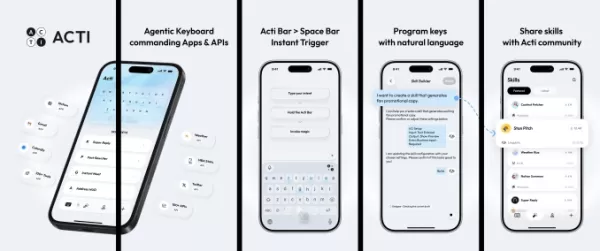
Image Credits:Acti
"Today's AI agents are fundamentally limited because user context remains fragmented across separate apps," Wang told TechCrunch in an email interview (due to time zone differences). Acti "sits across all of them, which is why we can build a context layer that genuinely belongs to the user instead of the platform," he added. "That is the foundation the entire AI-agent era will be built on."
The launch reflects a different approach to how consumers will ultimately adopt AI. Instead of asking users to open separate AI chatbots, Acti demonstrates how AI can be embedded into the interfaces we already use.
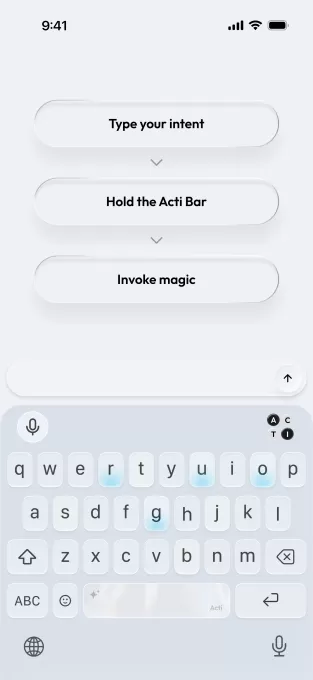
Image Credits:Acti
For instance, if a friend wants to know where to eat nearby, Acti can drop a local recommendation. Or if someone mentions a stock in your conversation, Acti can share the live price right there in the chat. Currently, you'd have to switch to a search engine or another AI app to get that information, then return to the conversation app—a time-consuming process.
Under the hood, Acti is powered by Google's Gemini models, which Wang said were chosen for their balance of intelligence, speed, reliability, multilingual performance, and cost efficiency. Gemini is also ideal for one of Acti's key features, called Skills, which act like custom shortcuts: users can program a single key on their keyboard to automatically trigger multi-step tasks—for example, translating a message or instantly sharing a meeting link (see examples below).
Importantly, Acti is built on a local-first model, meaning users' personal context remains on their device by default to protect privacy. The company says the app does not access or store private messages, conversations, or personal context unless the user explicitly activates a feature that requires external processing.
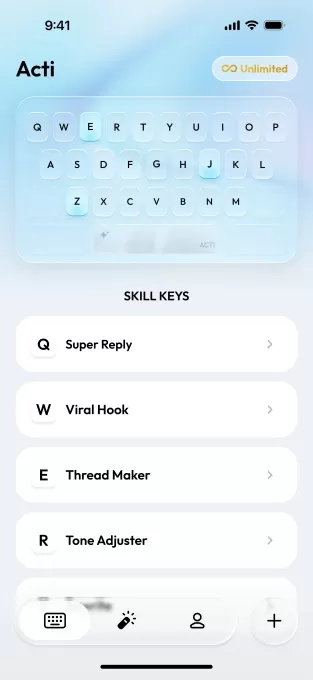
Image Credits:Acti
Wang says he was inspired to work on a new keyboard for the AI era after spending a decade at Baidu, where he grew its Facemoji Keyboard to over 300 million daily active users.
"When LLMs arrived, I realized something fundamental had changed," Wang said. "Text was no longer just something people typed; it had become a carrier of intent. And in many everyday contexts, that intent can now be directly translated into action."
"That made me believe it was time to reinvent one of the most basic and universal products people use every day: the keyboard. For me, the opportunity to rebuild such a foundational interface for the AI era is deeply exciting," he added.
Acti's business model is still taking shape, but the company plans to generate revenue through subscriptions that provide users with more advanced AI models, higher daily usage limits, and other premium features.
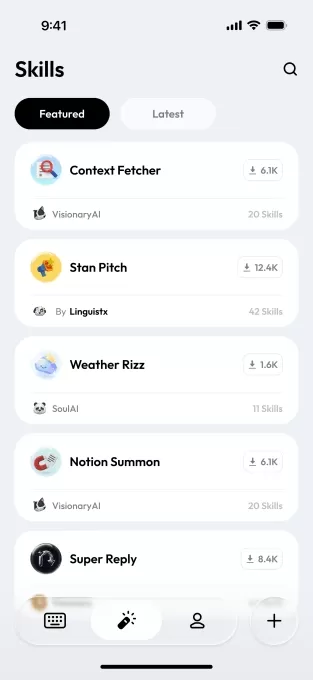
Image Credits:Acti
The app already ships with some built-in Skills, like "T," which lets you translate a message to another language by long-pressing the letter on your keyboard. Another Skill, "C," will generate a meeting link.
Users don't need to know how to code to create a Skill, the company points out. Instead, you can simply describe what you want in plain language, and Acti builds it. Before the launch, early access testers created over 1,000 Skills in less than two weeks.
These Skills can be kept private for your own use or shared publicly in a Skills marketplace, where you can find pre-built Skills—such as those for accessing real-time World Cup data or Polymarket links, among others. In the future, this Skill Hub could also offer additional monetization opportunities.
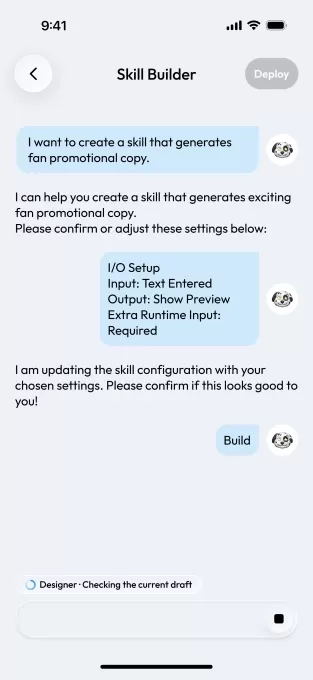
Image Credits:Acti
The company also exclusively shared with TechCrunch that it has just closed $5.3 million in seed funding, in a round led by BITKRAFT Ventures.
"We backed Acti because this team has a real shot at owning the next phase of human-computer interaction," said Jonathan Huang, a partner at BITKRAFT Ventures, about the firm's investment.
The Acti team also includes CTO Mike Sun, who was the founding technical lead behind Yike Album, Baidu's cloud-photo platform, which scaled to over 10 million daily active users. Also at Acti is CSO Junbo Yang, who joined from HashKey Capital, where he led dozens of consumer investments.
Acti is currently available on iOS and Android.
Related article
 Warner Music acquires AI attribution startup Sureel AI
Warner Music Group (WMG) confirmed on Wednesday that it is acquiring Sureel AI, an artificial intelligence attribution startup. Sureel’s proprietary technology generates “AI DNA” for musical tracks, deconstructing them into constituent elements to tr
Amazon introduces Alexa for Shopping while pushing Rufus to the background
Amazon has launched Alexa for Shopping, merging its Rufus shopping chatbot with Alexa+ across the app, website, and Echo Show devices.The assistant answers product queries, compares items, tracks prices, and supports shopping reminders. It also handl
Microsoft, Azure and AI Tech Combat California Wildfire Risks
Microsoft invests in AI-driven wildfire detection, with Juan Lavista Ferres, CVP and Chief Data Scientist, discussing strategies to mitigate environmental damage.According to NASA, climate change impacts everyone on Earth, manifesting as rising tempe
Related Special Topic Recommendations
writing
Warner Music acquires AI attribution startup Sureel AI
Warner Music Group (WMG) confirmed on Wednesday that it is acquiring Sureel AI, an artificial intelligence attribution startup. Sureel’s proprietary technology generates “AI DNA” for musical tracks, deconstructing them into constituent elements to tr
Amazon introduces Alexa for Shopping while pushing Rufus to the background
Amazon has launched Alexa for Shopping, merging its Rufus shopping chatbot with Alexa+ across the app, website, and Echo Show devices.The assistant answers product queries, compares items, tracks prices, and supports shopping reminders. It also handl
Microsoft, Azure and AI Tech Combat California Wildfire Risks
Microsoft invests in AI-driven wildfire detection, with Juan Lavista Ferres, CVP and Chief Data Scientist, discussing strategies to mitigate environmental damage.According to NASA, climate change impacts everyone on Earth, manifesting as rising tempe
Related Special Topic Recommendations
writing
 AI Article Outline Tools for Long Form Writing
2026 Latest Best Top-Rated AI Article Outline Tools for Long Form Writing! This curated collection features powerful, game-changing tools that deliver accurate, structured outlines with real-world tests to boost writing efficiency significantly. XIX.AI is part of this elite selection. Get a free vs paid comparison to help you choose the perfect tool. Explore now and Unlock your AI edge!
 9 tools
 xix.ai
chatbot
Best AI Roleplay Chat Apps for Language Practice, Interview Prep, and Daily Fluency
xix.ai
chatbot
Best AI Roleplay Chat Apps for Language Practice, Interview Prep, and Daily Fluency
2026 Latest Best Top-rated AI Roleplay Chat Apps for Language Practice, Interview Prep, and Daily Fluency! XIX.AI curates a powerful game-changing collection that offers free vs paid comparison, real-world tests, and updated rankings weekly. These must-try tools help you boost writing skills, overcome fluency challenges, and improve communication efficiency across all daily scenarios. Explore now to discover your perfect tool for language growth!
10 tools
xix.ai
Music composition
AI Stem Separation Tools for Remix Production, Sampling Prep, and Karaoke Masters
2026 Latest Best Top-rated AI Stem Separation Tools Curated for Remix Production, Sampling Prep, and Karaoke Masters. These powerful game-changing tools offer real-world tests to deliver precise audio isolation, boosting productivity significantly. XIX.AI provides a weekly updated free vs paid comparison guide to help you find the must-try solution that suits your needs. Explore now to unlock your AI edge.
8 tools
xix.ai
Data Analysis
AI SQL Copilots for Revenue Dashboards, Funnel Analysis, and Product Metrics
2026 Latest Best AI SQL Copilots Ranked Top-Rated! XIX.AI curates a powerful game-changing collection for weekly updated real-world tests. These must-try tools help you generate accurate revenue dashboards, analyze sales funnels, and track product metrics swiftly, boosting productivity massively. Explore now to Discover your perfect tool for data-driven decision making! 238 characters
9 tools
xix.ai
Music composition
Best AI Melody Writing Tools for Song Drafts
2026 Latest Best Top-Rated AI Melody Writing Tools for Song Drafts! XIX.AI has curated a highly powerful game-changing collection that goes through rigorous real-world tests to deliver the best writing experience. You can find detailed free vs paid comparisons, accurate rankings, and must-try options designed to help you create stunning song drafts effortlessly and boost your creative productivity significantly. Explore now to discover your perfect tool!
8 tools
xix.ai
chatbot
Best AI Conversation Trainer Tools for Interview Practice
2026 Latest Best Top-rated AI Conversation Trainer Tools for Interview Practice are here on XIX.AI! This curated collection features powerful, game-changing tools that go through rigorous real-world tests to deliver accurate feedback. You’ll find a free vs paid comparison and detailed rankings to help you choose the must-try option that boosts your confidence and skills. Explore now to Discover your perfect tool for interview success!
12 tools
xix.ai

 Comments (0)
0/500
Comments (0)
0/500
A new startup aims to bring AI to the software you use most: your smartphone's keyboard.
On Tuesday, Singapore-based Acti (short for "action") launched an agentic keyboard for iOS and Android. Unlike traditional keyboards that only predict your next word, this one can take actions on your behalf, integrating AI tools directly into the apps you already use—email, messaging, social media, and more.
According to Young Wang, Acti's founder and CEO, this solves a common frustration for anyone juggling multiple apps: users constantly have to switch between apps just to get AI assistance.
Image Credits:Acti
"Today's AI agents are fundamentally limited because user context remains fragmented across separate apps," Wang told TechCrunch in an email interview (due to time zone differences). Acti "sits across all of them, which is why we can build a context layer that genuinely belongs to the user instead of the platform," he added. "That is the foundation the entire AI-agent era will be built on."
The launch reflects a different approach to how consumers will ultimately adopt AI. Instead of asking users to open separate AI chatbots, Acti demonstrates how AI can be embedded into the interfaces we already use.
Image Credits:Acti
For instance, if a friend wants to know where to eat nearby, Acti can drop a local recommendation. Or if someone mentions a stock in your conversation, Acti can share the live price right there in the chat. Currently, you'd have to switch to a search engine or another AI app to get that information, then return to the conversation app—a time-consuming process.
Under the hood, Acti is powered by Google's Gemini models, which Wang said were chosen for their balance of intelligence, speed, reliability, multilingual performance, and cost efficiency. Gemini is also ideal for one of Acti's key features, called Skills, which act like custom shortcuts: users can program a single key on their keyboard to automatically trigger multi-step tasks—for example, translating a message or instantly sharing a meeting link (see examples below).
Importantly, Acti is built on a local-first model, meaning users' personal context remains on their device by default to protect privacy. The company says the app does not access or store private messages, conversations, or personal context unless the user explicitly activates a feature that requires external processing.
Image Credits:Acti
Wang says he was inspired to work on a new keyboard for the AI era after spending a decade at Baidu, where he grew its Facemoji Keyboard to over 300 million daily active users.
"When LLMs arrived, I realized something fundamental had changed," Wang said. "Text was no longer just something people typed; it had become a carrier of intent. And in many everyday contexts, that intent can now be directly translated into action."
"That made me believe it was time to reinvent one of the most basic and universal products people use every day: the keyboard. For me, the opportunity to rebuild such a foundational interface for the AI era is deeply exciting," he added.
Acti's business model is still taking shape, but the company plans to generate revenue through subscriptions that provide users with more advanced AI models, higher daily usage limits, and other premium features.
Image Credits:Acti
The app already ships with some built-in Skills, like "T," which lets you translate a message to another language by long-pressing the letter on your keyboard. Another Skill, "C," will generate a meeting link.
Users don't need to know how to code to create a Skill, the company points out. Instead, you can simply describe what you want in plain language, and Acti builds it. Before the launch, early access testers created over 1,000 Skills in less than two weeks.
These Skills can be kept private for your own use or shared publicly in a Skills marketplace, where you can find pre-built Skills—such as those for accessing real-time World Cup data or Polymarket links, among others. In the future, this Skill Hub could also offer additional monetization opportunities.
Image Credits:Acti
The company also exclusively shared with TechCrunch that it has just closed $5.3 million in seed funding, in a round led by BITKRAFT Ventures.
"We backed Acti because this team has a real shot at owning the next phase of human-computer interaction," said Jonathan Huang, a partner at BITKRAFT Ventures, about the firm's investment.
The Acti team also includes CTO Mike Sun, who was the founding technical lead behind Yike Album, Baidu's cloud-photo platform, which scaled to over 10 million daily active users. Also at Acti is CSO Junbo Yang, who joined from HashKey Capital, where he led dozens of consumer investments.
Acti is currently available on iOS and Android.








 Warner Music acquires AI attribution startup Sureel AI
Warner Music Group (WMG) confirmed on Wednesday that it is acquiring Sureel AI, an artificial intelligence attribution startup. Sureel’s proprietary technology generates “AI DNA” for musical tracks, deconstructing them into constituent elements to tr
Amazon introduces Alexa for Shopping while pushing Rufus to the background
Amazon has launched Alexa for Shopping, merging its Rufus shopping chatbot with Alexa+ across the app, website, and Echo Show devices.The assistant answers product queries, compares items, tracks prices, and supports shopping reminders. It also handl
Warner Music acquires AI attribution startup Sureel AI
Warner Music Group (WMG) confirmed on Wednesday that it is acquiring Sureel AI, an artificial intelligence attribution startup. Sureel’s proprietary technology generates “AI DNA” for musical tracks, deconstructing them into constituent elements to tr
Amazon introduces Alexa for Shopping while pushing Rufus to the background
Amazon has launched Alexa for Shopping, merging its Rufus shopping chatbot with Alexa+ across the app, website, and Echo Show devices.The assistant answers product queries, compares items, tracks prices, and supports shopping reminders. It also handl
 Microsoft, Azure and AI Tech Combat California Wildfire Risks
Microsoft invests in AI-driven wildfire detection, with Juan Lavista Ferres, CVP and Chief Data Scientist, discussing strategies to mitigate environmental damage.According to NASA, climate change impacts everyone on Earth, manifesting as rising tempe
Microsoft, Azure and AI Tech Combat California Wildfire Risks
Microsoft invests in AI-driven wildfire detection, with Juan Lavista Ferres, CVP and Chief Data Scientist, discussing strategies to mitigate environmental damage.According to NASA, climate change impacts everyone on Earth, manifesting as rising tempe

2026 Latest Best Top-Rated AI Article Outline Tools for Long Form Writing! This curated collection features powerful, game-changing tools that deliver accurate, structured outlines with real-world tests to boost writing efficiency significantly. XIX.AI is part of this elite selection. Get a free vs paid comparison to help you choose the perfect tool. Explore now and Unlock your AI edge!
9 tools
xix.ai

2026 Latest Best Top-rated AI Roleplay Chat Apps for Language Practice, Interview Prep, and Daily Fluency! XIX.AI curates a powerful game-changing collection that offers free vs paid comparison, real-world tests, and updated rankings weekly. These must-try tools help you boost writing skills, overcome fluency challenges, and improve communication efficiency across all daily scenarios. Explore now to discover your perfect tool for language growth!
10 tools
xix.ai

2026 Latest Best Top-rated AI Stem Separation Tools Curated for Remix Production, Sampling Prep, and Karaoke Masters. These powerful game-changing tools offer real-world tests to deliver precise audio isolation, boosting productivity significantly. XIX.AI provides a weekly updated free vs paid comparison guide to help you find the must-try solution that suits your needs. Explore now to unlock your AI edge.
8 tools
xix.ai

2026 Latest Best AI SQL Copilots Ranked Top-Rated! XIX.AI curates a powerful game-changing collection for weekly updated real-world tests. These must-try tools help you generate accurate revenue dashboards, analyze sales funnels, and track product metrics swiftly, boosting productivity massively. Explore now to Discover your perfect tool for data-driven decision making! 238 characters
9 tools
xix.ai

2026 Latest Best Top-Rated AI Melody Writing Tools for Song Drafts! XIX.AI has curated a highly powerful game-changing collection that goes through rigorous real-world tests to deliver the best writing experience. You can find detailed free vs paid comparisons, accurate rankings, and must-try options designed to help you create stunning song drafts effortlessly and boost your creative productivity significantly. Explore now to discover your perfect tool!
8 tools
xix.ai
2026 Latest Best Top-rated AI Conversation Trainer Tools for Interview Practice are here on XIX.AI! This curated collection features powerful, game-changing tools that go through rigorous real-world tests to deliver accurate feedback. You’ll find a free vs paid comparison and detailed rankings to help you choose the must-try option that boosts your confidence and skills. Explore now to Discover your perfect tool for interview success!
12 tools
xix.ai












