


 Home
600B Sparse MoE Activates 27B, Boosting Open-Source Flagship Cost-Effectiveness
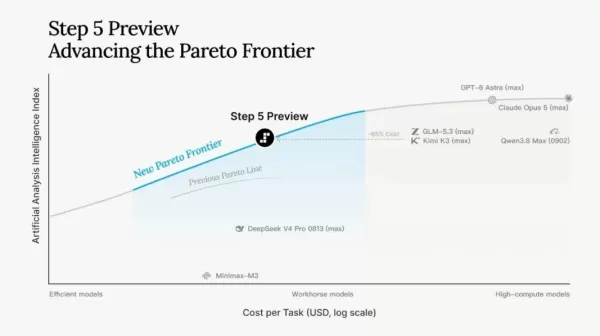
Step 5 Preview, the latest flagship foundation model, is now officially available. Its purpose is clear: a primary model engineered for real-world Agentic tasks. It addresses the longstanding "Pareto problem" in AI, where capability, efficiency, and cost often conflict. Historically, progress in one area required sacrificing another. However, advancing the Pareto frontier isn't about removing trade-offs but expanding the entire boundary through innovative design.
This iteration utilizes a sparse Mixture of Experts (MoE) architecture. Step 5 Preview contains 600 billion parameters, with only 27 billion activated per inference. It natively supports a context window of up to one million tokens and processes both text and visual inputs. Scoring 44 points on the Artificial Analysis Intelligence Index, it ranks among the top three global open-source models. Notably, its single-task cost is just one-eighth that of Claude Opus5, offering either enhanced intelligence within the same budget or superior capabilities at a lower price. On ALE-CLI, a subset of Agents' Last Exam, as well as the financial investment research benchmark FrontierFinance and the cross-domain deep research evaluation DRACO, it trails only GPT-6Astra or Claude Opus5, leaving other open-source models behind. GDPval-AA v2 incorporates the latest data up to September 19th, while DeepSWE v1.1 was evaluated using the SWE-agent harness with temperature=1.0 and top_p=0.95.
In software development, Step created StepCodeBench, encompassing 553 independent code repositories, nine task types, 20 application domains, and 33 programming languages. Step 5 Preview demonstrates strong overall success rates and cross-scenario stability, effectively handling real-world tasks like bug fixing, feature development, refactoring, and environment configuration. In one demonstration, it processed extensive ESP32 documentation to transform an ESP32-S3 development board into a Vibe Coding keyboard with Bluetooth buttons and voice input. It autonomously opened COM serial ports, adjusted cameras, captured device images, simulated mouse movements, and iteratively debugged code based on real-time errors, completing the task over three hours.
Long-running tasks highlight its true value. In the first experiment, given 24 hours and an H100 GPU, it optimized an MLA GPU kernel from scratch (head dimension 512, batch size 1, 64 attention heads, 8192 tokens). Step 5 Preview independently modified the code, executed the kernel, and measured throughput. When encountering a solution that worked but reduced speed, it discarded it and continued from the best version. After approximately 22 hours, it achieved a peak performance of 508 TFLOPS, surpassing Claude Opus5's 493 TFLOPS. The second experiment also spanned 24 hours, allowing it to enhance a Qwen3-30B-A3B base model's performance on AIME24 through automated post-training. The model determined how to utilize the annotated API and adjust data, ultimately increasing accuracy from 53.3% to 60%, matching Opus5 while using fewer annotated tokens.
Regarding front-end and visual applications, it goes beyond writing web pages; it can invoke Blender to build and iteratively modify 3D assets, then integrate them into Three.js for interactive applications and games. It even extracted information from a 1922 "Guangjiu Railway Travel Guide," creating a journey query, cost calculation, and route playback system. This turned historical materials into an interactive product, featuring a small train running along the historical line.
Finance serves as a comprehensive capability test. Step developed three internal evaluations focused on company research: FinStepBench-LiveSearch tests the ability to retrieve and verify financial information as requirements evolve; CorporateValuation assesses converting data and assumptions into reproducible valuations; and DeepResearch evaluates the entire process from evidence collection to a complete research report. External benchmarks like FrontierFinance cover six investment scenarios with 220 expert questions and 11,543 scoring criteria. Step 5 Preview delivered strong results across all four benchmarks.
From Step3.5Flash and Step3.7Flash to Step5Preview, Step has consistently focused on one principle: the next phase of scaling is not merely about adding more Compute, but using Compute more efficiently. Following today's full release, complete model weights will be available on October 15th. This open-source flagship, which redefines the balance of "capability-cost-efficiency," is now ready for developers to adopt as their primary tool for Agentic tasks.
Related article
 Former Spotify Exec Launches Vinyl Bar Startup in Shibuya to Redefine Music Apps
As generative AI continues to reshape the creative landscape, a new wave of startups is empowering users to produce music through AI prompts, mimicking the style of any artist. A Vinyl Bar in Shibuya, a startup with an indie band-inspired name, is de
JD Cloud Unveils MiniMax M3 Large Model, Marking a Leap in Inference Efficiency
JD Cloud’s JoyBuilder platform has integrated the newly launched MiniMax M3 model, making it available to users immediately upon release.This update focuses on enhanced inference performance. The platform leverages its proprietary inference framework
Nvidia’s Vera chip: The US$200 billion gamble Jensen Huang wants you to notice
The Nvidia Vera chip rarely grabs headlines when earnings exceed expectations, yet it deserves the spotlight. With Q1 revenue hitting US$81.62 billion—surpassing analyst estimates of US$78.86 billion—and a Q2 guidance of US$91 billion, well above Wal
Related Special Topic Recommendations
Design & Art
 Top AI Illustration Tools: Create Editorial Scenes and Cover Art Faster
2026 Latest Top-rated AI Illustration Tools: Our curated list features the best powerfully designed tools for creating stunning editorial scenes and eye-catching cover art quickly. Each option has gone through rigorous real-world tests, offering a free vs paid comparison to help you find the perfect match for your workflow. Try these must-try solutions today to unlock your AI edge and boost your creative productivity. Explore now at XIX.AI.
 10 tools
 xix.ai
Education and Learning
Top AI Tutors for Exam Prep: Practice Math, Science, and English
2026 Latest Top-Rated Best AI Tutors for Exam Prep are here on XIX.AI! Our curated list features powerful game-changing tools that offer free vs paid comparison, real-world tests, and weekly updated rankings. They help boost your writing efficiency, simplify complex topic learning, and unlock your academic potential. Explore now to Discover your perfect exam prep tool and Start creating today to Unlock your AI edge!
10 tools
xix.ai
Finance
AI Budget Planning Tools for Personal Money Management
2026 Latest Best Top-Rated AI Budget Planning Tools for Personal Money Management are here on XIX.AI! This curated collection features powerful, game-changing solutions that help you conduct real-world tests, understand spending habits, and create personalized plans to boost productivity. Enjoy a free vs paid comparison along with detailed rankings. Must-try tools designed to simplify money management and unlock your AI edge. Explore now!
11 tools
xix.ai
Health & Wellness
AI Sleep Tracking Assistants: Improve Recovery with Better Bedtime Habits
2026 Latest Best Top-Rated AI Sleep Tracking Assistants curated for ultimate recovery. This fully updated weekly guide features powerful tools that deliver real-world tests, free vs paid comparison, and detailed rankings to help you find the must-try solution that boosts sleep quality and supports better bedtime habits. Explore now at XIX.AI to Unlock your AI edge.
10 tools
xix.ai
Data Analysis
AI SQL Copilots for Product and Revenue Analytics
2026 Latest Best Top-Rated AI SQL Copilots for Product and Revenue Analytics! XIX.AI has curated a powerful, game-changing collection of must-try tools that undergo real-world tests through weekly updated rankings. These tools help users boost productivity significantly by accelerating data analysis, streamlining complex queries, and generating accurate insights to drive smarter business decisions. Explore now to Discover your perfect tool for unlocking your AI edge!
14 tools
xix.ai
Education and Learning
Best AI Homework Helpers That Teach: Learn Concepts, Not Just Answers
2026 Latest Best Top-Rated AI Homework Helpers That Teach Core Concepts Not Just Answers Powerful Tools for Students Must-Try Curated List Weekly Updated Free vs Paid Comparison Real-World Tests Accurate Rankings to Help You Unlock Your Full Learning Potential Explore now to Discover your perfect tool for smarter studying.
10 tools
xix.ai

 Comments (0)
0/500
Step 5 Preview, the latest flagship foundation model, is now officially available. Its purpose is clear: a primary model engineered for real-world Agentic tasks. It addresses the longstanding "Pareto problem" in AI, where capability, efficiency, and cost often conflict. Historically, progress in one area required sacrificing another. However, advancing the Pareto frontier isn't about removing trade-offs but expanding the entire boundary through innovative design.
This iteration utilizes a sparse Mixture of Experts (MoE) architecture. Step 5 Preview contains 600 billion parameters, with only 27 billion activated per inference. It natively supports a context window of up to one million tokens and processes both text and visual inputs. Scoring 44 points on the Artificial Analysis Intelligence Index, it ranks among the top three global open-source models. Notably, its single-task cost is just one-eighth that of Claude Opus5, offering either enhanced intelligence within the same budget or superior capabilities at a lower price. On ALE-CLI, a subset of Agents' Last Exam, as well as the financial investment research benchmark FrontierFinance and the cross-domain deep research evaluation DRACO, it trails only GPT-6Astra or Claude Opus5, leaving other open-source models behind. GDPval-AA v2 incorporates the latest data up to September 19th, while DeepSWE v1.1 was evaluated using the SWE-agent harness with temperature=1.0 and top_p=0.95.
In software development, Step created StepCodeBench, encompassing 553 independent code repositories, nine task types, 20 application domains, and 33 programming languages. Step 5 Preview demonstrates strong overall success rates and cross-scenario stability, effectively handling real-world tasks like bug fixing, feature development, refactoring, and environment configuration. In one demonstration, it processed extensive ESP32 documentation to transform an ESP32-S3 development board into a Vibe Coding keyboard with Bluetooth buttons and voice input. It autonomously opened COM serial ports, adjusted cameras, captured device images, simulated mouse movements, and iteratively debugged code based on real-time errors, completing the task over three hours.
Long-running tasks highlight its true value. In the first experiment, given 24 hours and an H100 GPU, it optimized an MLA GPU kernel from scratch (head dimension 512, batch size 1, 64 attention heads, 8192 tokens). Step 5 Preview independently modified the code, executed the kernel, and measured throughput. When encountering a solution that worked but reduced speed, it discarded it and continued from the best version. After approximately 22 hours, it achieved a peak performance of 508 TFLOPS, surpassing Claude Opus5's 493 TFLOPS. The second experiment also spanned 24 hours, allowing it to enhance a Qwen3-30B-A3B base model's performance on AIME24 through automated post-training. The model determined how to utilize the annotated API and adjust data, ultimately increasing accuracy from 53.3% to 60%, matching Opus5 while using fewer annotated tokens.
Regarding front-end and visual applications, it goes beyond writing web pages; it can invoke Blender to build and iteratively modify 3D assets, then integrate them into Three.js for interactive applications and games. It even extracted information from a 1922 "Guangjiu Railway Travel Guide," creating a journey query, cost calculation, and route playback system. This turned historical materials into an interactive product, featuring a small train running along the historical line.
Finance serves as a comprehensive capability test. Step developed three internal evaluations focused on company research: FinStepBench-LiveSearch tests the ability to retrieve and verify financial information as requirements evolve; CorporateValuation assesses converting data and assumptions into reproducible valuations; and DeepResearch evaluates the entire process from evidence collection to a complete research report. External benchmarks like FrontierFinance cover six investment scenarios with 220 expert questions and 11,543 scoring criteria. Step 5 Preview delivered strong results across all four benchmarks.
From Step3.5Flash and Step3.7Flash to Step5Preview, Step has consistently focused on one principle: the next phase of scaling is not merely about adding more Compute, but using Compute more efficiently. Following today's full release, complete model weights will be available on October 15th. This open-source flagship, which redefines the balance of "capability-cost-efficiency," is now ready for developers to adopt as their primary tool for Agentic tasks.








 Former Spotify Exec Launches Vinyl Bar Startup in Shibuya to Redefine Music Apps
As generative AI continues to reshape the creative landscape, a new wave of startups is empowering users to produce music through AI prompts, mimicking the style of any artist. A Vinyl Bar in Shibuya, a startup with an indie band-inspired name, is de
 JD Cloud Unveils MiniMax M3 Large Model, Marking a Leap in Inference Efficiency
JD Cloud’s JoyBuilder platform has integrated the newly launched MiniMax M3 model, making it available to users immediately upon release.This update focuses on enhanced inference performance. The platform leverages its proprietary inference framework
 Nvidia’s Vera chip: The US$200 billion gamble Jensen Huang wants you to notice
The Nvidia Vera chip rarely grabs headlines when earnings exceed expectations, yet it deserves the spotlight. With Q1 revenue hitting US$81.62 billion—surpassing analyst estimates of US$78.86 billion—and a Q2 guidance of US$91 billion, well above Wal

2026 Latest Top-rated AI Illustration Tools: Our curated list features the best powerfully designed tools for creating stunning editorial scenes and eye-catching cover art quickly. Each option has gone through rigorous real-world tests, offering a free vs paid comparison to help you find the perfect match for your workflow. Try these must-try solutions today to unlock your AI edge and boost your creative productivity. Explore now at XIX.AI.
10 tools
xix.ai

2026 Latest Top-Rated Best AI Tutors for Exam Prep are here on XIX.AI! Our curated list features powerful game-changing tools that offer free vs paid comparison, real-world tests, and weekly updated rankings. They help boost your writing efficiency, simplify complex topic learning, and unlock your academic potential. Explore now to Discover your perfect exam prep tool and Start creating today to Unlock your AI edge!
10 tools
xix.ai

2026 Latest Best Top-Rated AI Budget Planning Tools for Personal Money Management are here on XIX.AI! This curated collection features powerful, game-changing solutions that help you conduct real-world tests, understand spending habits, and create personalized plans to boost productivity. Enjoy a free vs paid comparison along with detailed rankings. Must-try tools designed to simplify money management and unlock your AI edge. Explore now!
11 tools
xix.ai

2026 Latest Best Top-Rated AI Sleep Tracking Assistants curated for ultimate recovery. This fully updated weekly guide features powerful tools that deliver real-world tests, free vs paid comparison, and detailed rankings to help you find the must-try solution that boosts sleep quality and supports better bedtime habits. Explore now at XIX.AI to Unlock your AI edge.
10 tools
xix.ai

2026 Latest Best Top-Rated AI SQL Copilots for Product and Revenue Analytics! XIX.AI has curated a powerful, game-changing collection of must-try tools that undergo real-world tests through weekly updated rankings. These tools help users boost productivity significantly by accelerating data analysis, streamlining complex queries, and generating accurate insights to drive smarter business decisions. Explore now to Discover your perfect tool for unlocking your AI edge!
14 tools
xix.ai

2026 Latest Best Top-Rated AI Homework Helpers That Teach Core Concepts Not Just Answers Powerful Tools for Students Must-Try Curated List Weekly Updated Free vs Paid Comparison Real-World Tests Accurate Rankings to Help You Unlock Your Full Learning Potential Explore now to Discover your perfect tool for smarter studying.
10 tools
xix.ai












