Discover quality AI tools
Bring together the world’s leading artificial intelligence tools to help improve work efficiency

Articles published by SamuelAdams
At the 2026 World AI Conference, Galaxy General Robotics CTO Wang He predicted embodied intelligence will achieve major breakthroughs before 2028, matching ChatGPT-level performance. Future foundation models trained on massive data could reach 70-80% success on untrained tasks, powered by advanced pretraining and efficient post-training paradigms.
At the 2026 World AI Conference, Galaxy General Robotics CTO Wang He predicted embodied intelligence will achieve major breakthroughs before 2028, matching ChatGPT-level performance. Future foundation models trained on massive data could reach 70-80% success on untrained tasks, powered by advanced pretraining and efficient post-training paradigms.

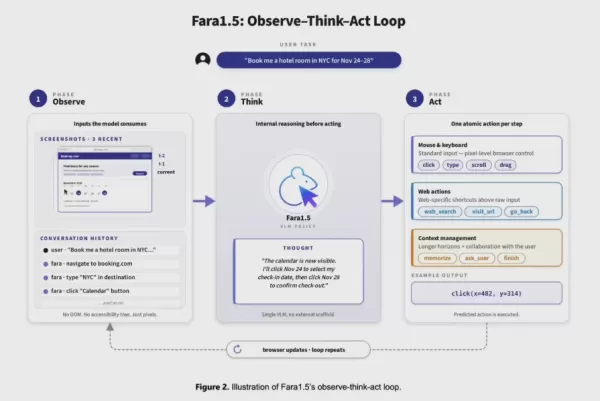
Microsoft Research AI Frontiers Lab released the Fara1.5 series of agent models designed for browser automation. The models, with parameter scales up to 27B, operate via the MagneticLite sandbox using an Observe-Think-Act cycle to complete web tasks. In benchmark tests, the 27B version achieved a 72% task success rate, outperforming rivals like OpenAI Operator. The models are trained on diverse data and incorporate safety features, halting for unclear tasks or privacy concerns before executing irreversible actions.
Microsoft Research AI Frontiers Lab released the Fara1.5 series of agent models designed for browser automation. The models, with parameter scales up to 27B, operate via the MagneticLite sandbox using an Observe-Think-Act cycle to complete web tasks. In benchmark tests, the 27B version achieved a 72% task success rate, outperforming rivals like OpenAI Operator. The models are trained on diverse data and incorporate safety features, halting for unclear tasks or privacy concerns before executing irreversible actions.
OpenAI open-sourced its 150M-parameter Privacy Filter model on Hugging Face and GitHub under Apache 2.0. The MoE-based model uses deep language understanding to anonymize personal data in text with 97.43 F1 score on benchmarks, supporting 128k-token contexts for local deployment. It aids in privacy protection for development pipelines but is not a compliance replacement for high-sensitivity fields.
OpenAI open-sourced its 150M-parameter Privacy Filter model on Hugging Face and GitHub under Apache 2.0. The MoE-based model uses deep language understanding to anonymize personal data in text with 97.43 F1 score on benchmarks, supporting 128k-token contexts for local deployment. It aids in privacy protection for development pipelines but is not a compliance replacement for high-sensitivity fields.
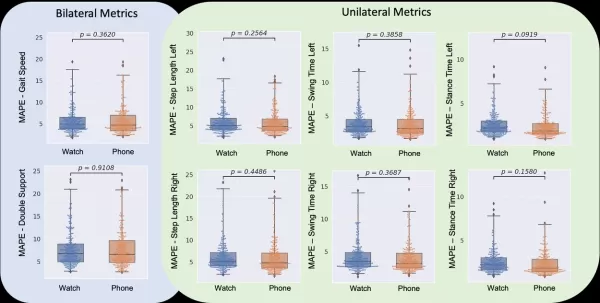
A large-scale validation study of 246 participants found that consumer smartwatches are a highly reliable platform for estimating key gait metrics, such as walking speed and step length. Using a novel deep learning model, wrist-worn smartwatches achieved accuracy comparable to smartphone-based methods. This enables practical, continuous gait analysis outside lab settings for health monitoring and fall risk assessment.
A large-scale validation study of 246 participants found that consumer smartwatches are a highly reliable platform for estimating key gait metrics, such as walking speed and step length. Using a novel deep learning model, wrist-worn smartwatches achieved accuracy comparable to smartphone-based methods. This enables practical, continuous gait analysis outside lab settings for health monitoring and fall risk assessment.