Discover quality AI tools
Bring together the world’s leading artificial intelligence tools to help improve work efficiency

Articles published by GregoryClark
Anthropic's prospectus reveals a $42 billion net loss in 2025 despite 12x revenue growth to $4.6 billion. Heavy spending on computing and infrastructure drove costs, with $7.33 billion spent last year. The company plans to invest $51.8 billion next year for model training and infrastructure. Revenue concentration risk is highlighted, with nearly 25% from two clients lacking long-term contracts, posing significant valuation uncertainty despite strong operational growth.
Anthropic's prospectus reveals a $42 billion net loss in 2025 despite 12x revenue growth to $4.6 billion. Heavy spending on computing and infrastructure drove costs, with $7.33 billion spent last year. The company plans to invest $51.8 billion next year for model training and infrastructure. Revenue concentration risk is highlighted, with nearly 25% from two clients lacking long-term contracts, posing significant valuation uncertainty despite strong operational growth.

Baidu released PaddleOCR-VL-1.6, a multi-modal derivative of its ERNIE large model. It achieved 96.33% accuracy on OmnicDocBench v1.6, surpassing GPT-5.2 and Gemini-3-Pro to claim the global top spot. The lightweight 0.9B model supports over 100 languages, excels in complex document and real-world scenarios, and scored 93.19% on Real5-OmniDocBench. With 79.2K GitHub stars, it has surpassed Tesseract OCR. Code and weights are open-sourced.
Baidu released PaddleOCR-VL-1.6, a multi-modal derivative of its ERNIE large model. It achieved 96.33% accuracy on OmnicDocBench v1.6, surpassing GPT-5.2 and Gemini-3-Pro to claim the global top spot. The lightweight 0.9B model supports over 100 languages, excels in complex document and real-world scenarios, and scored 93.19% on Real5-OmniDocBench. With 79.2K GitHub stars, it has surpassed Tesseract OCR. Code and weights are open-sourced.
Bristol Myers Squibb partners with Anthropic to deploy Claude Enterprise AI platform for 30,000+ employees, shifting from conversational tools to agentic AI. The integration aims to accelerate drug discovery, clinical development, and production workflows by leveraging AI for data analysis, documentation automation, and institutional knowledge access. This move aligns with industry predictions of AI boosting R&D efficiency by 35-45%, positioning BMS in the competitive race alongside other pharma giants adopting advanced AI solutions.
Bristol Myers Squibb partners with Anthropic to deploy Claude Enterprise AI platform for 30,000+ employees, shifting from conversational tools to agentic AI. The integration aims to accelerate drug discovery, clinical development, and production workflows by leveraging AI for data analysis, documentation automation, and institutional knowledge access. This move aligns with industry predictions of AI boosting R&D efficiency by 35-45%, positioning BMS in the competitive race alongside other pharma giants adopting advanced AI solutions.
Meituan Healthcare launched "Xiao Tu Health Assistant," an AI product for family health management, and a paid "Health Card" membership at the Wuzhen Health Conference. The AI assistant provides consultations, health records, and report analysis, integrating with Meituan's delivery for a closed-loop service from advice to medicine purchase. The membership offers drug rebates, faster delivery, and outpatient reimbursement, blending online and offline health services.
Meituan Healthcare launched "Xiao Tu Health Assistant," an AI product for family health management, and a paid "Health Card" membership at the Wuzhen Health Conference. The AI assistant provides consultations, health records, and report analysis, integrating with Meituan's delivery for a closed-loop service from advice to medicine purchase. The membership offers drug rebates, faster delivery, and outpatient reimbursement, blending online and offline health services.
Chinese AI firm Minimax launches Pinea Pi, its first AI-native edge computing development board. Based on NVIDIA Jetson with 275 TOPS INT8 performance, it deeply integrates with Minimax's MiniCPM edge-side large models for efficient offline multimodal AI. Designed for accessible hardware development, it supports natural language-driven programming for building intelligent physical devices.
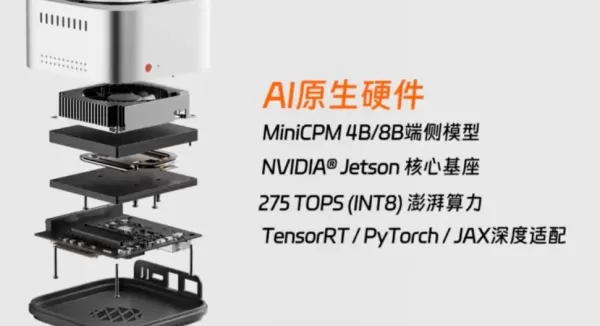
Chinese AI firm Minimax launches Pinea Pi, its first AI-native edge computing development board. Based on NVIDIA Jetson with 275 TOPS INT8 performance, it deeply integrates with Minimax's MiniCPM edge-side large models for efficient offline multimodal AI. Designed for accessible hardware development, it supports natural language-driven programming for building intelligent physical devices.