


 Home
HomeAnthropic Launches Claude Mythos to Solve Erdős Conjecture With Concise Proof
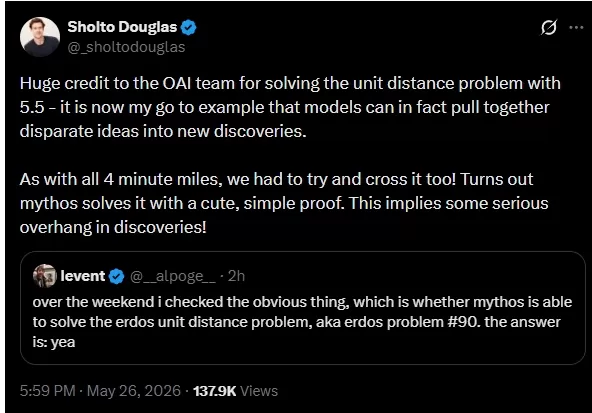
On May 26, Sholto Douglas, an engineer at Anthropic, took to X to announce that their latest model, Claude Mythos, had cracked a century-old puzzle in combinatorial geometry: the Erdős unit distance conjecture. Dubbed a "clever and concise proof," this breakthrough arrived shortly after OpenAI claimed GPT-5.5 had solved the same milestone, highlighting the escalating race among top AI labs in pure mathematical discovery.
This achievement highlighted a collaborative agent approach distinct from traditional single-model methods. Reports indicate the team deployed an automated testing framework featuring multiple independent Claude Code instances. Within this setup, agents with access to Mythos received problems and generated diverse solution paths, which were then aggregated and distributed to other independent instances for cross-validation.
While mathematician Daniel Litt noted that Mythos' initial output was "slightly inferior" to OpenAI's, the model eventually traced the same solution path, independently deriving a more original and streamlined proof. Anthropic has since officially released a proof version compiled by Opus4.7.
This development has reignited industry debates regarding the trajectory of "pure large language models (LLMs)" versus "symbolic reasoning assistance systems." Earlier, Google DeepMind announced it had solved nine Erdős problems using its AlphaProof Nexus system. However, its heavy reliance on the Lean formal proof language sparked controversy over the value of autonomous reasoning within purely generative AI.
In contrast, Claude Code, operating as an agent framework, is now addressing humanity's most pressing scientific challenges through multi-agent collaboration. The AI sector is undergoing rapid paradigm shifts, with a Fields Medal winner recently confirming that ChatGPT5.5Pro can autonomously complete doctoral-level mathematical research in just two hours. As models like Claude Mythos and GPT-5.5 demonstrate autonomous evolution in cutting-edge domains such as algorithm discovery and system vulnerability exploitation, AI is transitioning from the early "prompt engineering" era to one defined by autonomous agents with deep logical reasoning and scientific exploration capabilities.
Related article
 Amazon to Acquire Decart for $7B, Securing Key AI Chip Adapter
Per the Wall Street Journal, Amazon is negotiating to purchase AI startup Decart at an estimated $7 billion valuation. If no competing bids arise, the transaction could close shortly, underscoring major tech firms’ urgency to secure computing resourc
How Locus tackles one of robotics' biggest challenges: manipulation
NeuraGrasp handles diverse items, including small containers, porous polybags, and textiles. | Source: Locus RoboticsLocus Robotics Corp. has solved numerous robotic hurdles in live operational settings. Its autonomous mobile robots (AMRs) have trave
McKinsey warns 11 million Americans face job shifts or career changes as AI reshapes the workforce
McKinsey’s September 29 report on AI and employment highlights a critical challenge: not job displacement, but the massive task of redeploying millions of workers into new roles.By 2035, an estimated 11 million U.S. workers—roughly 7% of the current
Related Special Topic Recommendations
Design & Art
Amazon to Acquire Decart for $7B, Securing Key AI Chip Adapter
Per the Wall Street Journal, Amazon is negotiating to purchase AI startup Decart at an estimated $7 billion valuation. If no competing bids arise, the transaction could close shortly, underscoring major tech firms’ urgency to secure computing resourc
How Locus tackles one of robotics' biggest challenges: manipulation
NeuraGrasp handles diverse items, including small containers, porous polybags, and textiles. | Source: Locus RoboticsLocus Robotics Corp. has solved numerous robotic hurdles in live operational settings. Its autonomous mobile robots (AMRs) have trave
McKinsey warns 11 million Americans face job shifts or career changes as AI reshapes the workforce
McKinsey’s September 29 report on AI and employment highlights a critical challenge: not job displacement, but the massive task of redeploying millions of workers into new roles.By 2035, an estimated 11 million U.S. workers—roughly 7% of the current
Related Special Topic Recommendations
Design & Art
 Top AI Illustration Tools: Create Editorial Scenes and Cover Art Faster
2026 Latest Top-rated AI Illustration Tools: Our curated list features the best powerfully designed tools for creating stunning editorial scenes and eye-catching cover art quickly. Each option has gone through rigorous real-world tests, offering a free vs paid comparison to help you find the perfect match for your workflow. Try these must-try solutions today to unlock your AI edge and boost your creative productivity. Explore now at XIX.AI.
 10 tools
 xix.ai
Education and Learning
Top AI Tutors for Exam Prep: Practice Math, Science, and English
xix.ai
Education and Learning
Top AI Tutors for Exam Prep: Practice Math, Science, and English
2026 Latest Top-Rated Best AI Tutors for Exam Prep are here on XIX.AI! Our curated list features powerful game-changing tools that offer free vs paid comparison, real-world tests, and weekly updated rankings. They help boost your writing efficiency, simplify complex topic learning, and unlock your academic potential. Explore now to Discover your perfect exam prep tool and Start creating today to Unlock your AI edge!
10 tools
xix.ai
Finance
AI Budget Planning Tools for Personal Money Management
2026 Latest Best Top-Rated AI Budget Planning Tools for Personal Money Management are here on XIX.AI! This curated collection features powerful, game-changing solutions that help you conduct real-world tests, understand spending habits, and create personalized plans to boost productivity. Enjoy a free vs paid comparison along with detailed rankings. Must-try tools designed to simplify money management and unlock your AI edge. Explore now!
11 tools
xix.ai
Health & Wellness
AI Sleep Tracking Assistants: Improve Recovery with Better Bedtime Habits
2026 Latest Best Top-Rated AI Sleep Tracking Assistants curated for ultimate recovery. This fully updated weekly guide features powerful tools that deliver real-world tests, free vs paid comparison, and detailed rankings to help you find the must-try solution that boosts sleep quality and supports better bedtime habits. Explore now at XIX.AI to Unlock your AI edge.
10 tools
xix.ai
Data Analysis
AI SQL Copilots for Product and Revenue Analytics
2026 Latest Best Top-Rated AI SQL Copilots for Product and Revenue Analytics! XIX.AI has curated a powerful, game-changing collection of must-try tools that undergo real-world tests through weekly updated rankings. These tools help users boost productivity significantly by accelerating data analysis, streamlining complex queries, and generating accurate insights to drive smarter business decisions. Explore now to Discover your perfect tool for unlocking your AI edge!
14 tools
xix.ai
Education and Learning
Best AI Homework Helpers That Teach: Learn Concepts, Not Just Answers
2026 Latest Best Top-Rated AI Homework Helpers That Teach Core Concepts Not Just Answers Powerful Tools for Students Must-Try Curated List Weekly Updated Free vs Paid Comparison Real-World Tests Accurate Rankings to Help You Unlock Your Full Learning Potential Explore now to Discover your perfect tool for smarter studying.
10 tools
xix.ai

 Comments (0)
0/500
Comments (0)
0/500
On May 26, Sholto Douglas, an engineer at Anthropic, took to X to announce that their latest model, Claude Mythos, had cracked a century-old puzzle in combinatorial geometry: the Erdős unit distance conjecture. Dubbed a "clever and concise proof," this breakthrough arrived shortly after OpenAI claimed GPT-5.5 had solved the same milestone, highlighting the escalating race among top AI labs in pure mathematical discovery.
This achievement highlighted a collaborative agent approach distinct from traditional single-model methods. Reports indicate the team deployed an automated testing framework featuring multiple independent Claude Code instances. Within this setup, agents with access to Mythos received problems and generated diverse solution paths, which were then aggregated and distributed to other independent instances for cross-validation.
While mathematician Daniel Litt noted that Mythos' initial output was "slightly inferior" to OpenAI's, the model eventually traced the same solution path, independently deriving a more original and streamlined proof. Anthropic has since officially released a proof version compiled by Opus4.7.
This development has reignited industry debates regarding the trajectory of "pure large language models (LLMs)" versus "symbolic reasoning assistance systems." Earlier, Google DeepMind announced it had solved nine Erdős problems using its AlphaProof Nexus system. However, its heavy reliance on the Lean formal proof language sparked controversy over the value of autonomous reasoning within purely generative AI.
In contrast, Claude Code, operating as an agent framework, is now addressing humanity's most pressing scientific challenges through multi-agent collaboration. The AI sector is undergoing rapid paradigm shifts, with a Fields Medal winner recently confirming that ChatGPT5.5Pro can autonomously complete doctoral-level mathematical research in just two hours. As models like Claude Mythos and GPT-5.5 demonstrate autonomous evolution in cutting-edge domains such as algorithm discovery and system vulnerability exploitation, AI is transitioning from the early "prompt engineering" era to one defined by autonomous agents with deep logical reasoning and scientific exploration capabilities.








 Amazon to Acquire Decart for $7B, Securing Key AI Chip Adapter
Per the Wall Street Journal, Amazon is negotiating to purchase AI startup Decart at an estimated $7 billion valuation. If no competing bids arise, the transaction could close shortly, underscoring major tech firms’ urgency to secure computing resourc
How Locus tackles one of robotics' biggest challenges: manipulation
NeuraGrasp handles diverse items, including small containers, porous polybags, and textiles. | Source: Locus RoboticsLocus Robotics Corp. has solved numerous robotic hurdles in live operational settings. Its autonomous mobile robots (AMRs) have trave
McKinsey warns 11 million Americans face job shifts or career changes as AI reshapes the workforce
McKinsey’s September 29 report on AI and employment highlights a critical challenge: not job displacement, but the massive task of redeploying millions of workers into new roles.By 2035, an estimated 11 million U.S. workers—roughly 7% of the current
Amazon to Acquire Decart for $7B, Securing Key AI Chip Adapter
Per the Wall Street Journal, Amazon is negotiating to purchase AI startup Decart at an estimated $7 billion valuation. If no competing bids arise, the transaction could close shortly, underscoring major tech firms’ urgency to secure computing resourc
How Locus tackles one of robotics' biggest challenges: manipulation
NeuraGrasp handles diverse items, including small containers, porous polybags, and textiles. | Source: Locus RoboticsLocus Robotics Corp. has solved numerous robotic hurdles in live operational settings. Its autonomous mobile robots (AMRs) have trave
McKinsey warns 11 million Americans face job shifts or career changes as AI reshapes the workforce
McKinsey’s September 29 report on AI and employment highlights a critical challenge: not job displacement, but the massive task of redeploying millions of workers into new roles.By 2035, an estimated 11 million U.S. workers—roughly 7% of the current

2026 Latest Top-rated AI Illustration Tools: Our curated list features the best powerfully designed tools for creating stunning editorial scenes and eye-catching cover art quickly. Each option has gone through rigorous real-world tests, offering a free vs paid comparison to help you find the perfect match for your workflow. Try these must-try solutions today to unlock your AI edge and boost your creative productivity. Explore now at XIX.AI.
10 tools
xix.ai

2026 Latest Top-Rated Best AI Tutors for Exam Prep are here on XIX.AI! Our curated list features powerful game-changing tools that offer free vs paid comparison, real-world tests, and weekly updated rankings. They help boost your writing efficiency, simplify complex topic learning, and unlock your academic potential. Explore now to Discover your perfect exam prep tool and Start creating today to Unlock your AI edge!
10 tools
xix.ai

2026 Latest Best Top-Rated AI Budget Planning Tools for Personal Money Management are here on XIX.AI! This curated collection features powerful, game-changing solutions that help you conduct real-world tests, understand spending habits, and create personalized plans to boost productivity. Enjoy a free vs paid comparison along with detailed rankings. Must-try tools designed to simplify money management and unlock your AI edge. Explore now!
11 tools
xix.ai

2026 Latest Best Top-Rated AI Sleep Tracking Assistants curated for ultimate recovery. This fully updated weekly guide features powerful tools that deliver real-world tests, free vs paid comparison, and detailed rankings to help you find the must-try solution that boosts sleep quality and supports better bedtime habits. Explore now at XIX.AI to Unlock your AI edge.
10 tools
xix.ai

2026 Latest Best Top-Rated AI SQL Copilots for Product and Revenue Analytics! XIX.AI has curated a powerful, game-changing collection of must-try tools that undergo real-world tests through weekly updated rankings. These tools help users boost productivity significantly by accelerating data analysis, streamlining complex queries, and generating accurate insights to drive smarter business decisions. Explore now to Discover your perfect tool for unlocking your AI edge!
14 tools
xix.ai

2026 Latest Best Top-Rated AI Homework Helpers That Teach Core Concepts Not Just Answers Powerful Tools for Students Must-Try Curated List Weekly Updated Free vs Paid Comparison Real-World Tests Accurate Rankings to Help You Unlock Your Full Learning Potential Explore now to Discover your perfect tool for smarter studying.
10 tools
xix.ai












