


Discover quality AI tools
Bring together the world’s leading artificial intelligence tools to help improve work efficiency

Articles published by WillMartinez
Zhiyuan Robotics has acquired a stake in Mogan Shanghai Technology, boosting its registered capital to 1.1774 million yuan. Mogan specializes in electromagnetic metamaterial flexible electronic skin and tactile-integrated robots, addressing critical needs for precise tactile interaction in humanoid robotics. This move aligns with Zhiyuan's broader strategy to accelerate the commercialization of embodied intelligence. Previously, Zhiyuan invested in Zhishen Technology and signed a strategic order with Longqi Technology. Additionally, collaborations with Huatian Electronics and Lens Technology for manufacturing further solidify Zhiyuan's industrial closed loop from core component R&D to mass production, strengthening its position in the global robotics supply chain.
Zhiyuan Robotics has acquired a stake in Mogan Shanghai Technology, boosting its registered capital to 1.1774 million yuan. Mogan specializes in electromagnetic metamaterial flexible electronic skin and tactile-integrated robots, addressing critical needs for precise tactile interaction in humanoid robotics. This move aligns with Zhiyuan's broader strategy to accelerate the commercialization of embodied intelligence. Previously, Zhiyuan invested in Zhishen Technology and signed a strategic order with Longqi Technology. Additionally, collaborations with Huatian Electronics and Lens Technology for manufacturing further solidify Zhiyuan's industrial closed loop from core component R&D to mass production, strengthening its position in the global robotics supply chain.

Lenovo Group and Haier Group signed a strategic cooperation agreement at Lenovo’s Beijing headquarters last week, with senior executives from both sides present. As AI advances from research to industrial applications, the two firms will use their technical and ecological strengths to integrate computing power with various use cases, exploring ways to apply AI to boost the real economy. The cooperation covers five key areas (data centers, home robots, supply chain optimization, integrating Haier’s Casco platform with Lenovo’s computing resources and urban smart systems, and developing AI PCs for Haier’s smart homes). They will also establish industry standards and joint investment frameworks. The move helps Lenovo find practical uses for AI terminals while enabling Haier to strengthen its smart home and industrial internet capabilities through external computing power. Both aim to create integrated solutions combining devices, computing power, and services to support initiatives such as Digital China and dual carbon goals.
Lenovo Group and Haier Group signed a strategic cooperation agreement at Lenovo’s Beijing headquarters last week, with senior executives from both sides present. As AI advances from research to industrial applications, the two firms will use their technical and ecological strengths to integrate computing power with various use cases, exploring ways to apply AI to boost the real economy. The cooperation covers five key areas (data centers, home robots, supply chain optimization, integrating Haier’s Casco platform with Lenovo’s computing resources and urban smart systems, and developing AI PCs for Haier’s smart homes). They will also establish industry standards and joint investment frameworks. The move helps Lenovo find practical uses for AI terminals while enabling Haier to strengthen its smart home and industrial internet capabilities through external computing power. Both aim to create integrated solutions combining devices, computing power, and services to support initiatives such as Digital China and dual carbon goals.
AI company Anthropic added an imperceptible watermark to some of its Claude models to comply with EU AI Act requirements, aiming to identify AI-generated text. The measure has drawn criticism from users and professionals who fear it will appear in normal text processing tasks, leading some to cancel subscriptions and spurring a surge in demand for tools to remove AI markers. Several developers responded quickly, launching open-source watermark removal projects within days, with one gaining over 14,000 GitHub stars. While supporters of attribution labeling oppose the black-and-white approach, legal experts note such tools do not explicitly violate existing laws unless used to misrepresent content. As Anthropic plans to expand the feature, conflicts between watermarks and removal tools are expected to worsen.
AI company Anthropic added an imperceptible watermark to some of its Claude models to comply with EU AI Act requirements, aiming to identify AI-generated text. The measure has drawn criticism from users and professionals who fear it will appear in normal text processing tasks, leading some to cancel subscriptions and spurring a surge in demand for tools to remove AI markers. Several developers responded quickly, launching open-source watermark removal projects within days, with one gaining over 14,000 GitHub stars. While supporters of attribution labeling oppose the black-and-white approach, legal experts note such tools do not explicitly violate existing laws unless used to misrepresent content. As Anthropic plans to expand the feature, conflicts between watermarks and removal tools are expected to worsen.
ChatGPTs weekly active users are nearing 1 billion a milestone delayed by seven months due to competition from Google Gemini and Anthropics Claude as well as GPT-5 development setbacks. Despite this ChatGPT remains one of the fastest growing apps ever launched. However its first mover advantage is fading as the AI chatbot market shifts from monopoly to multipolar competition.
ChatGPTs weekly active users are nearing 1 billion a milestone delayed by seven months due to competition from Google Gemini and Anthropics Claude as well as GPT-5 development setbacks. Despite this ChatGPT remains one of the fastest growing apps ever launched. However its first mover advantage is fading as the AI chatbot market shifts from monopoly to multipolar competition.
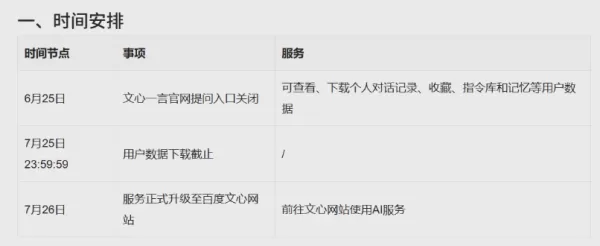
Baidu's ERNIE Bot service will migrate to the Baidu ERNIE website starting June 25, 2026, with a one-month data export buffer until July 25. The new platform offers upgraded AI tools including college admission guidance, PPT generation, and academic research. Paid members with unused benefits can request refunds.
Baidu's ERNIE Bot service will migrate to the Baidu ERNIE website starting June 25, 2026, with a one-month data export buffer until July 25. The new platform offers upgraded AI tools including college admission guidance, PPT generation, and academic research. Paid members with unused benefits can request refunds.
Lenovo is accelerating its AI push across multiple fronts. It joined NVIDIA's first batch of partners for the RTX Spark AI PC chip, expecting AI PCs to exceed 50% of sales. As the official tech partner for the 2026 FIFA World Cup, it will use full-stack AI for operations and broadcasting. It also launched enterprise AI products like Lenovo Tongxiang and Baiying AI 3.0, and is building an AI computing R&D center in Tianjin.
Lenovo is accelerating its AI push across multiple fronts. It joined NVIDIA's first batch of partners for the RTX Spark AI PC chip, expecting AI PCs to exceed 50% of sales. As the official tech partner for the 2026 FIFA World Cup, it will use full-stack AI for operations and broadcasting. It also launched enterprise AI products like Lenovo Tongxiang and Baiying AI 3.0, and is building an AI computing R&D center in Tianjin.
Spanish satellite startup Xoople raised $130 million in a Series B round led by Nazca Capital. The company focuses on providing high-precision geospatial data as a foundational source for enterprise AI models, claiming its sensor data will be 100 times better than current systems. Xoople partners with L3Harris for custom sensors and integrates its data into platforms like Microsoft and Esri. The firm has reached unicorn status with total funding of $225 million.
Spanish satellite startup Xoople raised $130 million in a Series B round led by Nazca Capital. The company focuses on providing high-precision geospatial data as a foundational source for enterprise AI models, claiming its sensor data will be 100 times better than current systems. Xoople partners with L3Harris for custom sensors and integrates its data into platforms like Microsoft and Esri. The firm has reached unicorn status with total funding of $225 million.


