Discover quality AI tools
Bring together the world’s leading artificial intelligence tools to help improve work efficiency

Articles published by RoyMartínez
ByteDance establishes a new department named Seed Model - Alignment & Preparedness to manage large model safety risks. Led by Yan Lin and reporting directly to Wu Yonghui, the team focuses on aligning AI outputs with human intentions and safety boundaries. This move underscores ByteDance's commitment to enhancing compliance and quality in its Doubao chatbot by preventing models from deviating from safe operational parameters.
ByteDance establishes a new department named Seed Model - Alignment & Preparedness to manage large model safety risks. Led by Yan Lin and reporting directly to Wu Yonghui, the team focuses on aligning AI outputs with human intentions and safety boundaries. This move underscores ByteDance's commitment to enhancing compliance and quality in its Doubao chatbot by preventing models from deviating from safe operational parameters.

DeepSeek recently released V4.1Flash, featuring a significant architectural overhaul equivalent to V5 level. The company plans to launch DeepSeek Code2.0 in September, a flagship coding model with over 3 trillion parameters, surpassing current competitors like K3 and Qwen3.8Max. Code2.0 focuses on computer control capabilities, enabling AI to autonomously manage complex tasks. It maintains an open-source approach and is expected to outperform frontier models such as Mythos5.1 and GPT-6Astra. This release follows the upcoming V4.1Pro series as DeepSeek challenges global AI benchmarks with a multi-route product strategy.
DeepSeek recently released V4.1Flash, featuring a significant architectural overhaul equivalent to V5 level. The company plans to launch DeepSeek Code2.0 in September, a flagship coding model with over 3 trillion parameters, surpassing current competitors like K3 and Qwen3.8Max. Code2.0 focuses on computer control capabilities, enabling AI to autonomously manage complex tasks. It maintains an open-source approach and is expected to outperform frontier models such as Mythos5.1 and GPT-6Astra. This release follows the upcoming V4.1Pro series as DeepSeek challenges global AI benchmarks with a multi-route product strategy.
OpenAI CEO Sam Altman stated in a podcast on August 23 that he is concerned AI could end up under control of a few companies or individuals, leaving most consumers without influence over its development. He argued that people should have strong control over AI’s future to ensure society and models evolve together, warning that prioritizing security by limiting freedom could lead to monopolies. He also noted the contradiction between his fear of AI losing human control and such security measures, citing Anthropic’s CEO Amode’s calls for government regulation of the Mythos model as an example. Altman highlighted that Anthropic was the only major company to reject a previous call for open weights, while China has adopted this approach to develop AI at lower cost. He added that U.S. AI leaders have failed to clearly explain how AI boosts people’s autonomy, despite the technology driving a record number of small business startups.
OpenAI CEO Sam Altman stated in a podcast on August 23 that he is concerned AI could end up under control of a few companies or individuals, leaving most consumers without influence over its development. He argued that people should have strong control over AI’s future to ensure society and models evolve together, warning that prioritizing security by limiting freedom could lead to monopolies. He also noted the contradiction between his fear of AI losing human control and such security measures, citing Anthropic’s CEO Amode’s calls for government regulation of the Mythos model as an example. Altman highlighted that Anthropic was the only major company to reject a previous call for open weights, while China has adopted this approach to develop AI at lower cost. He added that U.S. AI leaders have failed to clearly explain how AI boosts people’s autonomy, despite the technology driving a record number of small business startups.
Wang Xingxing, founder of Yuque Technology which recently listed on the Sci-Tech Innovation Board, gave his first public speech after the listing at the 2026 World Robot Conference. He said the humanoid robot industry needs to overcome a specific development hurdle akin to the ChatGPT moment before achieving full growth, with the goal that robots can independently handle most tasks in unfamiliar scenarios based on verbal instructions. He estimated this turning point will arrive within 2 to 3 years or at latest 5 to 10 years, after which the industry will reach this stage. The main obstacle now is alignment issues between AI models and physical robots, as generated instructions often deviate when converted into actionable moves for real machines.
Wang Xingxing, founder of Yuque Technology which recently listed on the Sci-Tech Innovation Board, gave his first public speech after the listing at the 2026 World Robot Conference. He said the humanoid robot industry needs to overcome a specific development hurdle akin to the ChatGPT moment before achieving full growth, with the goal that robots can independently handle most tasks in unfamiliar scenarios based on verbal instructions. He estimated this turning point will arrive within 2 to 3 years or at latest 5 to 10 years, after which the industry will reach this stage. The main obstacle now is alignment issues between AI models and physical robots, as generated instructions often deviate when converted into actionable moves for real machines.
Investors betting on prediction market Polymarket now believe Anthropic will secure the world’s largest IPO in 2026, with a 44% chance, slightly behind SpaceX’s 55%. The gap between the two companies has narrowed sharply due to Anthropic’s rapid financial growth, with its annualized revenue reaching $65 billion by the end of July, more than six times higher than last year’s level. The company is preparing for an IPO that could start as early as October this year. Currently valued at $965 billion in its most recent funding round, some investors expect its valuation to reach $2 trillion or higher after going public, while predicting its annualized revenue will rise to between $100 billion and $120 billion by 2026. Its main competitor OpenAI, valued at $852 billion, submitted an IPO prospectus in June but has not set a listing date, with 78% of investors expecting it to delay its offering to 2027 or later.
Investors betting on prediction market Polymarket now believe Anthropic will secure the world’s largest IPO in 2026, with a 44% chance, slightly behind SpaceX’s 55%. The gap between the two companies has narrowed sharply due to Anthropic’s rapid financial growth, with its annualized revenue reaching $65 billion by the end of July, more than six times higher than last year’s level. The company is preparing for an IPO that could start as early as October this year. Currently valued at $965 billion in its most recent funding round, some investors expect its valuation to reach $2 trillion or higher after going public, while predicting its annualized revenue will rise to between $100 billion and $120 billion by 2026. Its main competitor OpenAI, valued at $852 billion, submitted an IPO prospectus in June but has not set a listing date, with 78% of investors expecting it to delay its offering to 2027 or later.
Microsoft will launch a Report a Concern feature in Teams by August 2026, letting participants flag phishing, identity theft, and AI-driven fraud. Meeting metadata will be shared with enterprise security teams for investigation. Additionally, Teams will identify and manage external AI bots to prevent unauthorized access.
Microsoft will launch a Report a Concern feature in Teams by August 2026, letting participants flag phishing, identity theft, and AI-driven fraud. Meeting metadata will be shared with enterprise security teams for investigation. Additionally, Teams will identify and manage external AI bots to prevent unauthorized access.

Anthropic launched Claude Fable5 with hidden restrictions that secretly reduced performance for users developing competing AI, including on high-risk topics. After industry backlash, the company apologized and revised its policy. Now all security measures are transparent, with clear warnings and rejections instead of covert slowdowns.
Anthropic launched Claude Fable5 with hidden restrictions that secretly reduced performance for users developing competing AI, including on high-risk topics. After industry backlash, the company apologized and revised its policy. Now all security measures are transparent, with clear warnings and rejections instead of covert slowdowns.
The surging demand for AI computing power has driven tin prices up 40% to around 420,000 yuan per ton in half a year, as the metal becomes essential in advanced semiconductor packaging. AI servers use over three times more tin than traditional servers. Supply constraints from Myanmar and Indonesia, plus depleting reserves—only 15 years globally and 12 years in China—are pushing leading firms to boost tin recycling from old circuit boards.
The surging demand for AI computing power has driven tin prices up 40% to around 420,000 yuan per ton in half a year, as the metal becomes essential in advanced semiconductor packaging. AI servers use over three times more tin than traditional servers. Supply constraints from Myanmar and Indonesia, plus depleting reserves—only 15 years globally and 12 years in China—are pushing leading firms to boost tin recycling from old circuit boards.
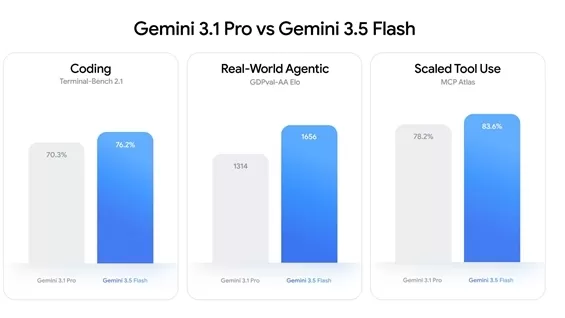
Google launches Gemini 3.5 Flash, offering high performance at low cost. Alibaba Cloud debuts Qwen Cloud, an AI agent platform with a new token subscription model. Google and Samsung introduce AI-powered smart glasses. Apple unveils new AI accessibility features, including eye-controlled wheelchair tech via Vision Pro. Google releases the multimodal Gemini Omni model. Tongyi Lab's Qwen3.7-Max model leads in evaluations with its novel architecture. Google's Gemini Spark agent platform enables automated tasks. YouTube integrates Gemini for conversational search and enhanced content tools.
Google launches Gemini 3.5 Flash, offering high performance at low cost. Alibaba Cloud debuts Qwen Cloud, an AI agent platform with a new token subscription model. Google and Samsung introduce AI-powered smart glasses. Apple unveils new AI accessibility features, including eye-controlled wheelchair tech via Vision Pro. Google releases the multimodal Gemini Omni model. Tongyi Lab's Qwen3.7-Max model leads in evaluations with its novel architecture. Google's Gemini Spark agent platform enables automated tasks. YouTube integrates Gemini for conversational search and enhanced content tools.